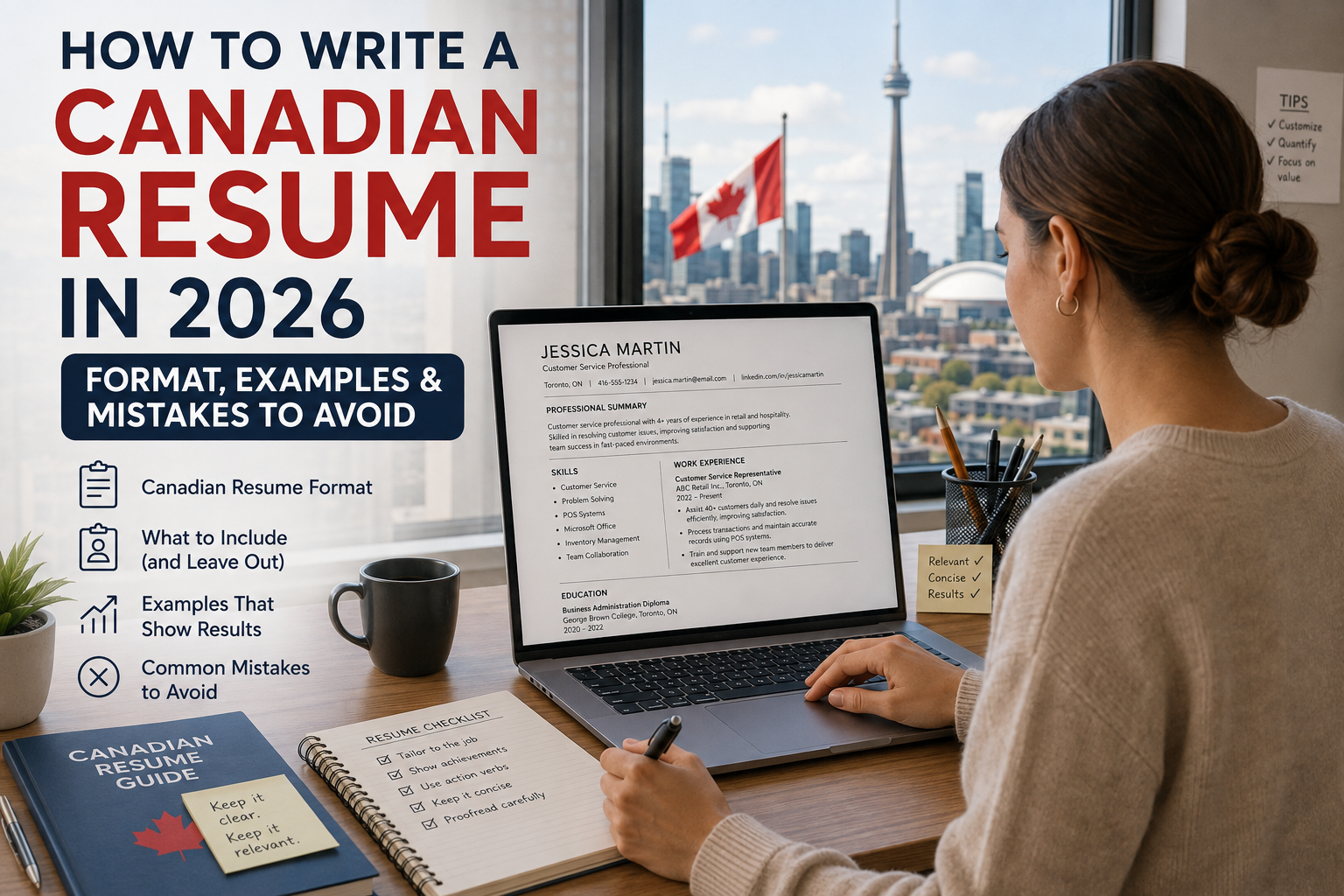
Writing a resume for the Canadian job market is not simply a matter of translating the resume you already use in another country. Canadian employers generally expect a document that is concise, relevant to the position and focused on what you can contribute.
That matters whether you are already working in Canada, looking for your first job, changing careers or preparing to enter the Canadian labour market.
The Government of Canada's Job Bank recommends keeping a resume clear and concise, tailoring it to the position and emphasizing accomplishments rather than simply listing job duties. It also recommends limiting a resume to two pages and reducing or removing older experience that is no longer relevant.
This guide explains how to build a Canadian-style resume in 2026, what sections to include, what information to leave out and how to turn ordinary job descriptions into stronger examples of your experience.
What Does a Canadian Resume Look Like in 2026?
There is no single mandatory Canadian resume template. The best format depends on your experience, career stage and the type of position you are pursuing.
However, a strong Canadian resume will usually make the most important information easy to find quickly.
A practical structure is:
- Contact information
- Professional summary
- Key skills
- Work experience
- Education
- Relevant certifications or additional qualifications
Volunteer experience, projects and language skills can also be useful when they strengthen your application.
The Job Bank's Resume Builder currently provides a traditional template for workers with established experience and another template designed for youth and recent graduates. This is a useful reminder that the best resume structure depends on the applicant rather than on one universal design.
How Long Should a Canadian Resume Be?
For most applicants, one or two pages is enough.
The Government of Canada Job Bank specifically recommends limiting a resume to two pages and placing greater emphasis on recent experience. It suggests cutting or minimizing older jobs and experience from more than 15 years ago when they are no longer relevant.
| Situation | Practical Resume Length |
|---|---|
| Student or first-time job seeker | Often 1 page |
| Early-career professional | 1–2 pages |
| Experienced professional | Usually up to 2 pages |
| Academic or research application | A CV may be required instead |
The goal is not to fill two pages. A focused one-page resume can be stronger than a two-page resume filled with unrelated information.
1. Start With Clear Contact Information
Place your contact details at the top of the first page where an employer can immediately find them.
Typically, this section can include:
- Your full name
- City and province
- Phone number
- Professional email address
- LinkedIn profile when relevant
Make sure your email address looks professional and that every contact detail is current. A recruiter cannot invite you to an interview if the phone number or email address on your resume is wrong.
What You Should Not Put on a Canadian Resume
This is one of the biggest differences some newcomers notice when preparing a resume for Canada.
According to the Government of Canada Job Bank, unnecessary personal details should be left out. It also specifically advises applicants not to include a photograph and never to include a Social Insurance Number (SIN).
| Usually Include | Usually Leave Out |
|---|---|
| Name | Photograph |
| Phone number | Social Insurance Number |
| Professional email | Age or date of birth |
| City and province | Marital status |
| Relevant LinkedIn profile | Religion or political views |
| Relevant qualifications | Height, weight or other unrelated personal characteristics |
Your resume should keep the employer's attention on your ability to do the job.
2. Write a Professional Summary That Says Something Useful
A professional summary is a short introduction near the beginning of the resume. Think of it as a quick explanation of the value you could bring to the employer.
Avoid generic statements such as:
Hard-working professional seeking an opportunity to grow in a successful company.
It sounds positive, but it tells the employer very little.
A more useful version could be:
Customer service professional with four years of experience in retail and hospitality. Experienced in resolving customer concerns, processing transactions and supporting customers in fast-paced environments. Fluent in English and Portuguese.
The second example immediately communicates experience, relevant skills and language ability.
Change this section when applying for substantially different positions. A resume should not be treated as a one-size-fits-all document.
3. Tailor Your Resume to the Job Posting
One of the strongest themes in the Government of Canada's resume guidance is customization.
Before sending your resume, read the job advertisement carefully and identify the experience, qualifications and skills the employer emphasizes.
Then make sure your most relevant qualifications are easy to find.
For example, imagine a posting repeatedly mentions:
- Customer service
- Inventory management
- Point-of-sale systems
- Teamwork
If you genuinely have those skills, your resume should describe where and how you used them instead of hiding them beneath unrelated information.
Job Bank also advises incorporating relevant keywords from the job description into a customized resume. The important point is accuracy: use terms that genuinely describe your experience rather than copying keywords for skills you do not have.
4. Make Your Work Experience About Results
The work experience section is often the most important part of the resume.
A common mistake is filling it entirely with job duties.
Compare these two examples:
| Weak | Stronger |
|---|---|
| Responsible for customer service. | Assisted 40+ customers per shift and resolved routine service issues at the first point of contact. |
| Worked with inventory. | Tracked weekly inventory and helped reduce recurring stock discrepancies. |
| Responsible for employees. | Supervised a team of 8 employees during evening operations. |
| Worked in sales. | Exceeded monthly sales target by 12% during a three-month promotional period. |
Do not invent numbers just to make a bullet point sound impressive. Use measurable results only when you can support them.
The Job Bank recommends quantifying achievements where possible, including information such as the number of people supervised, products sold or percentage increases in sales.
5. Use Action Verbs and Plain Language
A resume does not become stronger simply because it uses complicated language.
Job Bank recommends simple wording combined with persuasive action verbs. Depending on what you actually did, useful verbs can include:
- Managed
- Led
- Developed
- Improved
- Coordinated
- Increased
- Reduced
- Trained
- Supported
- Resolved
Start bullet points with the result or action whenever possible.
Instead of:
Was responsible for training new employees.
Try:
Trained 6 new employees on customer service procedures and point-of-sale operations.
The second version is easier to scan and gives the employer more context.
6. Keep Each Work Experience Entry Easy to Scan
A straightforward format works well:
Job Title — Company
City, Province | Month Year – Month Year
- Achievement or responsibility most relevant to the new position.
- Second accomplishment with a measurable result when available.
- Another relevant responsibility demonstrating a required skill.
The Job Bank recommends using industry-standard job titles and arranging bullet points by relevance. It also recommends keeping descriptions specific and concise.
You do not need to give every past responsibility equal space. The qualifications most relevant to the job you want should receive the most attention.
7. Add Skills Strategically
A skills section can help employers quickly identify important qualifications, but a long list of generic buzzwords adds little value.
Instead of listing:
- Hard-working
- Motivated
- Team player
- Good communicator
prioritize skills that can be connected to the position, such as:
- Microsoft Excel
- QuickBooks
- Inventory management
- Forklift operation
- Customer relationship management software
- Project coordination
- Bilingual customer service
The exact skills will depend on your occupation. Read the job posting and compare its requirements with your genuine qualifications.
8. Include Education Without Overcomplicating It
Your education section normally needs the qualification, institution and location. Recent graduates may give education greater prominence, while experienced workers will often place work history first.
For example:
Business Administration Diploma
Example College — Toronto, Ontario
If a qualification was completed outside Canada, describe it accurately. Do not claim that an international credential is equivalent to a Canadian credential unless that equivalency has actually been established where required.
Depending on the occupation, employers or regulatory bodies may require credential assessment, licensing or certification separately from the resume itself.
9. Volunteer Experience Can Be Valuable
Paid employment is not the only way to demonstrate useful experience.
The Job Bank recommends including unpaid work when it showcases skills relevant to the position.
This can be particularly helpful for:
- Students
- Recent graduates
- Newcomers building Canadian experience
- People returning to the workforce
- Career changers
Relevant volunteer work can be presented similarly to paid experience, focusing on what you accomplished and the skills you demonstrated.
10. Do Not Put References Directly on the Resume
You usually do not need to use valuable resume space listing references.
The Job Bank recommends keeping references on a separate sheet and providing them when an employer specifically requests them.
You also do not need to write "References available upon request." Employers already understand that references may be requested later in the hiring process.
Canadian Resume Example
Here is a simplified example of how the sections can fit together:
JORDAN MARTIN
Toronto, Ontario | 416-555-0000 | jordan.martin@example.com | LinkedInPROFESSIONAL SUMMARY
Customer service professional with four years of retail experience, including point-of-sale operations, inventory support and customer issue resolution.KEY SKILLS
Customer service | POS systems | Inventory | Microsoft Office | Team trainingWORK EXPERIENCE
Customer Service Associate — Example Retailer
Toronto, Ontario | 2023–2026
- Assisted 40+ customers during high-volume shifts.
- Resolved routine customer concerns and escalated complex cases when necessary.
- Trained new employees on POS and customer service procedures.
EDUCATION
Business Administration Diploma — Example College, Toronto, Ontario
This is only an example. Your resume should reflect your actual background and the requirements of the position.
Should You Use the Same Resume for Every Job?
Usually, no.
You do not have to rewrite everything from scratch for every application. A better approach is to maintain a strong master resume and create tailored versions from it.
For each application, review:
- Professional summary
- Order of skills
- Most prominent accomplishments
- Keywords that accurately match the posting
- Older or unrelated information that can be removed
The Government of Canada's Job Bank Resume Builder supports this approach by allowing users to create multiple resumes and customize sections for different jobs.
What About Applicant Tracking Systems (ATS)?
Some employers use software to help organize and review applications. This is one reason clarity and relevance matter.
You do not need to turn your resume into a wall of keywords. Instead, use straightforward section headings, accurately incorporate terminology from the job posting and avoid hiding your most important qualifications inside complicated wording.
A resume ultimately needs to work for a human reader. If an employer can quickly understand your experience, skills and accomplishments, you are already solving one of the most important resume problems.
Common Canadian Resume Mistakes to Avoid
Before sending an application, check for these common problems:
- Using the exact same generic resume for every job
- Sending more than two pages of mostly irrelevant information
- Including a photograph
- Including your SIN or unnecessary personal information
- Listing duties without showing accomplishments
- Using vague statements without examples
- Adding skills you cannot actually demonstrate
- Using an unprofessional email address
- Including references directly on the resume
- Leaving spelling or grammar errors
Proofreading deserves special attention. A small error can create a poor first impression even when the applicant has strong experience.
A Simple Resume Checklist Before You Apply
| Check | Question to Ask Yourself |
|---|---|
| Length | Is every section relevant, and is the resume no longer than necessary? |
| Contact details | Are my phone number and email correct? |
| Customization | Does this version clearly match the position? |
| Experience | Have I highlighted accomplishments instead of only duties? |
| Numbers | Can I quantify any genuine achievements? |
| Personal information | Have I removed photo, SIN and unrelated personal details? |
| Keywords | Have I naturally used relevant terminology from the job posting? |
| Accuracy | Can I support every claim on the resume? |
| Proofreading | Have I checked spelling, grammar and formatting? |
Free Canadian Resume Tool
Job seekers can also use the Government of Canada's Job Bank Resume Builder. As of June 2026, the tool offers templates, predefined skills and job duties, customizable sections and the ability to maintain multiple resumes for different types of jobs.
It can be especially useful if you are unsure how to organize your first Canadian-style resume.
Final Thoughts
A strong Canadian resume is not necessarily the one with the fanciest design or the longest work history.
It is the one that makes your relevant qualifications easy to understand.
Keep it concise. Tailor it to the position. Show what you accomplished. Remove personal information that employers do not need. Most importantly, make every line earn its place on the page.
If you are currently planning your job search, you can also read our guide on how to find a job in Canada as a newcomer and explore our guide to high-paying jobs in Canada without a degree.
Information in this guide is general and may not reflect the hiring requirements of every employer, profession or regulated occupation. Always follow the instructions in the specific job posting.