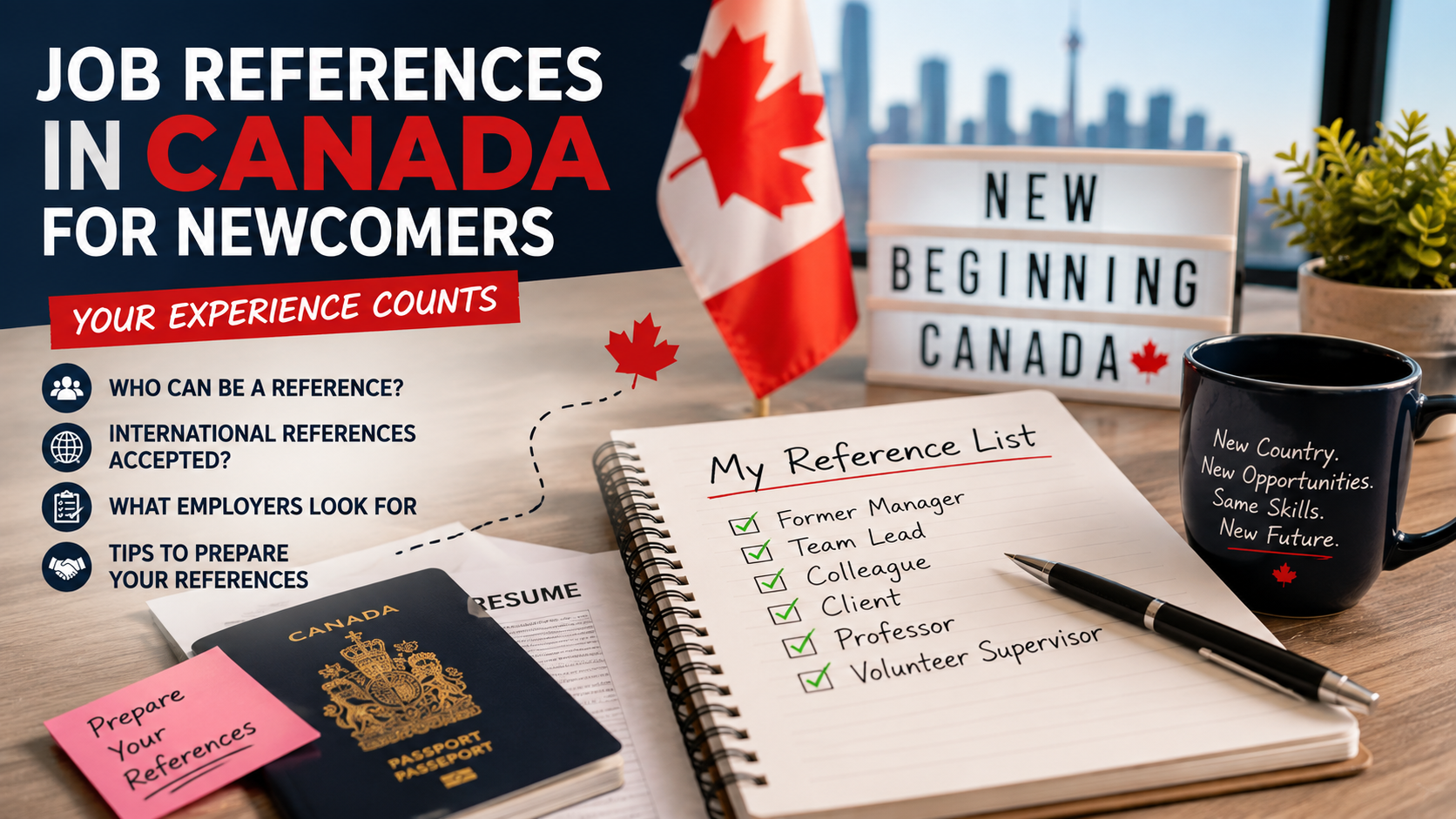
Getting close to a job offer in Canada can be exciting—until an employer asks for references and you realize that everyone who knows your work is in another country.
This is a common concern for newcomers, but having no Canadian references does not automatically mean you have no useful references.
A professional reference is generally someone who can speak credibly about your past work, skills, performance and professional behaviour. Depending on the employer and position, a former supervisor, manager, colleague, client or another person who has directly observed your work may be appropriate.
This guide explains how job references work in Canada, whether newcomers can use international references, who you should ask, how to prepare your referees and what to do if you have limited work experience.
What is a job reference in Canada?
A job reference is a person an employer may contact to learn more about your previous work and qualifications.
A reference check can help an employer verify information you provided during the hiring process and learn how you performed in previous professional situations.
For example, Canada's Public Service Commission describes reference checking as a way to verify applicant qualifications and assess past job performance and accomplishments.
Reference checks are only one part of hiring. Employers may also consider your résumé, cover letter, interview, assessments, credentials and other information relevant to the position.
Do Canadian employers ask for references?
Some employers do, but practices vary considerably by employer, industry and position.
A reference check may happen after interviews when an employer is seriously considering a candidate, although the timing can differ.
The Government of Canada's structured reference-checking guidance notes that reference checks are commonly conducted during the later stages of an assessment process after the candidate pool has been reduced.
That does not mean every Canadian employer follows exactly the same process.
Do you need Canadian references to get a job?
There is no general rule saying every newcomer must already have Canadian professional references before being considered for employment.
If you recently arrived, the people who have the strongest knowledge of your work may naturally be located outside Canada.
The more important question is whether the referee can provide relevant and credible information about your professional performance.
If your broader concern is finding employment without a Canadian work history, see our guide to getting a job in Canada with no Canadian experience.
Can newcomers use references from another country?
Potentially, yes.
An international reference may be useful when the person has directly supervised or worked with you and can discuss your relevant experience.
However, the employer decides which references it considers appropriate for its hiring process.
Before providing an overseas reference, consider practical issues such as:
- whether the referee can communicate in the language required by the employer;
- whether the contact information is current;
- the time-zone difference;
- whether the referee understands the position you are applying for;
- whether they can respond promptly; and
- whether they can provide concrete examples of your work.
Who can be a professional reference?
The strongest reference is usually someone who has had enough opportunity to observe your work.
Depending on your employment history and the employer's requirements, possibilities may include:
- a current or former supervisor;
- a manager or team leader;
- a senior colleague;
- a former client;
- a project leader;
- a professor or instructor in appropriate circumstances;
- a volunteer supervisor; or
- another professional who has directly observed relevant work.
Canada's Public Service Commission notes that supervisors, peers, direct reports, clients and other colleagues can all provide useful information in appropriate circumstances.
Who is usually the strongest reference?
A recent direct supervisor can often be particularly valuable because that person may have observed your performance over time and across multiple work situations.
Government guidance on structured reference checking recommends choosing referees who:
- had sufficient opportunity to observe your work;
- worked with you recently and for a meaningful period; and
- can communicate candidly about relevant performance.
But a former supervisor is not automatically the right choice for every candidate.
The employer may specify exactly what type of referee it wants.
Can a coworker be a reference?
Possibly.
A colleague who worked closely with you may be able to discuss teamwork, technical ability, communication, reliability or project performance.
However, if an employer specifically requests a managerial or supervisory reference, a coworker may not satisfy that requirement.
Read the employer's instructions before choosing your referees.
Can a client be a reference?
A client may be appropriate for some occupations, particularly when your work involved consulting, freelancing, contracting or providing professional services.
A useful client reference should have direct knowledge of the work you performed.
For example, they might be able to discuss:
- quality of work;
- meeting deadlines;
- communication;
- problem solving;
- professionalism; or
- results delivered.
Again, whether a client is acceptable depends on the employer's reference requirements.
Can a professor or teacher be a job reference?
For students, recent graduates or people with little employment history, an instructor or professor may sometimes be useful.
This is especially true when the person can comment on job-relevant abilities demonstrated through projects, research, placements or other substantial work.
An academic reference may be less useful for a senior professional position where an employer specifically wants evidence of workplace performance.
Can a volunteer supervisor be a reference?
Potentially.
Volunteer work can demonstrate real skills and professional behaviour.
A volunteer supervisor who directly observed your contribution may be able to discuss reliability, teamwork, communication, organization and other relevant competencies.
This can be particularly useful for newcomers building their first professional network in Canada.
Should you use friends or family as references?
Generally, professional references are stronger when they come from people who know your work rather than people whose relationship with you is primarily personal.
A friend or relative may be able to provide a personal or character reference if an employer specifically asks for one, but that is different from a professional reference.
If the employer requests professional references, choose people who can credibly discuss your work.
Professional reference vs. personal reference
| Type | What the person can usually discuss |
|---|---|
| Professional reference | Work performance, skills, achievements, reliability and workplace behaviour |
| Academic reference | Academic performance, projects, research and relevant abilities |
| Volunteer reference | Performance and behaviour observed during volunteer work |
| Personal/character reference | Personal qualities rather than direct professional performance |
The type of reference you provide should match what the employer requests.
How many references should you prepare?
There is no universal number required by every Canadian employer.
Preparing several strong referees gives you flexibility when an employer requests references.
Canada's structured reference-checking guidance for federal public-service hiring describes contacting at least two or three referees as a good practice in that context.
Private-sector employers can use different processes.
If an employer asks for two references, provide two unless instructed otherwise. If it asks for three, prepare three suitable people.
Should references be included on a Canadian résumé?
Generally, you do not need to place the names and contact information of your references directly on your résumé.
Canada's Job Bank specifically recommends keeping references on a separate sheet and providing them when an employer requests them.
This also helps protect your referees' personal contact information from being distributed unnecessarily with every application.
If you are still adapting your résumé, review our guide to writing a Canadian-style résumé in 2026.
Should you write “References available upon request”?
It is usually unnecessary.
Employers already understand that they can request references later in the hiring process.
The space on your résumé is generally more valuable when used for relevant skills, achievements and experience.
If a job posting specifically asks for references as part of the initial application, follow those instructions instead.
When should you give references to an employer?
Provide them when requested.
For many hiring processes, this may happen after one or more interviews when the employer is seriously considering you.
You do not need to send your referees' contact information to every company unless the application specifically requires it.
Job Bank advises candidates to keep a list of references available, and its job-search guidance recommends having a reference list ready for interviews.
What should a reference list include?
A simple professional reference sheet can include:
- referee's full name;
- professional title;
- company or organization;
- relationship to you;
- professional email address;
- telephone number;
- country and time zone if relevant; and
- any information specifically requested by the employer.
Keep the formatting clean and consistent with your résumé.
Should you ask permission before listing someone?
Yes. This is an important professional practice.
Do not surprise a former manager with an unexpected call from a Canadian employer.
Canada's structured reference-checking guidance recommends that applicants ensure referees have agreed to provide reference information and are available during the assessment process.
Asking first also gives the person an opportunity to tell you whether they feel comfortable providing a strong reference.
How should you ask someone to be your reference?
Keep the request short and professional.
Explain:
- that you are applying for jobs in Canada;
- the types of positions you are targeting;
- why you believe they can speak about your relevant experience;
- that employers may contact them by phone or email; and
- that you will notify them before sharing their details whenever possible.
Give the person an easy opportunity to decline.
A reluctant reference is usually not a strong reference.
Should you send your résumé to your references?
This can be very useful.
The Public Service Commission's reference-checking guidance recommends that candidates prepare their referees by giving them information such as the résumé, job announcement and hiring organization.
Before an expected reference check, consider sending your referee:
- your current résumé;
- the job description;
- the employer's name;
- a short reminder of relevant projects you completed together; and
- the skills the position emphasizes.
You are not telling the referee what to say. You are giving them context so they can provide accurate and relevant information.
What do Canadian employers ask references?
Questions vary by employer and position.
A reference checker may try to verify employment information and understand your previous performance.
Topics may include:
- how the referee knows you;
- your previous role;
- work responsibilities;
- skills relevant to the new position;
- reliability;
- communication;
- teamwork;
- problem solving;
- performance in specific situations; or
- other job-related competencies.
Well-structured reference checks focus on job-related information and observable workplace behaviour.
Will employers verify your employment dates?
They may.
Reference checks can be used to verify information candidates provided in résumés, applications and interviews.
Make sure dates, job titles and responsibilities on your résumé are accurate.
Small formatting differences are one thing; intentionally exaggerating your employment history can create serious credibility problems.
Can an employer contact your current employer?
This depends on the hiring process and the consent or information you have provided.
If contacting your current employer could put your existing job at risk, communicate that concern clearly with the prospective employer.
Government reference-checking guidance emphasizes obtaining candidate consent before contacting referees in the federal context.
Do not list a current supervisor without discussing the situation first if you do not want them contacted unexpectedly.
What if your old manager no longer works at the company?
That does not automatically make the person useless as a reference.
If they directly supervised you and can credibly discuss your work, they may still be a valuable professional referee.
Provide current contact information and clearly explain the previous working relationship.
For example:
Former Operations Manager — directly supervised my work from 2022 to 2025.
This gives the prospective employer context.
What if your previous company closed?
A former supervisor or colleague may still be able to provide a reference even if the company no longer operates.
You may also want to keep legitimate records that help document your employment history, such as:
- employment letters;
- contracts;
- pay records;
- tax records;
- professional certificates; or
- other authentic employment documentation.
Do not create or alter documents to replace records you no longer have.
What if your reference does not speak English or French?
This can create a practical difficulty if the prospective employer cannot communicate with the referee.
Ask the employer how it handles international references and whether another verification method is acceptable.
If you have another equally strong referee who can communicate directly with the employer, that person may be easier to use.
Do not pretend that someone speaks a language they cannot comfortably use in a professional conversation.
How do time zones affect international references?
Time-zone differences are easy to solve if everyone knows about them.
When providing an overseas reference, include the country and consider telling the employer the referee's normal availability.
Also tell your referee that a Canadian employer may contact them.
A missed call from an unfamiliar Canadian number is less likely to be ignored when the person is expecting it.
Can employers email international references?
They may, although employers choose their own reference-checking methods.
Government guidance notes that reference checks can be conducted in different ways, although interactive conversations allow the reference checker to ask follow-up questions.
Make sure your referee's email address and phone number are accurate.
A professional company or institutional email address can also make the relationship easier to understand when one is available.
What if you cannot contact your former supervisor?
Do not invent a reference.
Consider other people who genuinely observed your work, subject to the prospective employer's requirements.
Possibilities may include:
- another manager;
- team leader;
- senior colleague;
- client;
- project supervisor; or
- another appropriate professional contact.
Explain the situation to the employer if it specifically requests a supervisor and you genuinely cannot provide one.
What if you have never had a job?
Students and first-time workers may not have traditional employment references.
Depending on what the employer accepts, you might consider someone who supervised or observed you through:
- an internship;
- volunteer work;
- a substantial academic project;
- research;
- a placement;
- community work; or
- another structured environment relevant to the job.
Tell the employer honestly that you are entering the workforce rather than trying to present a personal relationship as professional employment.
What if you were self-employed?
Self-employed newcomers may not have a traditional manager.
Depending on the position and employer's requirements, former clients, business partners or professionals who directly observed your work may be possible references.
A client could potentially verify:
- the service you provided;
- quality of your work;
- professionalism;
- communication;
- deadlines; and
- results.
Be transparent about the relationship.
Can LinkedIn recommendations replace references?
Do not assume they can.
A public recommendation on a professional networking profile can support your overall professional image, but a prospective employer may still want to contact a referee directly and ask questions relevant to the position.
Keep a proper reference list even if you have strong online recommendations.
What if a former employer only confirms dates and title?
Some organizations have policies limiting the information they provide about former employees.
If that applies to your previous company, tell the prospective employer when appropriate.
You may be able to provide another professional referee who has direct knowledge of your performance, depending on the employer's requirements.
Do not pressure someone to violate their organization's policies.
Can a bad reference cost you a job?
Reference information can affect hiring decisions, particularly when the reference check is being used to assess qualifications or verify information provided during the application process.
This is why you should choose referees carefully.
Ask yourself:
- Did this person actually observe my work?
- Was our professional relationship positive?
- Can they remember my work clearly?
- Can they provide specific examples?
- Will they respond professionally?
If you are unsure whether someone is comfortable recommending you, ask before listing them.
Should you coach your references?
You should prepare them, not script them.
Sending the job description and reminding someone of projects you completed together is reasonable.
Telling the referee to make false statements or exaggerate your performance is not.
References are most useful when they provide genuine observations based on actual experience working with you.
Can employers ask references personal questions?
Reference checks should focus on information relevant to employment.
Federal structured-reference guidance specifically warns against questions involving prohibited discrimination grounds and unrelated personal matters.
The guidance emphasizes job-related behaviour and qualifications rather than topics unrelated to performance.
Private-sector rules can also be affected by applicable federal or provincial privacy and human-rights legislation.
Reference checks and background checks are not the same thing
These processes can overlap, but they should not automatically be treated as identical.
A reference check usually focuses on information from people familiar with your previous professional performance.
Depending on the job, a separate background or security process may involve other verification.
For example, some positions may have security, identity, criminal-record, education or professional-licensing requirements.
Always read the employer's instructions so you understand what information is being requested.
Does a reference prove you are authorized to work in Canada?
No.
A professional reference and authorization to work in Canada are separate issues.
A referee may discuss your previous professional performance, but your immigration or work authorization is established through the appropriate Canadian documentation.
Newcomers who are authorized to work will also generally need a Social Insurance Number for employment and tax purposes. Our guide to getting a SIN in Canada explains that process separately.
Are reference letters the same as reference checks?
Not necessarily.
A reference letter is a written document describing your employment, experience or professional qualities.
A reference check involves the prospective employer contacting a referee to verify information or ask questions.
An employer may request one, the other or both.
Interestingly, IRCC also lists reference letters from past employers among supporting documents required in certain employer-specific work permit applications. That immigration documentation requirement should not be confused with the hiring reference process used by a prospective employer.
What information should you give your referee?
Once someone agrees to be your reference, give them enough context to prepare.
| Information | Why it helps |
|---|---|
| Your current résumé | Refreshes their memory about your experience and career progression |
| Job description | Shows which skills the prospective employer considers important |
| Employer name | Lets the referee recognize who may contact them |
| Relevant projects | Reminds them of real examples they personally observed |
| Expected timing | Helps ensure they are available when contacted |
How should international references be listed?
Make it easy for a Canadian employer to contact them.
A reference entry might contain:
Maria Example
Former Operations Manager
Example Company
Relationship: Direct supervisor from 2022–2025
Email: professional email address
Phone: full international number including country code
Location: São Paulo, Brazil
Time zone: BRT
This is only a formatting example. Use the referee's real information and share it only with their permission.
Should you translate your referee's job title?
If the original title is unfamiliar to Canadian employers, a clear English or French explanation can help, but it should remain accurate.
Do not upgrade or change someone's seniority simply to make the title sound more impressive.
If necessary, you can provide the original title followed by a short accurate explanation.
How can you build Canadian references over time?
You do not need to manufacture Canadian experience simply to create references.
Instead, focus on building genuine professional relationships through legitimate activities such as:
- paid employment;
- volunteering;
- internships or placements;
- professional associations;
- training programs;
- community organizations;
- freelance projects; or
- other real professional activities.
Over time, people who directly observe your work may become appropriate referees.
For a broader employment strategy, read our How to Get a Job in Canada as a Newcomer in 2026 guide.
What if you are changing careers?
Your previous supervisor may know you well but may not have observed the exact skills needed in your new occupation.
Choose referees who can speak about transferable abilities relevant to the new role, such as:
- leadership;
- communication;
- organization;
- problem solving;
- customer service;
- technical learning;
- teamwork; or
- project management.
If your new career is regulated, remember that references do not replace professional licensing. Our guide to foreign credential recognition in Canada explains the separate recognition process.
Job reference checklist for newcomers
| Step | What to do |
|---|---|
| 1 | Identify three or more people who genuinely know your professional work. |
| 2 | Check the employer's requirements before choosing which referees to provide. |
| 3 | Ask each person for permission. |
| 4 | Confirm their current title, email and telephone number. |
| 5 | Include the international country code where necessary. |
| 6 | Tell the referee which jobs you are applying for. |
| 7 | Send your updated résumé and relevant job description. |
| 8 | Warn them when a reference check is likely. |
| 9 | Keep references on a separate document unless instructed otherwise. |
| 10 | Thank your referees after they help you. |
Common reference mistakes newcomers should avoid
- Believing every reference must already be Canadian.
- Putting referees' private information on every résumé you send.
- Listing someone without asking permission.
- Providing an old phone number or inactive email address.
- Using relatives when an employer specifically requests professional references.
- Listing a senior executive who barely knows your work instead of a manager who directly supervised you.
- Failing to tell an international referee that a Canadian employer may call.
- Ignoring time-zone differences.
- Giving a reference who cannot communicate with the prospective employer without discussing alternatives first.
- Providing false references.
- Asking someone to exaggerate your performance.
- Assuming a reference letter means the employer will not conduct a reference check.
- Confusing professional references with credential recognition or work authorization.
What should you do before your next interview?
Prepare your reference list before you actually need it.
Contact your strongest potential referees now and confirm that they are willing to help.
Then keep their information separate from your résumé.
If an interview goes well and the employer asks for references, you can respond quickly instead of trying to locate a former manager at the last minute.
Job Bank recommends preparing for interviews in advance and having a list of references available.
Bottom line
Being new to Canada does not erase the professional reputation you built in another country.
If your strongest supervisors, colleagues or clients are overseas, they may still be useful references when they meet the prospective employer's requirements and can credibly discuss your work.
Choose people who actually observed your performance, ask their permission, confirm their contact information and prepare them with your résumé and the job description.
Keep references on a separate document rather than automatically placing them on your résumé, and provide them when requested unless the application says otherwise.
As you gain Canadian employment, volunteer or other relevant professional experience, you may naturally build additional local references over time.
Important: Hiring and reference-checking practices vary by employer, occupation and jurisdiction. This article provides general information based on Canadian government employment guidance available in 2026. Always follow the instructions provided by the specific employer.