Opening a bank account is one of the first financial tasks many newcomers face after arriving in Canada. The process is usually straightforward, but arriving at a branch without the right identification can turn a simple appointment into a second trip.
The important part is knowing what Canadian banking rules actually require. You do not necessarily need a Canadian job, an established Canadian credit history or even money to deposit immediately just to have the right to open a personal bank account at a federally regulated bank.
This guide explains what identification may be used to open a bank account in Canada, how the rules apply to newcomers, what to prepare before applying and what to do if a bank refuses to open an account.
What do you need to open a bank account in Canada?
The most important requirement is identity verification. A bank must be able to confirm who you are using acceptable identification or another permitted verification method.
According to the Financial Consumer Agency of Canada (FCAC), there are two main ways to satisfy the identification requirements for opening a personal bank account at a federally regulated bank.
Option 1: provide two documents from reliable sources
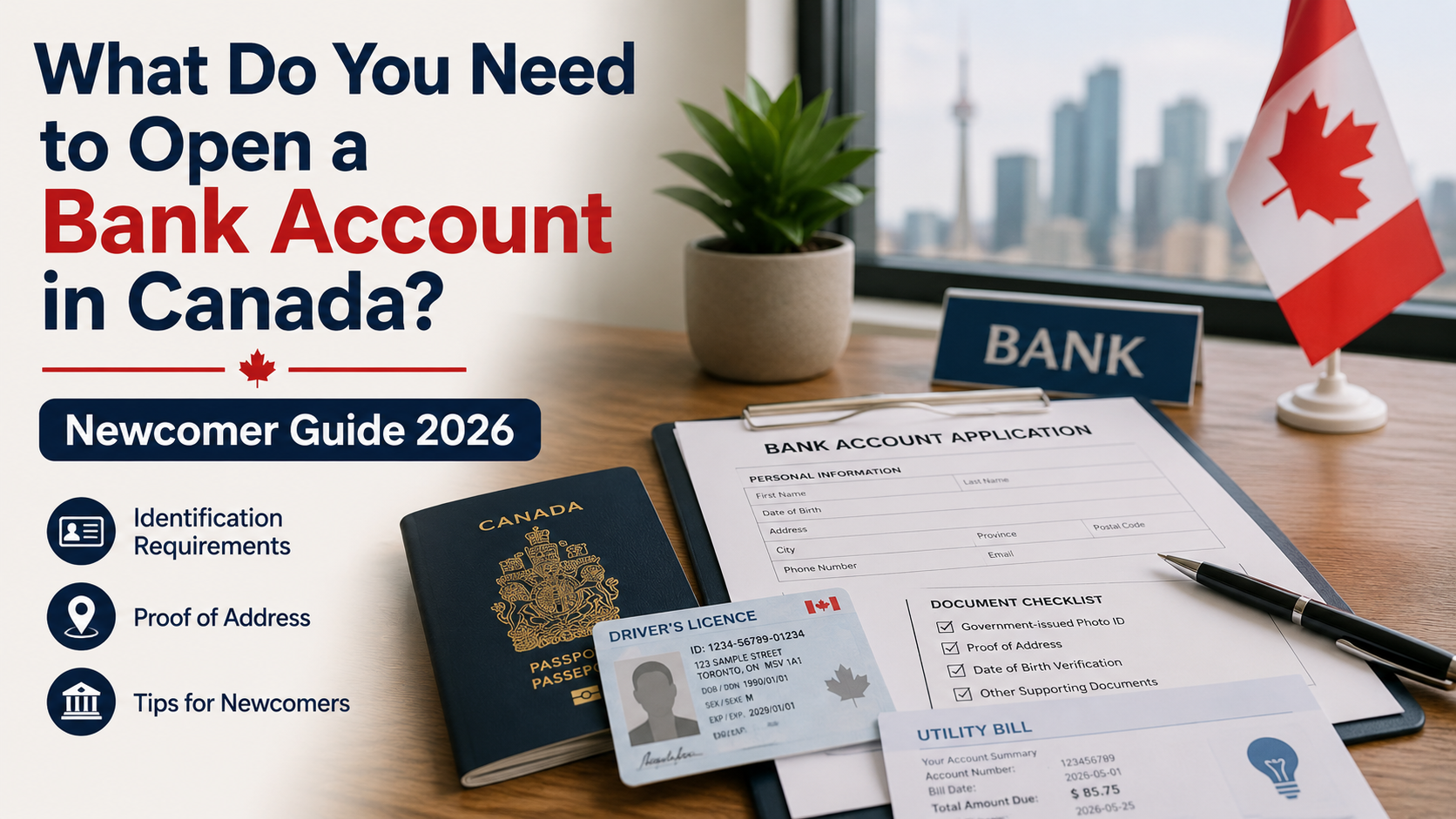
You may provide two original documents from reliable sources:
- One document must show your name and address.
- The other must show your name and date of birth.
Examples listed by the Government of Canada include certain federal or provincial government identification, recent Canadian public utility bills, recent Canadian bank or credit card statements, recent government benefit statements, recent tax assessment notices and foreign passports.
Option 2: one document plus identity confirmation
There is another route for people who may not have two qualifying documents.
You may provide a document from a reliable source showing your name and date of birth if your identity is also confirmed by either:
- a customer who is in good standing with the bank; or
- a person of good standing in the community where you are opening the account.
The bank still needs to verify your identity and determine whether the documents and confirmation meet the applicable requirements.
Quick checklist for newcomers
| Item | Why it may matter |
|---|---|
| Original identification | The bank must verify your identity. The FCAC instructs consumers to provide original identification rather than photocopies when using the document-based process. |
| Foreign passport | A foreign passport is among the documents listed by the Government of Canada for the identification process. |
| Proof showing your Canadian address | One of the two documents under the two-document method must indicate your name and address. |
| Immigration documents | A financial institution may request or accept immigration-related documentation depending on its verification process and the product you are applying for. |
| Tax information, when applicable | Financial institutions may have tax-residency reporting obligations and may request tax identification information in applicable circumstances. |
| Phone number and email | Useful for account communications, online banking setup and electronic alerts. |
Important: The exact documents requested can depend on the financial institution, how you apply and your circumstances. Check directly with the bank before visiting a branch, especially if you have recently arrived and do not yet have many Canadian documents.
Can a newcomer use a foreign passport?
Yes. A foreign passport is specifically included by the Government of Canada among the types of documents that may be used in the identification process for opening a bank account.
That can be particularly useful for newcomers who have not yet obtained a Canadian driver's licence or other provincial identification.
However, a passport showing your name and date of birth does not automatically satisfy every part of the two-document method. Under that method, you also need a qualifying document showing your name and address.
This distinction matters because many newly arrived residents have strong identity documentation but very little Canadian proof of address.
What can be used as proof of address?
Under the FCAC's two-document approach, one reliable-source document must indicate your name and address.
The government's examples include documents such as:
- recent Canadian public utility bills;
- recent bank account statements;
- recent credit card statements;
- certain recent government benefit statements;
- certain recent notices of tax assessment; and
- qualifying government-issued identification containing the required information.
Do not assume that every document containing an address will automatically be accepted. The document must satisfy the applicable reliability and verification requirements.
Do you need a Social Insurance Number to open a bank account?
A Social Insurance Number (SIN) should not be treated as a universal substitute for the identity-verification requirements described above.
There are also situations in which a financial institution may need tax identification information. For example, the Canada Revenue Agency explains that financial institutions have reporting obligations involving certain non-resident account holders and U.S. citizens, and Canadian SIN information may need to be provided when applicable.
Because the requirements can depend on the account, tax residency and individual circumstances, ask the institution exactly why it requires a SIN or other tax identification information before providing it.
Protect your SIN carefully. It is sensitive personal information and should not be shared unnecessarily.
Do you need a job to open a Canadian bank account?
No. One of the most useful rules for newcomers is that having a job is not a general requirement for the right to open a personal bank account at a bank covered by the federal rules.
The Financial Consumer Agency of Canada states that you can open a bank account even if you:
- do not have a job;
- do not have money to deposit immediately; or
- have been bankrupt.
This is particularly relevant for newcomers who want to establish their financial setup before finding their first Canadian job.
If employment is your next priority, our guide to getting a job in Canada as a newcomer explains the job-search process in more detail.
Do you need Canadian credit history?
Opening a basic deposit account is different from applying for credit.
A newcomer may not yet have a Canadian credit history, but that does not mean they should assume they cannot open a bank account. Credit products such as credit cards, overdraft facilities and loans involve separate eligibility and risk-assessment considerations.
Once you have established your basic banking setup, you can learn more in our guide on how to build credit in Canada as a newcomer.
Can you open a Canadian bank account before arriving in Canada?
Some financial institutions offer processes that may allow prospective newcomers to begin an application before arrival, but this should not be confused with the general legal identification requirements or with a guarantee that the entire account-opening process can be completed abroad.
The FCAC notes that bank accounts may be opened in person, electronically or by telephone when the bank can properly confirm identity. It also notes that a person who is not a Canadian citizen — and even someone living in another country — may be able to open an account with proper identification, although an in-person visit may be required.
Therefore, check the specific institution's current procedure before relying on a pre-arrival banking option.
Can temporary residents open bank accounts?
Being a Canadian citizen is not a general requirement for opening a Canadian bank account.
The FCAC states that you may be able to open an account with proper identification even if you are not a Canadian citizen or live in another country.
Temporary residents such as international students and workers may therefore have banking options, subject to identification, verification and the particular financial institution's account requirements.
Newcomers may qualify for no-cost banking
There is another development worth knowing about in 2026.
Under Canada's commitment on low-cost and no-cost accounts, eligible newcomers may qualify for a no-cost account during their first year in Canada at participating financial institutions.
For purposes of that commitment, newcomers include eligible permanent residents, refugees and certain temporary residents, including students and workers.
The availability and eligibility requirements should be checked directly with participating financial institutions.
This is separate from promotional newcomer packages. If you want to compare those offers, see our guide to newcomer bank account offers in Canada in 2026.
What type of account should a newcomer open?
For everyday banking, a chequing account is often the first account newcomers consider because it can be used for common transactions such as debit purchases, bill payments, withdrawals and receiving employment income through direct deposit.
A savings account serves a different purpose and may pay interest on money you do not need for everyday spending.
Before choosing an account, compare:
- monthly account fee;
- number of included transactions;
- ATM access;
- Interac e-Transfer conditions;
- minimum balance requirements, if any;
- international transfer options;
- newcomer eligibility rules;
- promotional periods and what happens after they end; and
- deposit insurance eligibility.
Our guide to bank accounts for newcomers in Canada covers the account-selection side in more detail.
Do not choose a bank only because of a welcome offer
Cash bonuses, waived monthly fees and newcomer promotions can be attractive, but they should not be the only reason you choose an account.
A promotion can expire while your account may remain open for years.
Before applying, find out:
- how long promotional pricing lasts;
- the regular monthly fee after the promotion;
- whether a minimum balance is required to waive fees;
- how many transactions are included;
- what conditions must be completed to receive a bonus; and
- whether you actually need additional products included in the package.
Always verify current terms directly with the financial institution because promotions and eligibility requirements can change.
What information must a bank give you?
When you open a personal account at a federally regulated financial institution, you have disclosure rights.
The bank must provide required information about the account, including applicable fees and account terms. The FCAC also explains that banks have obligations when introducing new charges or increasing certain fees.
Read the account agreement before accepting the product and keep a copy for your records.
What if the bank refuses to open an account?
A bank's obligation to provide access to basic banking services is not unlimited. There are circumstances in which a bank may refuse an account.
Examples identified by the FCAC include situations where the bank has reasonable grounds to believe the account will be used for illegal or fraudulent purposes, the applicant knowingly provides false information, the applicant does not permit the bank to verify identification, or certain other specified conditions apply.
If a bank refuses to open an account under these rules, it must provide a written statement and information about its complaint-handling process.
If you believe you were treated unfairly, you can use the institution's complaint process and consult the Financial Consumer Agency of Canada's guidance on resolving complaints.
What if you do not have standard Canadian ID?
This is especially important for newcomers.
The FCAC has specifically addressed access to basic banking services for consumers who present non-standard identification. Its guidance says banks should have policies and procedures that accommodate qualifying identification from reliable sources rather than interpreting the rules too narrowly.
That does not mean a bank can skip identity verification. The institution still has legal obligations to verify identity and comply with anti-money-laundering requirements.
But a newcomer should not automatically assume that lacking a conventional Canadian photo ID makes opening a basic deposit account impossible.
Can you open an account online?
Potentially. The Government of Canada states that accounts may be opened in person, electronically or by telephone, provided the bank can properly confirm your identity.
However, the process differs among institutions. Some online-only financial institutions may require an existing account at another financial institution as part of their process.
For someone who has just arrived in Canada and has limited Canadian documentation, visiting a branch can sometimes make identity verification easier.
What to do before visiting a bank
A few minutes of preparation can save considerable time.
- Check the institution's identification requirements. Do this on its official website or by contacting it directly.
- Bring original documents. Do not rely on photocopies for the FCAC document-based identification process.
- Confirm what will establish your address. This is particularly important if you have only recently arrived.
- Compare account fees. Do not assume a newcomer account will remain free permanently.
- Ask what happens after promotional benefits expire.
- Understand any bonus conditions before opening the account.
- Keep copies of your account agreement and important disclosures.
What to do after opening your first Canadian bank account
Once your account is active, set up the basics carefully.
Protect your debit card PIN and online banking password, enable available security alerts and review your transactions regularly.
If you start working, you may also be able to arrange direct deposit of your pay into the account.
Newcomers who are building a broader financial foundation can then consider credit history, emergency savings and monthly budgeting. Our guide on how much money you need to live in Canada can help with the budgeting side of that process.
Common mistakes newcomers should avoid
- Going to a branch without checking acceptable identification first.
- Assuming a foreign passport alone will always satisfy every verification requirement.
- Choosing an account solely because of a temporary cash bonus.
- Ignoring the monthly fee that begins after a promotional period.
- Confusing opening a deposit account with being approved for credit.
- Sharing a SIN or other sensitive information without understanding why it is required.
- Using unofficial websites to submit sensitive banking or identification information.
- Failing to read the account agreement and fee disclosure.
Bottom line
Newcomers do not need to wait until they have established a long Canadian financial history before looking into opening a bank account.
The key requirement is proper identity verification. Canadian federal banking rules provide more than one route for meeting identification requirements, including options that can be particularly relevant to people who have recently arrived and do not yet have a full set of Canadian documents.
Prepare your original identification, determine how you will establish your address, check the financial institution's requirements before applying and compare the long-term cost of the account rather than focusing only on introductory promotions.
Important: Banking procedures, product eligibility, promotions and identification practices can change. This article provides general information based on official Canadian guidance available in 2026. Always confirm current requirements directly with the financial institution before applying.
Official Sources & Further Reading
- Financial Consumer Agency of Canada — Opening a Bank Account
- Financial Consumer Agency of Canada — Opening a Personal Bank Account: Know Your Rights
- Immigration, Refugees and Citizenship Canada — Banking in Canada
- Financial Consumer Agency of Canada — Low-Cost and No-Cost Accounts
- Financial Consumer Agency of Canada — Access to Basic Banking Services
- FINTRAC — Methods to Verify the Identity of Persons and Entities