Finding an affordable place to live in Canada can make an enormous difference to your monthly budget. Housing is usually the biggest expense, and choosing a smaller or less expensive city can leave significantly more room for groceries, transportation, savings and other priorities.
That does not mean the cheapest city is automatically the best place to live. Employment opportunities, wages, transportation, health services, climate and lifestyle all matter when deciding where to settle.
In this guide, we look at 12 Canadian cities that can be worth considering in 2026 for people seeking a lower cost of living than Canada's most expensive markets.
Before comparing individual cities, read our complete guide to the cost of living in Canada in 2026 to understand how rent, groceries, utilities and transportation affect a typical monthly budget.
What Are the Cheapest Places to Live in Canada in 2026?
There is no single official ranking of the cheapest Canadian cities. Affordability depends on both your expenses and your income.
However, people looking beyond Toronto and Vancouver can find cities where housing costs may be considerably easier to manage.
The 12 places worth considering in this guide are:
- Regina, Saskatchewan
- Saskatoon, Saskatchewan
- Winnipeg, Manitoba
- Edmonton, Alberta
- Red Deer, Alberta
- Quebec City, Quebec
- Sherbrooke, Quebec
- Trois-Rivières, Quebec
- Moncton, New Brunswick
- Saint John, New Brunswick
- Fredericton, New Brunswick
- Thunder Bay, Ontario
This list should be treated as a practical shortlist rather than a strict cheapest-to-most-expensive ranking. Rental prices change continuously, and the most affordable option for one household may not be the best option for another.
Affordable Canadian Cities at a Glance
| City | Province | Why Consider It | Important Trade-Off |
|---|---|---|---|
| Regina | Saskatchewan | Lower housing pressure than major Canadian metros | Cold winters and car dependence in some areas |
| Saskatoon | Saskatchewan | Housing and growing regional economy | Winter climate |
| Winnipeg | Manitoba | Large-city services with comparatively accessible housing | Very cold winters |
| Edmonton | Alberta | Major job market without Toronto or Vancouver housing costs | Transportation can increase expenses |
| Red Deer | Alberta | Smaller-city housing and central Alberta location | Smaller employment market |
| Quebec City | Quebec | Housing and strong public services | French is important for many jobs |
| Sherbrooke | Quebec | University city with relatively accessible housing | Smaller labour market |
| Trois-Rivières | Quebec | Lower-cost alternative to larger Quebec cities | French is especially important |
| Moncton | New Brunswick | Growing Atlantic Canadian centre | Rental costs have changed considerably |
| Saint John | New Brunswick | Smaller Atlantic housing market | Fewer jobs than major metros |
| Fredericton | New Brunswick | Government and university employment base | Smaller rental inventory |
| Thunder Bay | Ontario | Alternative to expensive southern Ontario markets | Remote location and cold climate |
Housing conditions can change quickly. Statistics Canada publishes quarterly asking-rent statistics for Canadian census metropolitan areas, while the Canada Mortgage and Housing Corporation publishes detailed rental-market information.
1. Regina, Saskatchewan
Regina is one of the first places worth researching if affordability is a priority.
As Saskatchewan's provincial capital, the city has employment connected to government, health care, education, construction, agriculture-related industries and other services.
For someone moving from Toronto or Vancouver, housing can be one of Regina's biggest attractions. However, the total budget should include transportation and winter-related expenses rather than rent alone.
Regina's climate can be challenging for newcomers unfamiliar with Prairie winters, and owning a vehicle may be useful depending on where you live and work.
2. Saskatoon, Saskatchewan
Saskatoon combines a relatively manageable housing market with a population large enough to provide many of the services expected from a regional economic centre.
The economy is connected to sectors including agriculture, mining, education, health care, construction and professional services.
For newcomers, Saskatoon may provide a middle ground between moving to a very small community and paying the housing costs associated with Canada's largest metropolitan areas.
Before relocating, compare local wages with expected expenses. The Government of Canada's Job Bank wage comparison tool can help you research wages by occupation and location.
3. Winnipeg, Manitoba
Winnipeg deserves particular attention because it offers many characteristics of a major Canadian city while housing can remain more accessible than in Toronto or Vancouver.
The city has employment across transportation and logistics, manufacturing, financial services, government, health care, construction and other industries.
Winnipeg also has public transit, universities, hospitals, shopping and other major urban services.
The trade-off is climate. Winters can be extremely cold, which matters not only for lifestyle but also for clothing, transportation and potentially household utility costs.
Someone considering Winnipeg should therefore compare total annual expenses rather than focusing exclusively on monthly rent.
4. Edmonton, Alberta
Edmonton is particularly interesting because it combines a major metropolitan labour market with housing costs that can be lower than Canada's most expensive cities.
The city has employment opportunities connected to government, health care, education, construction, energy, technology, retail and professional services.
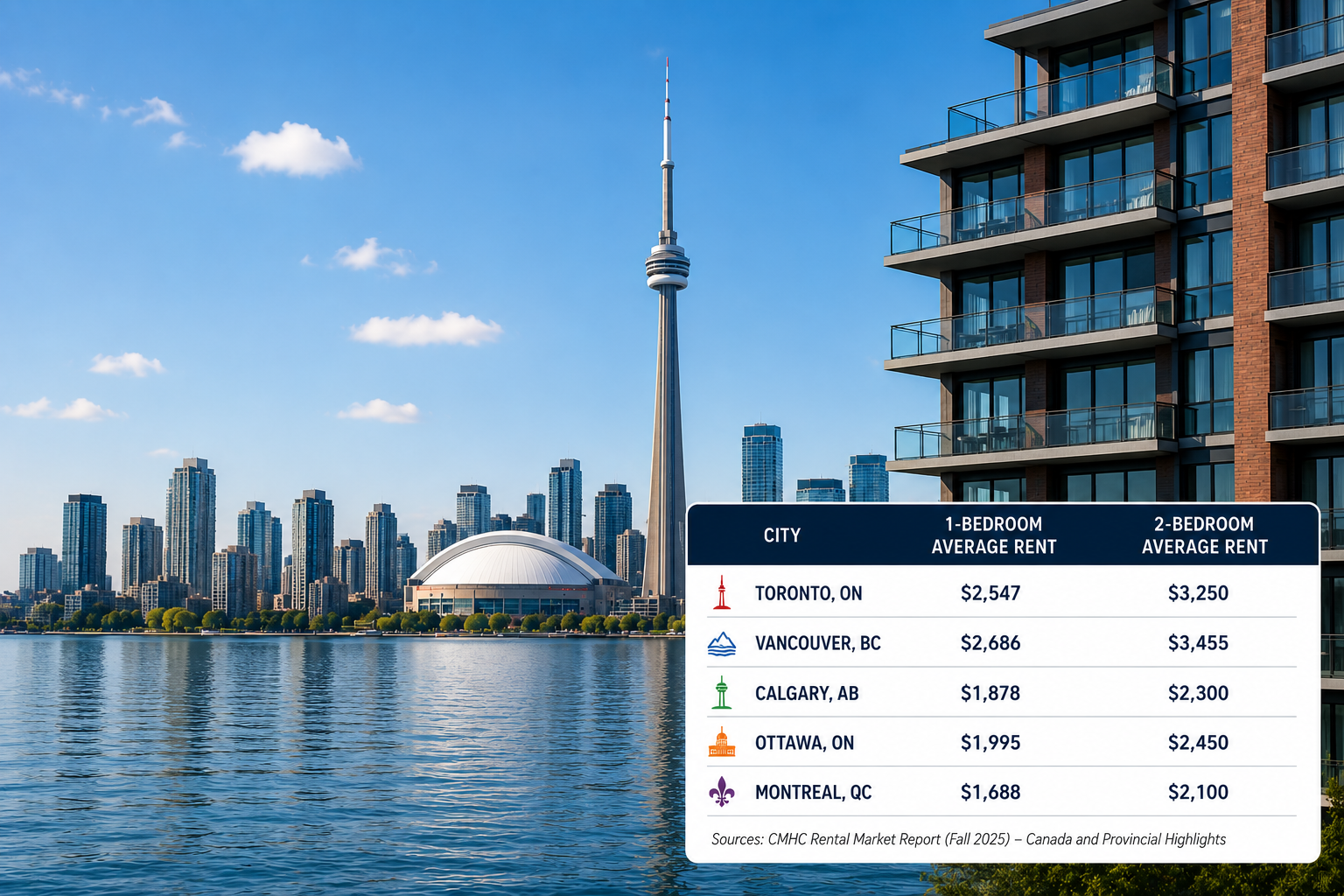
CMHC's 2025 Rental Market Report showed a turnover rent of about C$1,600 for a two-bedroom purpose-built rental apartment in Edmonton in October 2025. For comparison, the corresponding figure was C$2,547 in Toronto and C$2,696 in Vancouver.
These figures do not mean every two-bedroom apartment costs that amount. They are market indicators and individual listings can be higher or lower.
For newcomers who want access to a large labour market without paying Toronto or Vancouver housing prices, Edmonton deserves serious consideration.
5. Red Deer, Alberta
Located between Calgary and Edmonton, Red Deer offers a smaller-city alternative within Alberta.
Housing may be more accessible than in some larger metropolitan areas, while the city's central location provides access to two of Alberta's largest economic centres.
Potential residents should pay particular attention to employment before moving. A lower monthly rent is less valuable if your occupation has limited opportunities locally.
This is why researching the labour market should always be part of an affordability comparison.
6. Quebec City, Quebec
Quebec City can offer an attractive combination of urban services, employment and housing costs compared with some of Canada's most expensive metropolitan areas.
As Quebec's provincial capital, government is an important employer. Tourism, health care, education, technology and professional services also contribute to the local economy.
There is one major consideration for newcomers: French.
French-language ability can be essential for employment and everyday life in Quebec City. Someone choosing a city based purely on housing prices without considering language and career requirements could encounter difficulties after moving.
7. Sherbrooke, Quebec
Sherbrooke is a university city in southern Quebec that can appeal to students, families and workers looking for an alternative to Canada's largest urban centres.
Education and health care play important roles in the local economy, and the city's smaller size may appeal to people who do not need the employment scale of Toronto or Montreal.
Again, French ability is an important consideration.
A smaller labour market also means that researching your specific occupation before relocating is especially important.
8. Trois-Rivières, Quebec
Trois-Rivières sits roughly between Montreal and Quebec City and is another Quebec community worth researching for affordability.
The city offers a smaller urban environment and may provide lower housing costs than Canada's largest metropolitan areas.
However, affordability should be evaluated alongside employment. People working remotely or with a job already secured may evaluate Trois-Rivières very differently from someone who needs to find work immediately after arriving.
9. Moncton, New Brunswick
Moncton has attracted significant attention as one of Atlantic Canada's growing urban centres.
Its economy includes transportation, logistics, health care, retail, education, financial services and other industries.
Historically, Atlantic Canadian cities were frequently viewed as inexpensive alternatives to Toronto and Vancouver. However, renters should not assume older affordability comparisons still apply.
Rental markets have changed, making current research essential before relocating.
Moncton's bilingual environment can also be an advantage for workers who speak both English and French.
10. Saint John, New Brunswick
Saint John provides another option for people considering New Brunswick.
The local economy includes industries connected to energy, health care, manufacturing, transportation and services.
Housing can make Saint John attractive compared with Canada's largest metropolitan areas, but the employment market is considerably smaller.
If you already work remotely or have a job offer, the affordability equation may therefore look particularly attractive.
11. Fredericton, New Brunswick
Fredericton is the capital of New Brunswick and has employment connected to government, universities, technology, health care and professional services.
Its relatively small population can appeal to people looking for a quieter lifestyle while still having access to important services.
However, smaller cities generally have fewer rental listings than huge metropolitan areas. That means finding the right apartment can still take time even when headline prices appear affordable.
12. Thunder Bay, Ontario
Ontario does not automatically mean Toronto-area prices.
Thunder Bay, located in northwestern Ontario, offers a very different housing and lifestyle environment from the Greater Toronto Area.
The city serves as an important regional centre for health care, education, transportation and other services.
Its location is also its biggest trade-off. Thunder Bay is geographically distant from the large southern Ontario metropolitan areas, and winters are cold.
For someone whose work and lifestyle fit the region, however, it can be worth investigating as an alternative to southern Ontario's more expensive housing markets.
How Much Can You Save by Avoiding Toronto or Vancouver?
Housing is where the difference can become substantial.
CMHC's latest annual rental-market report illustrates the gap. For two-bedroom purpose-built rental apartments rented to new tenants, October 2025 turnover rents were approximately:
| Market | 2-Bedroom Turnover Rent |
|---|---|
| Vancouver | C$2,696 |
| Toronto | C$2,547 |
| Ottawa | C$2,155 |
| Halifax | C$2,058 |
| Calgary | C$1,836 |
| Montreal | C$1,644 |
| Edmonton | C$1,600 |
Source: Canada Mortgage and Housing Corporation, 2025 Rental Market Report.
Statistics Canada's newer asking-rent statistics also show why using current data matters. In the first quarter of 2026, the average asking rent for a two-bedroom apartment across Canadian census metropolitan areas was C$2,150, down slightly from C$2,170 one year earlier.
For a deeper breakdown of housing costs, see our guide to average rent in Canada in 2026.
Cheap Rent Does Not Always Mean a Cheap Life
This is one of the most important things to understand before moving.
Imagine Apartment A costs C$300 less per month than Apartment B. That sounds like an obvious saving.
But if living in Apartment A requires buying and operating a car while Apartment B allows you to commute using public transportation, some or all of that housing saving could disappear.
The Government of Canada specifically advises newcomers to consider housing alongside utilities, transportation and other household expenses when preparing financially for life in Canada.
Our 2026 Canada cost-of-living guide provides a broader monthly budget that can help with this comparison.
Check Jobs Before Choosing a Cheap City
Housing should never be the only factor when choosing where to live.
A C$1,300 apartment is not affordable if you cannot find suitable employment nearby.
Before moving, research:
- Demand for your occupation
- Typical local wages
- Major employers
- Unemployment conditions
- Professional licensing requirements
- Transportation to employment areas
- Remote-work possibilities
The federal Job Bank labour market information service lets workers research wages, job prospects and labour-market conditions across Canada.
If finding employment is your main concern, read our guide to getting a job in Canada without Canadian experience.
Should Newcomers Choose a Smaller Canadian City?
For some newcomers, yes. But the decision should be based on more than rent.
Smaller and mid-sized cities can offer advantages such as:
- Lower housing costs in some markets
- Shorter commutes
- Less congestion
- A quieter lifestyle
- Potentially lower home purchase prices
They can also have disadvantages:
- Smaller job markets
- Less public transportation
- Fewer specialized services
- Greater need for a vehicle
- Smaller newcomer communities in some locations
The Government of Canada's newcomer housing guidance recommends considering not just housing costs but also proximity to schools, health care, public transportation, grocery stores and other essential services.
Renting Your First Home in Canada
Newcomers should understand that rental rules vary by province and territory.
Before signing a lease, confirm what the rent includes and whether you will pay separately for:
- Electricity
- Heating
- Water
- Internet
- Parking
- Tenant insurance
Official newcomer guidance from the Government of Canada explains that provinces and territories have their own rental rules, including rules surrounding rent increases.
Our guide to renting in Canada as a newcomer covers documents, costs and apartment hunting in more detail.
How to Choose the Best Affordable City for You
Instead of searching for the single cheapest city in Canada, create a shortlist based on your personal situation.
Start with five questions:
- Can I realistically find work there?
- What will my after-tax income be?
- How much will housing cost?
- Will I need a car?
- Does the city provide the lifestyle and services I need?
Then calculate a complete monthly budget.
Someone earning C$70,000 in a moderately priced city may have more disposable income than someone earning C$85,000 in a city where housing consumes a much larger share of their pay.
This is why salary and cost of living should always be evaluated together. You can compare income levels in our article about the average salary in Canada.
How Much Money Should You Have Before Moving?
Even when moving to an affordable city, arriving with financial reserves is important.
Your first weeks can involve expenses that will not appear in your normal monthly budget, including temporary accommodation, household items, transportation, furniture and rental setup costs.
The Government of Canada warns newcomers that their financial situation can change after arrival and that some people may initially need to accept lower-paying employment while gaining Canadian experience or upgrading their qualifications.
For more detailed planning, see how much money you need to live in Canada in 2026.
Final Thoughts
Canada still offers alternatives for people who do not want to pay the housing costs associated with Toronto or Vancouver.
Cities such as Regina, Saskatoon, Winnipeg, Edmonton, Quebec City and several smaller Canadian centres deserve consideration when affordability is a priority.
But there is no universally cheapest place that works for everyone.
The best city is the one where your income, housing costs, employment opportunities and lifestyle create a sustainable overall budget.
Research current rental listings before moving, compare local wages, calculate transportation expenses and investigate the employment market for your occupation.
For newcomers preparing their move, our guide to moving to Canada in 2026 covers additional steps worth completing before arrival.
Rental markets and living costs can change quickly. Figures and comparisons in this article are provided for general informational purposes. Always verify current rental listings, local costs and employment conditions before making relocation or financial decisions.
Official Sources & Further Reading
- Statistics Canada — Quarterly Rent Statistics, First Quarter 2026
- Canada Mortgage and Housing Corporation — Rental Market Report
- Government of Canada — Prepare Financially for Life in Canada
- Government of Canada — Housing in Canada for Newcomers
- Government of Canada Job Bank — Labour Market Information