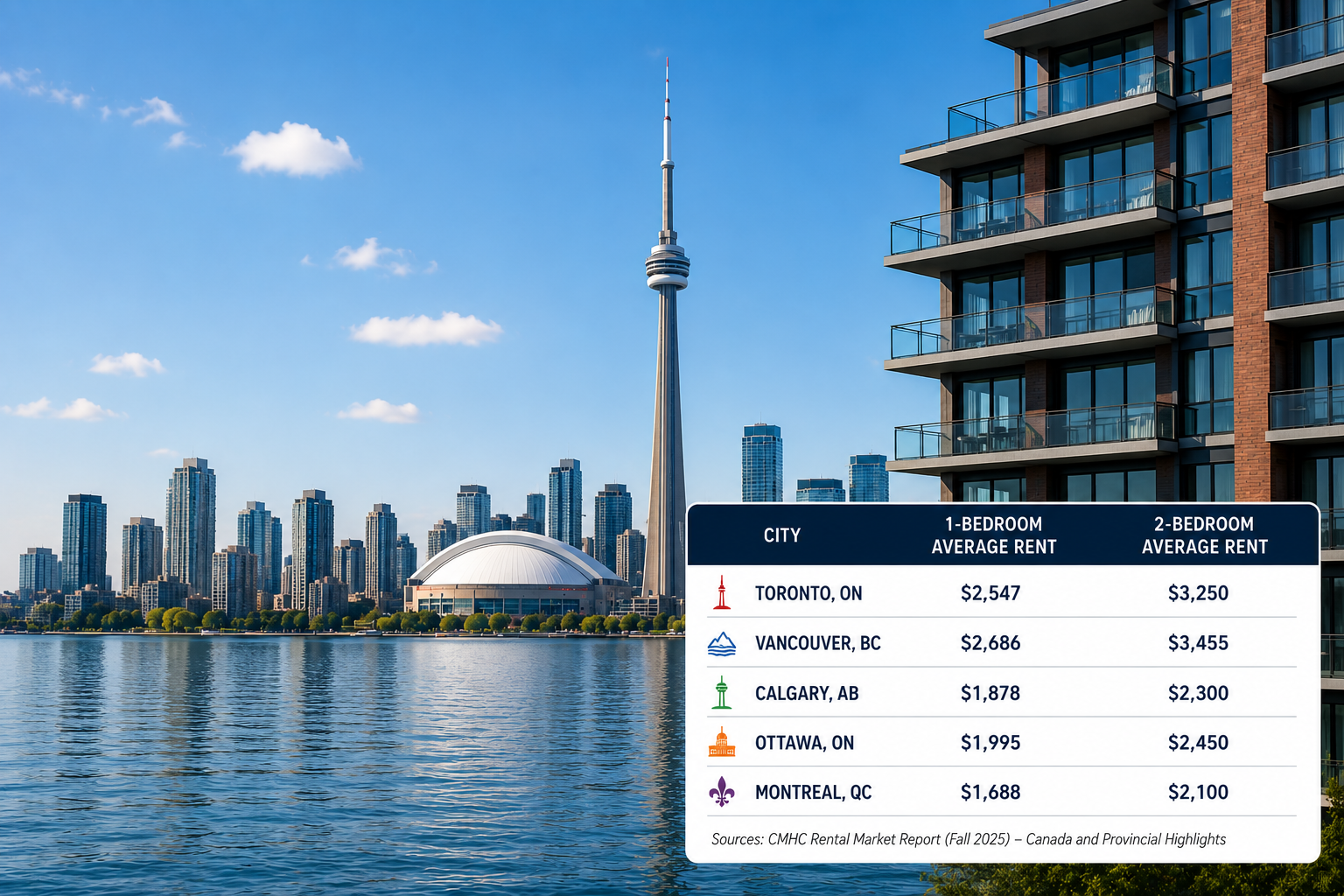
Rent is one of the biggest expenses for anyone living in Canada. Whether you are moving to the country for the first time, changing cities or simply trying to build a better monthly budget, understanding how much housing costs can make a major difference in your financial planning.
In 2026, there is no single number that represents the cost of renting across Canada. Housing markets vary significantly between provinces and cities, and even two neighbourhoods within the same city can have very different prices.
This guide explains what renters should expect, why prices vary so much and how to compare housing costs before deciding where to live.
What Is the Average Rent in Canada in 2026?
The average rent in Canada depends heavily on the type of property, location and whether you are looking at existing rental units or newly advertised listings. National averages can therefore be useful as a reference, but they should never be treated as the exact amount every renter will pay.
A one-bedroom apartment in a major metropolitan area will generally cost considerably more than a similar property in a smaller community. Toronto and Vancouver remain among the country's more expensive rental markets, while renters can often find lower housing costs in smaller cities and some Prairie or Atlantic communities.
Another important distinction is between the rent paid by existing tenants and the asking rent advertised to someone searching for a new home. A person who has occupied the same rent-controlled apartment for several years may pay substantially less than someone signing a new lease nearby.
Why Rent Varies So Much Across Canada
Canada is geographically enormous, and its housing markets operate under very different local conditions. Population growth, employment opportunities, construction activity, vacancy rates, available housing supply and local demand can all influence rental prices.
Large employment centres tend to attract more workers, students and newcomers. When many people compete for a limited number of available homes, rents can remain high even when the broader economy slows.
Housing supply matters as well. Cities that add rental apartments quickly may have more options available to tenants, while markets with very low vacancy rates can become much more competitive.
This is why comparing only salaries between Canadian cities can be misleading. A higher-paying job may look attractive until you calculate how much of that additional income will be spent on housing.
Rent in Toronto
Toronto offers one of Canada's largest employment markets, but housing is also a major expense. Rent can vary dramatically depending on the neighbourhood, building age, proximity to public transit and apartment size.
Downtown properties and homes close to subway stations generally command a premium. Renters willing to live farther from the city centre may find lower prices, although transportation costs and commuting time should be included in the calculation.
Before accepting a job in Toronto, compare your expected take-home pay with rent, utilities, transportation, groceries and other recurring expenses. Gross salary alone does not tell you how comfortable your monthly budget will be.
Rent in Vancouver
Vancouver has historically been one of Canada's most expensive housing markets. Its strong demand, limited geography and desirable location contribute to high housing costs.
For renters, looking beyond the city itself can sometimes expand the number of available options. Communities throughout Metro Vancouver are connected by public transportation, although commute times and transit costs should be considered before choosing a property.
A lower monthly rent is not automatically a better financial decision if it requires an expensive or extremely long commute. The goal should be to compare the total cost of living rather than housing alone.
Rent in Calgary
Calgary is frequently considered by people who want access to a major Canadian job market while exploring alternatives to Toronto and Vancouver. Alberta also has a different tax environment from several other provinces, which can affect household finances.
However, renters should not assume Calgary is inexpensive simply because it has historically been cheaper than Canada's two largest high-cost markets. Rental conditions can change as population and housing demand change.
Anyone considering Calgary should research current listings in the specific neighbourhoods where they expect to live and compare them with expected wages in their occupation.
Rent in Edmonton
Edmonton can provide another option for workers considering Alberta. Housing costs have traditionally differed from Toronto and Vancouver, but the amount a renter actually pays depends on location, apartment type and current market conditions.
Transportation is particularly important when comparing Edmonton neighbourhoods. Depending on where you work, owning a vehicle could add insurance, fuel, maintenance and parking expenses to your monthly budget.
A cheaper apartment therefore does not necessarily produce the cheapest lifestyle. Always calculate housing and transportation together.
Rent in Ottawa
Canada's capital has a large public-sector workforce as well as employment in technology, professional services, education and other industries. Rental demand can differ considerably across Ottawa and surrounding communities.
Living farther from central areas may reduce housing costs, but commuting requirements should again be considered. Renters should also check whether utilities, parking or other services are included in the advertised monthly rent.
Rent in Montreal
Montreal has historically offered a different housing-cost profile from Toronto and Vancouver, but rental affordability varies significantly by neighbourhood and property type.
People moving to Quebec should also consider factors beyond rent, including provincial taxes, language requirements for certain jobs and transportation. These can influence whether Montreal makes financial sense for a particular household.
Smaller Canadian Cities Can Be Worth Considering
Many people researching Canada focus immediately on Toronto, Vancouver or Montreal. Those cities provide large employment markets, but they are not the only places where newcomers and Canadian workers can build a career.
Depending on your occupation, cities such as Winnipeg, Saskatoon, Regina, Halifax, Moncton and other regional centres may deserve consideration.
The important question is not simply, “Where is rent cheapest?” It is, “Where can I earn a reasonable income relative to my total monthly expenses?”
How Much of Your Income Should Go Toward Rent?
A common budgeting benchmark is to compare housing expenses with household income. However, a fixed percentage does not work equally well for everyone.
A household with children, childcare expenses and a vehicle may have very different financial needs from a single person using public transportation. Debt payments, insurance, food costs and savings goals also affect how much rent you can realistically afford.
Instead of relying entirely on one percentage, create a complete monthly budget. Start with your expected after-tax income and subtract realistic estimates for housing, utilities, groceries, transportation, phone service, insurance, debt payments and essential personal expenses.
The amount remaining gives you a much clearer picture of whether a particular rent level is sustainable.
Costs Renters Should Remember
The advertised rent is not always the complete cost of a home. Before signing a lease, determine exactly what is included.
- Electricity and other utilities
- Heating, when not included
- Internet service
- Tenant insurance
- Parking
- Laundry
- Transportation from the property to work
- Moving and setup expenses
These additional expenses can significantly change the real monthly cost of an apartment.
How to Find More Affordable Rent in Canada
Flexibility can make a substantial difference when searching for housing. Compare multiple neighbourhoods rather than focusing on a single area, and calculate commute costs before rejecting properties farther from downtown.
Apartment size is another major factor. Someone arriving alone may decide that renting a room or sharing a property temporarily provides more financial flexibility while establishing employment and building savings.
Always research the property and rental arrangement carefully. Be cautious when someone pressures you to transfer money quickly, refuses to provide normal documentation or offers a property at a price that appears dramatically below comparable listings.
Should You Choose a City Based on Rent?
Rent should be an important part of your decision, but it should not be the only factor. Employment opportunities, expected salary, transportation, taxes and lifestyle expenses all matter.
Imagine that one city offers a job paying several thousand dollars more per year but requires significantly higher rent. Another city may offer a lower salary but leave you with more disposable income after housing and transportation.
This is why Canada Worth recommends comparing cities using net income and total expenses rather than salary or rent in isolation.
Final Thoughts
The average rent in Canada in 2026 can provide a useful starting point, but your personal housing cost will depend primarily on where you live, what type of property you rent and current conditions in that local market.
Before moving, check recent rental information for your destination and compare several neighbourhoods. Then build a realistic budget using your expected after-tax income.
For newcomers especially, keeping housing expenses manageable during the first months in Canada can provide valuable financial flexibility while you establish employment, build credit and create an emergency fund.
Important: Rental prices and market conditions change frequently. Always verify current listings, lease requirements and provincial tenancy rules before making a housing or relocation decision.
Canada Worth Editorial Team
How to Check the Rent Figure for Your Own Situation
City averages hide most of what determines your actual rent. Before treating any average as your budget, adjust for the four variables that move a Canadian listing price the most:
- Unit type. A one-bedroom and a bachelor/studio in the same building can differ substantially; a room in a shared apartment is a different market again.
- Distance from the core. Suburban and transit-adjacent neighbourhoods usually price below downtown, but add a monthly transit or car cost that has to go back into the comparison.
- What is included. "Heat and hydro included" can be worth a meaningful amount per month; see our utilities cost guide for what those bills look like separately.
- Purpose-built rental versus condo sublet. Averages published for purpose-built rentals do not always reflect what individual condo landlords ask.
Canada Worth Today Analysis: Rent as a Share of Take-Home Pay
A widely used affordability rule of thumb is that housing should stay near or below roughly 30% of income. Two cautions apply when using it in Canada. First, apply it to take-home pay rather than gross salary, because income tax, CPP/QPP and EI are deducted before you ever see the money. Second, apply it to rent plus the utilities and tenant insurance you actually pay, not to the advertised rent alone.
Working method: take your monthly after-tax income, multiply by 0.30, then subtract your expected utilities and tenant insurance. What remains is the realistic advertised rent you can look at. If that number is below the local average for the unit you want, the practical options are a roommate, a smaller unit, a different neighbourhood or a different city — this is exactly the trade-off our cheapest places to live guide is for.
Documents Landlords Usually Ask For
- Government-issued photo identification
- Proof of income, such as a job offer letter or recent pay stubs
- References from a previous landlord or employer
- A completed rental application, and in most provinces a first-and-last-month rent deposit where the provincial tenancy rules allow it
If you have no Canadian credit file or Canadian references yet, read our guide to renting without a credit history, and gather proof of address early.
Rental Red Flags
- A landlord who will not let you view the unit or meet in person and asks for a deposit by e-transfer or cryptocurrency first
- Rent noticeably below everything comparable in the same neighbourhood
- Pressure to sign immediately, or refusal to provide a written lease
- A request for several months of rent up front beyond what your province's tenancy law permits
- Listings copied word for word across multiple sites with different contact details