One of the first challenges newcomers may face after arriving in Canada is proving where they live.
You may be asked for proof of address when dealing with a bank, applying for provincial identification, accessing government services or completing other important everyday tasks.
But there is an important point to understand: Canada does not have one universal document called a “proof of address certificate” that automatically works everywhere.
Different organizations and government programs have their own requirements. A document accepted by one institution may not be accepted by another.
This guide explains what proof of address means in Canada, which documents may be accepted, how newcomers can start establishing a Canadian address and what you can do if you have just arrived and do not yet have utility bills or other documents in your name.
What is proof of address in Canada?
Proof of address is documentation that helps an organization verify where you currently live.
Depending on the transaction, you may also see terms such as:
- proof of residence;
- proof of residency;
- residential address verification;
- proof of provincial residence; or
- proof of current address.
These expressions can sound interchangeable, but the exact requirement depends on the organization requesting the documentation.
For example, proving that you have an address for a financial transaction is not necessarily the same as proving that you meet a province's legal residency requirements for a government program.
Why do newcomers need proof of address?
After arriving in Canada, your address can become relevant to several parts of everyday life.
Depending on the institution and service, you may be asked to establish your address when:
- opening or managing a bank account;
- applying for provincial identification;
- applying for a driver's licence;
- registering for provincial health coverage;
- setting up certain financial services;
- dealing with insurance companies;
- registering for some government services;
- completing certain employment or educational processes; or
- handling other transactions where residency must be verified.
The important word is depending. Not every service asks for the same proof, and some services have alternative ways to verify your identity or address.
What documents can be used as proof of address in Canada?
There is no universal Canada-wide list that applies to every transaction.
However, depending on the organization and jurisdiction, commonly encountered documents can include:
- utility bills;
- bank statements;
- credit card statements;
- residential lease agreements;
- government correspondence;
- tax documents;
- insurance documents;
- employment documents;
- provincial identification showing your address; or
- other documents specifically accepted by the organization.
Never assume that an item on this general list will automatically be accepted. Check the official requirements for the transaction you are completing.
What information should a proof-of-address document show?
Requirements differ, but an organization will commonly want documentation that clearly connects you to the address.
For example, Alberta's requirements for a driver's licence or provincial ID card say residence documents must contain the applicant's full name and Alberta address and generally be dated within the previous 90 days.
This illustrates three details that frequently matter:
- your name;
- your current residential address; and
- a sufficiently recent date.
But another organization may use a different time limit or require different information.
Can you use a utility bill as proof of address?
Often, yes, when the organization accepts utility bills.
Examples may include bills for services such as:
- electricity or hydro;
- natural gas;
- water;
- cable; or
- other qualifying public utilities.
For example, Canada's federal banking guidance includes recent Canadian public utility bills among documents that may be used in one of the permitted identification methods for opening an account.
Ontario also lists utility bills such as cable TV, hydro, gas and water among documents that can establish Ontario residency for a health card.
If you are setting up your first home, our Utilities Cost in Canada 2026 guide explains common household services and expenses.
What if utilities are included in your rent?
This is common in some Canadian rentals.
If electricity, water or heating is included in the rent, you may never receive those utility bills in your own name.
That does not automatically mean you cannot prove your address.
Depending on the transaction, another accepted document such as a residential lease, bank statement, government document or other approved evidence may work instead.
Check the specific list provided by the organization requesting proof.
Can you use a lease as proof of address?
A residential lease can be accepted as proof of residence for some purposes.
For example, Alberta lists a residential lease agreement among documents that may establish Alberta residence for driver's licence and identification-card services.
Ontario's 2026 municipal voter-identification guidance also includes a lease or rental agreement relating to property in Ontario among documents that can show name and address for that particular purpose.
This does not make every lease universally acceptable throughout Canada.
The document may need to show information such as your legal name, property address and other details required by the organization.
If you are still looking for permanent housing, read our guide to renting in Canada as a newcomer.
Can a bank statement be proof of address?
It can be for certain purposes.
Alberta, for example, specifically lists bank and credit card statements showing an Alberta address as acceptable examples of Alberta residence documentation for identification-card services.
The statement must meet the applicable requirements, including the rules regarding the name, address and date.
If you have recently opened a Canadian bank account, make sure the institution has your correct residential or mailing information as applicable.
You may eventually be able to download statements through online banking, but whether a digital or printed statement is accepted depends on the organization requesting it.
Can you open a Canadian bank account before you have proof of address?
Do not automatically assume that you must already have a utility bill before you can open a bank account.
Federally regulated banks have specific identification rules.
The Financial Consumer Agency of Canada explains that there are different permitted methods for establishing identity when opening a bank account.
Under one method, two documents from reliable sources can be used: one showing your name and address and another showing your name and date of birth.
There are also other identification methods described by the federal rules.
Newcomers should therefore ask the bank which identification method applies to their situation rather than assuming a missing utility bill makes account opening impossible.
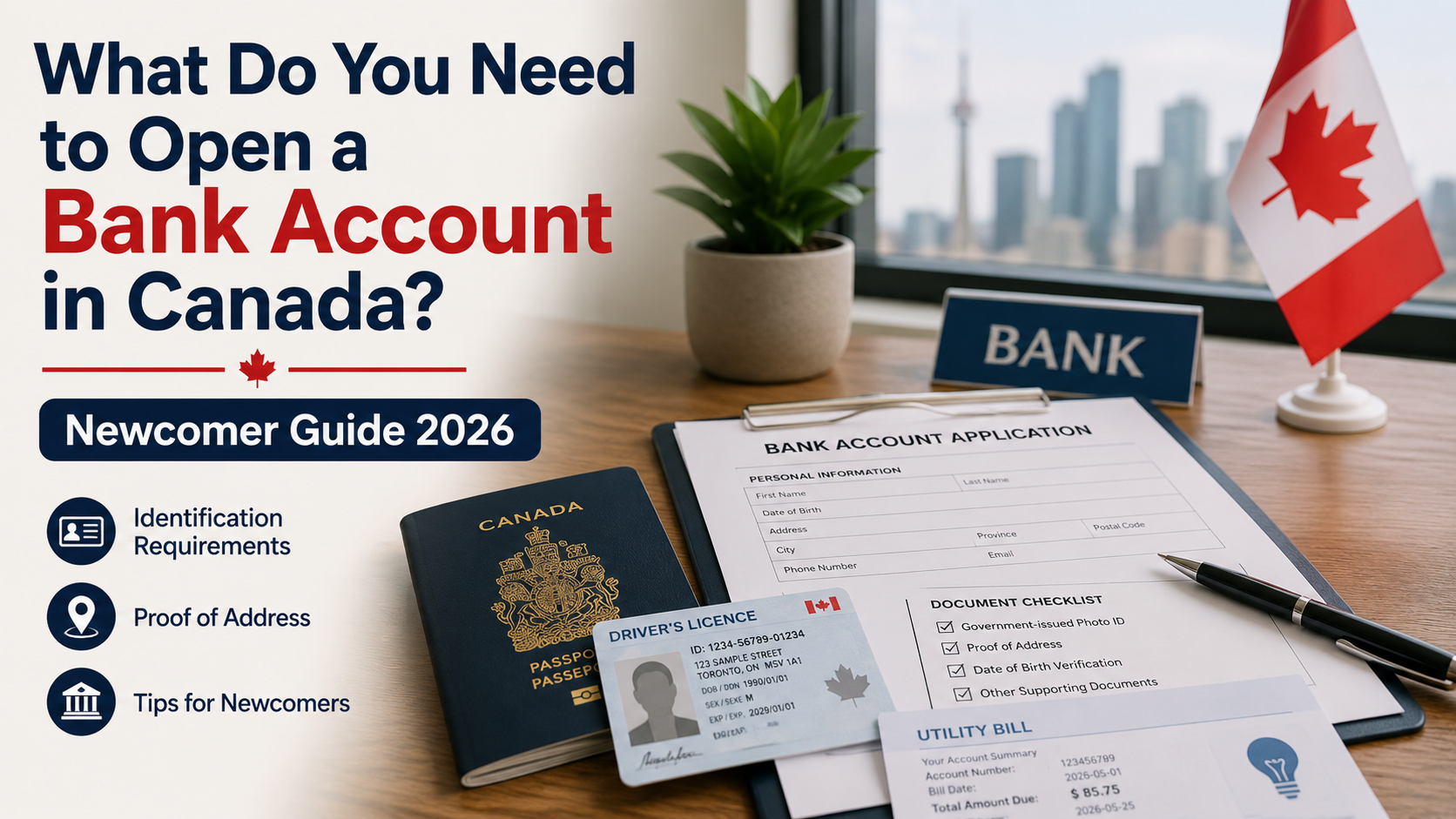
For the complete banking process, see our guide to the documents needed to open a bank account in Canada.
Can a credit card statement be used?
Potentially, when the organization requesting proof accepts it.
Alberta includes credit card statements showing an Alberta address among its examples of acceptable residence documentation for driver's licence and ID-card services.
Again, this is not a universal rule for every Canadian institution.
Check whether the organization accepts:
- electronic statements;
- printed online statements;
- only original mailed statements; or
- statements issued within a particular period.
Can a cell phone bill be proof of address?
Sometimes, but you should not assume it will be accepted.
The definition of an acceptable utility or telecommunications bill varies depending on the program.
Some government programs explicitly list telephone or cable documentation, while others use narrower lists.
Before using a mobile-phone bill, check the requesting organization's exact acceptable-document list.
If you are still choosing Canadian mobile service, our Cell Phone Plans in Canada for Newcomers 2026 guide explains the difference between prepaid and postpaid service.
Can government mail be used as proof of address?
Certain government-issued documents or correspondence may be accepted for particular purposes.
For example, Ontario's 2026 municipal voter-identification list includes various government documents showing a person's name and qualifying address.
Federal banking rules also recognize certain recent government-issued notices and benefit statements within the applicable identification framework.
However, simply receiving any envelope from a government office does not guarantee that it qualifies.
The type of document, issuer, date and information displayed can all matter.
Can a tax document be proof of address?
Some tax documents can be accepted in specific situations.
For example, Canada's banking rules include recent notices of tax assessment issued by the Government of Canada or certain other governments among the reliable documents that may be used under the relevant identification method.
Ontario's voter-identification rules also include an income tax assessment notice for that particular purpose.
A newly arrived newcomer may not have Canadian tax documentation yet, so this option is generally more relevant after you have begun establishing your life in Canada.
Can employment documents prove your address?
For some provincial processes, employment documentation can help establish residence.
Alberta lists written confirmation of Alberta employment as one possible residence document for driver's licence and ID-card purposes. The province specifies that this confirmation must be signed and dated.
That does not mean a job offer or pay stub will be accepted for every address-verification request in Canada.
Always follow the rules of the specific program.
Can your provincial photo ID become proof of address?
A government-issued provincial identification card showing your current address can be a useful document for many transactions where that form of ID is accepted.
This creates an important settlement cycle:
Establish residence → obtain local identification → use local identification for future transactions.
If you do not drive, our guide to getting Canadian provincial photo ID without a driver's licence explains the non-driver identification options in more detail.
Is a passport proof of address?
A passport is primarily an identity and travel document, not generally a document establishing your current Canadian residential address.
A valid passport can be extremely useful for proving who you are.
For example, Ontario accepts a valid foreign passport as an identity document for an Ontario Photo Card because it can establish legal name and date of birth.
But that does not mean the passport proves where you currently live in Canada.
Identity and residency are different concepts.
Is your immigration document proof of address?
Immigration documents primarily establish information about your immigration or legal status in Canada.
Whether a particular immigration document can also satisfy an address requirement depends on the program and the information shown on the document.
Do not assume a work permit, study permit, Permanent Resident Card or Confirmation of Permanent Residence automatically satisfies every proof-of-address request.
When an organization asks for both proof of identity or status and proof of residence, you may need separate documents.
Is a SIN proof of address?
No. Your Social Insurance Number should not be treated as a general proof-of-address document.
A SIN is used primarily for employment, income tax and access to certain government programs and benefits.
It is sensitive personal information and should only be provided when legally required or when there is a legitimate reason to request it.
If you have not applied yet, see our How to Get a SIN in Canada in 2026 guide.
Is a health card proof of address?
A provincial health card can be accepted for some transactions, depending on the jurisdiction and rules involved.
But a health card exists primarily for the provincial or territorial health system and should not be assumed to function as universal proof of residence.
For example, Ontario has its own list of documents that establish residency when applying for an Ontario health card.
If health coverage is your immediate goal, use our guide to getting a health card in Canada rather than relying on a generic proof-of-address list.
What if you just arrived in Canada?
This is where proof of address can feel confusing.
You may have:
- a passport;
- a work or study permit;
- immigration documents;
- money;
- a Canadian phone number;
but still have no utility bill, Canadian bank statement or permanent lease.
The solution is not to manufacture proof or provide an address where you do not actually live.
Instead, identify the specific transaction you need to complete and check its official requirements. There may be alternative documents or verification procedures for newcomers who do not yet have traditional proof of residence.
What if you are staying with family or friends?
If you initially live with relatives or friends, household bills may be in someone else's name.
This can make traditional address verification more difficult.
Do not simply submit another person's utility bill and assume it proves that you live there.
Ask the organization requesting proof what it accepts for someone living with another person.
Depending on the program, there may be alternative documentation or a specific declaration process.
Rules vary, so obtaining instructions directly from the organization is safer than relying on an unofficial template found online.
What if you are staying in a hotel?
A hotel can be your temporary accommodation without necessarily satisfying the definition of residence required by a particular government program.
Some services distinguish between:
- mailing address;
- temporary accommodation; and
- primary residential address.
Before using a hotel address, check what the organization actually requires.
Do not claim permanent residence at an address if that does not accurately describe your situation.
What if you are staying in an Airbnb or short-term rental?
The same caution applies to short-term accommodation.
A booking confirmation may demonstrate that you have accommodation, but it is not automatically accepted as formal proof of provincial or residential status.
Ask whether the program accepts short-term rental documentation and what additional evidence may be necessary.
Can you use a foreign address?
A foreign address generally does not prove that you currently reside at a Canadian address.
Your foreign documents may still be useful for establishing your identity, previous residence or financial history where relevant.
But if an organization specifically asks for proof that you live in Ontario, Alberta or another Canadian jurisdiction, documentation showing only an overseas address may not satisfy that requirement.
What is the difference between residential and mailing address?
Your residential address is where you actually live.
Your mailing address is where you receive mail.
Sometimes they are the same. Sometimes they are different.
For example, someone may receive mail at a post office box while physically living at another location.
Government programs can distinguish between these concepts.
Ontario's Photo Card regulation, for example, defines residence in a way that requires an actual physical location for certain purposes and clarifies that a person whose only Ontario address is a post office box does not meet that particular definition of Ontario residence.
Always provide the type of address requested.
Can a PO box be used as your residential address?
A post office box is a mailing location rather than a physical home.
It therefore may not satisfy requirements that specifically ask for your residential address.
Some organizations allow a mailing address in addition to a residential address.
For example, Alberta collects both physical and mailing addresses during certain identification services.
Do not substitute a PO box for a residential address unless the organization explicitly permits it.
Do digital statements count as proof of address?
Sometimes.
Acceptance of electronic documents depends on the program.
Alberta's ID requirements state that qualifying residence documents may be presented in paper form or electronically.
Ontario's health-card residency guidance also allows certain residency evidence to be shown as an original, printed version or digital image.
Other organizations may have different rules.
If you plan to show a statement on your phone, confirm beforehand that digital documents are accepted.
How recent does proof of address need to be?
There is no universal Canadian time limit.
For Alberta driver's licence and ID-card services, the listed residence documents must generally be dated less than 90 days before they are presented.
Another organization may define “recent” differently.
This is why using a six-month-old statement without checking the requirements can lead to an unnecessary second visit.
Does the name have to match your identification?
Generally, organizations need to be able to connect the address document to your identity.
Name differences can create complications, particularly after marriage, divorce or a legal name change.
If your passport, immigration document, lease and bank statement show different versions of your name, check whether you need supporting documentation explaining the difference.
Do not alter documents yourself.
How can a newcomer start building proof of address?
The best strategy is to gradually create legitimate Canadian records as you settle.
- Use your real residential address consistently. When appropriate, update legitimate accounts and services with the address where you actually live.
- Keep your lease or rental agreement. It may become useful for transactions that accept rental documentation.
- Set up eligible household services. If utilities are your responsibility, bills in your name can become useful documentation.
- Keep Canadian financial records. Bank or credit card statements may be accepted for certain transactions.
- Keep government correspondence. Some official documents may qualify depending on the service.
- Apply for appropriate provincial identification. Once obtained, local government ID can simplify future identity verification.
A practical first-week example
Imagine that you arrive in Canada and initially stay with a friend.
You have a passport and immigration documents but no bills in your name.
Instead of trying to solve every documentation problem at once, you can work through the settlement process in sequence:
- identify which services you need immediately;
- check their official identification requirements;
- open eligible accounts using the identification methods available to you;
- secure longer-term accommodation when appropriate;
- update your legitimate records with your real Canadian address;
- retain statements and official documents; and
- apply for provincial documents for which you become eligible.
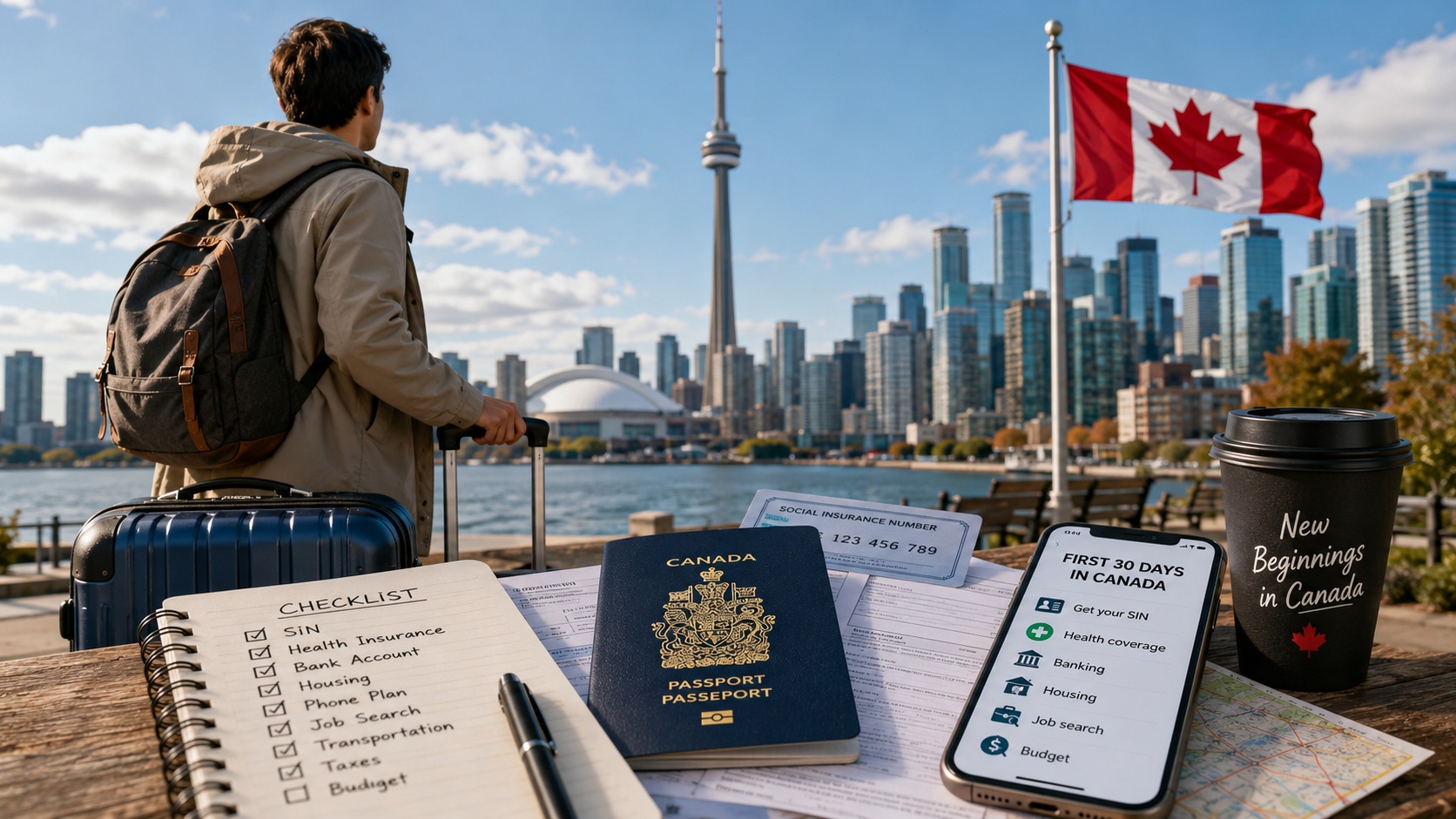
Our First 30 Days in Canada: Newcomer Checklist puts these early settlement tasks into a broader order.
Proof of address for banking
Banking deserves special attention because newcomers often believe a utility bill is always mandatory.
Canada's federal rules give banks specific methods for verifying identity.
Under one method, a person can present two reliable-source documents, with one showing name and address and another showing name and date of birth.
The official list includes qualifying government identification, recent tax assessments, certain benefit statements and recent Canadian public utility bills, among other permitted documents.
There are additional verification methods under the rules, so contact the bank if your documents do not fit the first method.
Proof of address for provincial ID
Requirements differ substantially by province.
Alberta provides a clear example. For a first driver's licence or Alberta ID card, a registry agent needs to be satisfied about your identity, Alberta residence and legal entitlement to remain in Canada.
Examples of Alberta residence evidence include:
- utility bills;
- bank or credit card statements;
- residential lease agreement;
- mortgage document or land title; and
- signed and dated written confirmation of Alberta employment.
Those documents must meet Alberta's specific requirements.
Do not copy this list and assume Ontario, British Columbia, Quebec or another jurisdiction follows the same rules.
Proof of address for health coverage
Provincial health systems also establish their own residency requirements.
Ontario, for example, requires a document proving that you live in Ontario when applying for an Ontario health card.
The province's current list includes options such as an Ontario driver's licence, Ontario Photo Card and qualifying utility bills, along with additional accepted documents.
This demonstrates why a newcomer should always use the program-specific list instead of a generic internet list.
Proof of address is not the same as proof of legal status
This distinction is extremely important.
| Requirement | What it generally establishes |
|---|---|
| Proof of identity | Who you are |
| Proof of address/residence | Where you live |
| Immigration/legal-status document | Your status or authorization in Canada |
| SIN | Your number for employment, tax and certain government purposes |
One document may sometimes help establish more than one requirement, but never assume that it does.
Proof of address checklist for newcomers
| Step | What to check |
|---|---|
| 1 | Identify exactly why proof of address is being requested. |
| 2 | Read the official acceptable-document list for that transaction. |
| 3 | Check whether the document must show your full legal name. |
| 4 | Confirm that it shows your current residential address. |
| 5 | Check how recent the document must be. |
| 6 | Confirm whether electronic statements are accepted. |
| 7 | Check whether originals are required. |
| 8 | Bring separate identity or immigration documents if required. |
| 9 | Ask about alternatives if you recently arrived and lack traditional documents. |
| 10 | Never provide false address information or altered documentation. |
Common mistakes newcomers should avoid
- Assuming Canada has one universal proof-of-address document.
- Using a list from another province without checking local requirements.
- Assuming a passport proves your current Canadian address.
- Assuming a SIN is general identification or proof of address.
- Submitting a bill that is in someone else's name without checking whether it is acceptable.
- Using an outdated statement when the program requires a recent document.
- Confusing a mailing address with a residential address.
- Assuming a PO box proves where you physically live.
- Using Airbnb or hotel documentation without confirming that temporary accommodation qualifies.
- Changing or editing a document yourself to make the address match.
- Relying on unofficial online lists instead of the organization requesting the proof.
What if none of your documents are accepted?
Contact the organization requesting the proof before making repeated applications.
Explain that you recently arrived in Canada and ask what alternative verification procedures are available.
Some programs have additional options that may not be obvious from a simple list of common documents.
For example, Alberta tells people who cannot present enough identification for an ID card that a registry agent can assist them and may use additional verification procedures.
Never purchase fake documents, modify statements or claim to live somewhere you do not.
How proof of address becomes easier over time
The first few weeks can be the most difficult because your Canadian paper trail is still small.
Over time, you may accumulate:
- a lease;
- bank statements;
- credit card statements;
- utility accounts;
- provincial identification;
- insurance documents;
- employment records;
- tax documents; and
- government correspondence.
That makes future identity and residency verification much easier.
This is one reason newcomers benefit from keeping important Canadian documents organized from the beginning.
Bottom line
Getting proof of address in Canada as a newcomer is not about obtaining one special national certificate.
Instead, you need documentation that satisfies the specific organization or government program asking you to prove where you live.
Utility bills, bank or credit card statements, residential leases, government documents and provincial identification can all be useful in certain situations, but none should be treated as universally accepted.
If you have just arrived and do not yet have traditional proof of address, check the official rules for the service you need. Alternative identification or verification procedures may be available.
As you establish a bank account, housing, local identification and other legitimate Canadian records, proving your address generally becomes much easier.
Important: Proof-of-address requirements vary by institution, province, territory and type of service and may change. This article provides general information based on official Canadian guidance available in 2026. Always check the current requirements of the organization requesting your proof of address before submitting documents.
Official Sources & Further Reading
- Financial Consumer Agency of Canada — Opening a Bank Account
- Government of Alberta — ID Requirements for Licences and Identification Cards
- Government of Alberta — Get a Government ID Card
- Government of Ontario — Documents Needed to Get a Health Card
- Government of Ontario — Acceptable Identity Documents
- Government of Ontario — 2026 Acceptable Documents for Voter Identification