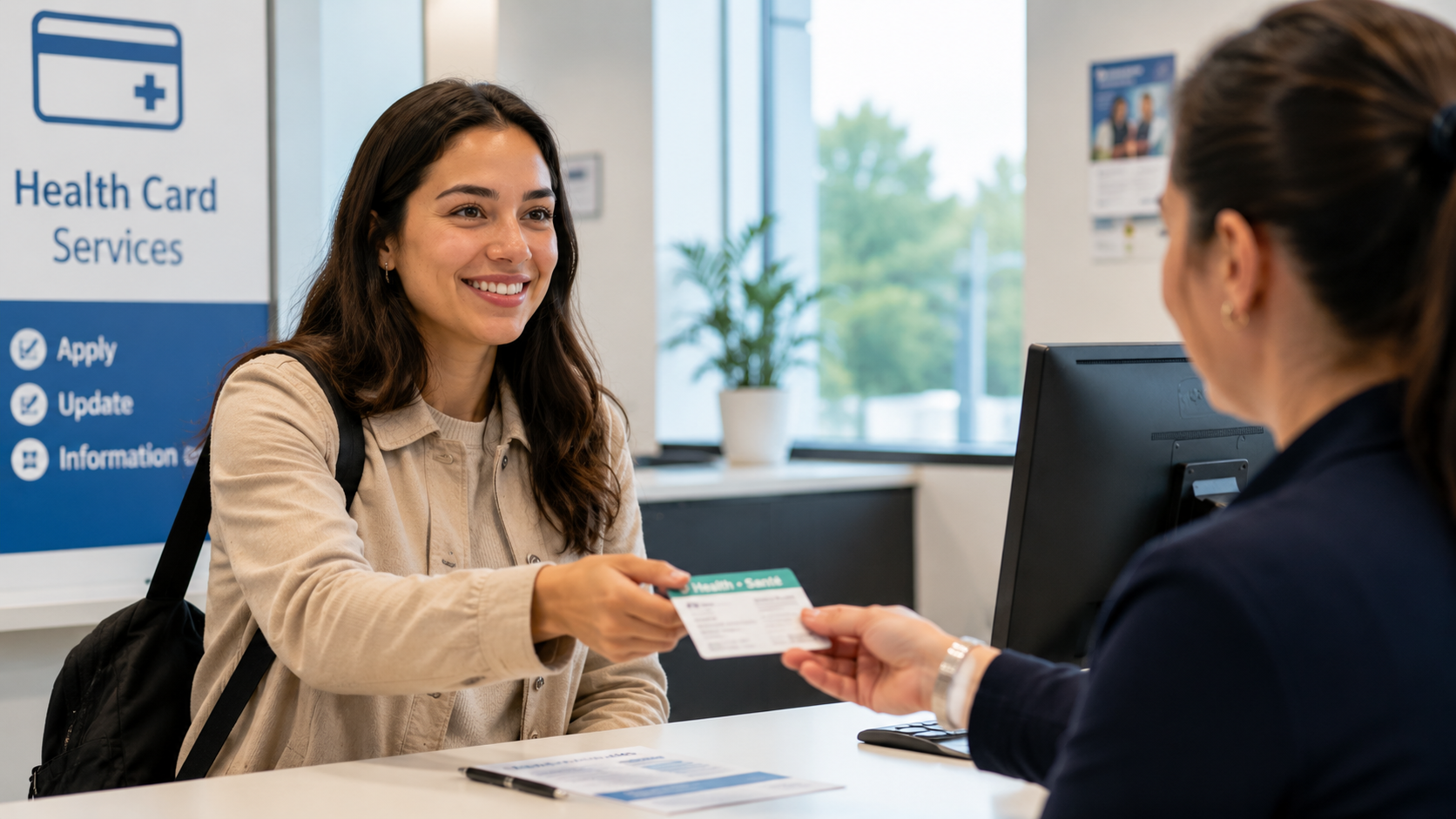
Getting a health card should be near the top of your newcomer checklist after arriving in Canada. A provincial or territorial health card proves that you are registered for the public health insurance plan where you live and allows you to access eligible publicly funded health services.
But there is an important distinction newcomers need to understand: Canada does not issue one national health card. Each province and territory operates its own health insurance plan, sets its own eligibility rules and determines how residents apply.
Your immigration status, the province or territory where you live and the documents you hold can all affect your eligibility. This guide explains how Canada's health cards work, what newcomers should prepare and what to do if public coverage does not begin immediately.
What is a health card in Canada?
A health card is proof that you are registered with the public health insurance plan of your province or territory.
Canada's health care system is publicly funded through taxes, but the plans themselves are administered by provincial and territorial governments rather than through one federal insurance program.
Eligible residents register with the plan where they live and receive a health card. You generally present that card when accessing insured services from hospitals, doctors and other participating health care providers.
Is there one Canadian health card?
No. This is one of the most common points of confusion for newcomers.
There are 13 provincial and territorial health insurance systems. The name of the program and health card depends on where you live.
| Province or territory | Public health insurance program or authority |
|---|---|
| Alberta | Alberta Health Care Insurance Plan (AHCIP) |
| British Columbia | Medical Services Plan (MSP) |
| Manitoba | Manitoba Health |
| New Brunswick | New Brunswick Medicare |
| Newfoundland and Labrador | Medical Care Plan (MCP) |
| Northwest Territories | NWT Health Care Plan |
| Nova Scotia | Medical Services Insurance (MSI) |
| Nunavut | Nunavut Health Care Plan |
| Ontario | Ontario Health Insurance Plan (OHIP) |
| Prince Edward Island | PEI Health Card |
| Quebec | Québec Health Insurance Plan administered by RAMQ |
| Saskatchewan | Saskatchewan Health Card |
| Yukon | Yukon Health Care Insurance Plan |
The table is a starting point, not a substitute for checking the rules of your province or territory. Eligibility and application procedures can change.
Who can get public health insurance in Canada?
Under Canada's health care framework, eligible residents of a province or territory can apply for publicly funded health coverage.
Canadian citizens and permanent residents can generally apply when they meet the residency requirements of the jurisdiction where they live.
Some temporary residents may also qualify, but eligibility varies considerably by province or territory and by immigration status.
For example, certain work permit holders, international students and their eligible family members may qualify under provincial or territorial rules, while others may need private insurance.
Do not assume that holding a Canadian visa, study permit or work permit automatically makes you eligible for every provincial health plan. Check the official rules for the province or territory where you actually live.
When should newcomers apply for a health card?
Apply as soon as you are eligible after establishing residence in your province or territory.
Immigration, Refugees and Citizenship Canada advises newcomers to apply for government health insurance through their provincial or territorial health authority as soon as possible after arriving.
Applying early is particularly important if your jurisdiction has a delay before coverage begins or if additional documents are required.
If you are organizing your first administrative tasks after arrival, health coverage belongs alongside essentials such as obtaining your Social Insurance Number. Our guide to getting a SIN in Canada explains that process separately.
What documents do you need for a health card?
There is no single nationwide document list because each province and territory sets its own registration requirements.
Depending on where you live and your immigration status, you may be asked for documents that establish:
- your identity;
- your legal status or authorization to be in Canada;
- your residence in the province or territory; and
- other eligibility information required by the local health plan.
Examples can include a Canadian passport, Permanent Resident Card, Confirmation of Permanent Residence, qualifying immigration permit, provincial identification or documents showing your residential address.
These are examples only. Do not rely on a generic checklist when attending an appointment. Use the official provincial or territorial website to determine exactly which documents apply to you.
Ontario: how OHIP works for newcomers
Ontario's public health insurance program is the Ontario Health Insurance Plan, commonly known as OHIP.
Ontario currently states that there is no waiting period for OHIP. Eligible applicants can apply for coverage as soon as they arrive in Ontario.
Applications are made in person at a ServiceOntario centre.
Ontario generally requires three separate qualifying documents:
- one proving Canadian citizenship or OHIP-eligible immigration status;
- one proving Ontario residency; and
- one proving identity.
Eligibility rules still apply, so arriving in Ontario does not automatically mean every visitor or temporary resident qualifies for OHIP.
British Columbia: understanding MSP
British Columbia's provincial health insurance program is the Medical Services Plan, usually called MSP.
New residents should apply promptly after establishing residence in British Columbia rather than waiting until they need medical care.
Eligibility depends on residency and immigration circumstances, and applicants should use Health Insurance BC's current instructions to determine which documents are required and when coverage starts.
Because provincial policies can change, verify the current MSP coverage-start rules directly with British Columbia before relying on older articles or forum posts.
What about Alberta?
Alberta residents use the Alberta Health Care Insurance Plan, or AHCIP.
New residents who meet Alberta's eligibility requirements should register for AHCIP and provide the documents required to establish identity, legal entitlement to be in Canada and Alberta residency.
As with every jurisdiction, temporary residents should check their specific eligibility rather than assuming that the rules for permanent residents apply to them.
Quebec has its own health insurance system
Quebec's public health insurance is administered by the Régie de l'assurance maladie du Québec, commonly known as RAMQ.
Eligibility and registration depend on your situation, and some people settling in Quebec may face a waiting period before coverage begins.
Because Quebec's rules can differ from those of other provinces, newcomers should register with RAMQ promptly and confirm whether temporary insurance is appropriate while waiting.
Do all provinces have a three-month waiting period?
No.
You may encounter older newcomer guides stating that everyone must wait three months for Canadian health insurance. That is not an accurate nationwide rule.
The federal government warns that some provincial or territorial programs may not cover certain newcomers immediately and that a waiting period can be as long as three months in some circumstances.
Other jurisdictions may provide eligible residents with coverage without that waiting period. Ontario, for example, currently states that OHIP has no waiting period for eligible applicants.
The safest approach is to check the official health authority for your destination rather than assuming a national waiting period.
Should you buy private health insurance while waiting?
If you are not yet covered by a provincial or territorial health plan, private health insurance can protect you against potentially significant medical expenses.
IRCC recommends preparing for a possible waiting period and advises newcomers to consider private health insurance when public coverage does not begin immediately.
Before purchasing a policy, check:
- emergency medical coverage;
- hospital coverage;
- doctor visits;
- prescription medication coverage;
- deductibles;
- coverage limits;
- pre-existing-condition exclusions;
- the policy's effective date; and
- how claims are submitted.
Private insurance policies vary significantly. Read the policy wording rather than choosing only by price.
How much does a provincial health card cost?
Canada's publicly funded health system is financed primarily through taxation rather than by charging patients at the point of care for insured medically necessary hospital and physician services.
However, having a health card does not mean every health-related expense in Canada is free.
Depending on your province, age, income, employment benefits and circumstances, you may still have expenses for services or products that are outside the core public plan.
This distinction is important when planning your Canadian budget. Our guide on how much money you need to live in Canada covers broader newcomer living expenses.
What does public health insurance generally cover?
Under the Canada Health Act framework, provincial and territorial plans insure medically necessary hospital and physician services and certain surgical-dental services provided in hospitals.
The provinces and territories determine which services meet their coverage rules.
For an eligible resident, core insured care commonly includes medically necessary services such as:
- physician services;
- hospital care; and
- certain diagnostic and surgical services when covered under the provincial or territorial plan.
Exact coverage should always be checked with your local health plan.
What may not be fully covered by your health card?
Newcomers sometimes assume that Canada's public system pays for every medical expense. It does not.
Depending on your jurisdiction and eligibility for supplementary programs, expenses that may not be universally covered include:
- routine dental care;
- routine vision care;
- many outpatient prescription drugs;
- ambulance services;
- physiotherapy and other paramedical services;
- private hospital rooms; and
- some medical devices and supplies.
Employer benefit plans or personal health insurance may cover some services that the provincial plan does not.
Do newcomers need separate dental insurance?
A provincial health card should not be assumed to provide comprehensive routine dental coverage.
Dental coverage in Canada can come from several sources, including employer benefits, private insurance and government programs for eligible individuals.
Check your eligibility before paying for additional insurance, particularly because public dental programs have changed substantially in recent years.
Can temporary foreign workers get provincial health insurance?
Temporary foreign workers may qualify for provincial or territorial coverage depending on where they live, the duration and conditions of their work authorization and other local eligibility rules.
The federal government states that temporary foreign workers will have access to health care under the applicable provincial or territorial system when eligible, but there can be a period after arrival before that coverage is active.
In certain Temporary Foreign Worker Program situations, employers have obligations concerning private emergency health insurance during a period when the worker is not yet covered by the provincial or territorial system.
Workers should verify their own status and coverage rather than assuming an employer's insurance replaces provincial registration.
Can international students get a health card?
There is no Canada-wide answer.
Health coverage for international students varies by province and territory. Depending on the jurisdiction and institution, a student may qualify for the public plan, may need a university or college health plan, or may need other private coverage.
Check both the provincial health authority and your educational institution before arriving.
What about spouses and children?
Each eligible family member generally needs to be registered appropriately for provincial or territorial coverage.
Do not assume that one person's health card automatically covers an entire household.
Document requirements and eligibility for spouses and dependants can differ based on immigration status and the jurisdiction's rules.
If your family has recently arrived, prepare the immigration and identity documents for each person and check whether separate applications are required.
What health coverage is available to eligible refugees?
Some refugees, refugee claimants and other eligible groups may receive temporary health coverage through the federal Interim Federal Health Program (IFHP).
The IFHP provides limited and temporary health-care coverage for eligible beneficiaries, including during certain periods before they transition to provincial or territorial insurance.
IFHP eligibility and benefits are separate from ordinary provincial health-card eligibility and can change.
People in these circumstances should use IRCC's current IFHP information rather than assuming that general newcomer rules apply to them.
What happens if you need emergency care before getting your health card?
Do not delay urgent medical attention because you are waiting for a health card.
However, whether you will personally be charged for care can depend on your eligibility, location, coverage status and circumstances.
If your provincial coverage has not started, medical costs can be substantial. This is one reason newcomers should establish exactly when their coverage begins and consider appropriate temporary insurance when necessary.
For a medical emergency in Canada, call 911 or seek emergency medical care.
Can you use your health card in another province?
Provincial and territorial plans have portability arrangements for insured medically necessary services, but coverage outside your home province is not identical to being at home.
Some services, such as ambulance costs, prescription drugs or non-emergency care, may not be covered in the same way.
If you are travelling, particularly for an extended period, check your provincial plan and consider whether additional insurance is appropriate.
What happens when you move to another province?
Your health coverage does not simply transfer permanently without action.
If you move from one province or territory to another, notify your existing health insurance plan and register with the plan in your new jurisdiction.
Federal guidance explains that portability rules help maintain insured coverage during the transition, subject to the applicable requirements.
Register promptly after moving instead of waiting until you need medical care.
If you are still deciding where to settle, our guide to the cheapest places to live in Canada can help you compare broader living-cost considerations.
Does a health card help you find a family doctor?
A health card establishes your registration for eligible public coverage, but it does not automatically assign you a family doctor.
How residents find primary care varies across Canada. Provinces may offer registries or other services for people looking for a family doctor or nurse practitioner.
Depending on availability, newcomers may also use walk-in clinics, community health centres or other primary-care services while searching for a regular provider.
Protect your health card and personal information
Your health card contains important personal information and should be protected.
Do not lend your card to another person or use someone else's card.
If your card is lost, stolen, damaged or contains incorrect information, contact the appropriate provincial or territorial authority.
Also be cautious about unsolicited messages asking you to provide health-card information or pay unexpected fees through unfamiliar links.
Newcomer health card checklist
| Step | What to do |
|---|---|
| 1 | Identify the public health insurance plan for your province or territory. |
| 2 | Check eligibility based on your immigration status and residency. |
| 3 | Gather the exact identity, immigration and residency documents required. |
| 4 | Apply as soon as you are eligible. |
| 5 | Confirm the exact date your public coverage begins. |
| 6 | Consider appropriate private coverage if there is a gap. |
| 7 | Learn which services your provincial plan does and does not cover. |
| 8 | Register eligible family members as required. |
| 9 | Protect your health card and update your information when necessary. |
Other important first steps after arriving in Canada
Your health card is only one part of establishing yourself in Canada.
Newcomers commonly need to organize employment documentation, banking, housing and a realistic monthly budget during the same period.
For banking, our newcomer guide to the documents needed to open a Canadian bank account explains the identification process.
If employment is your priority, see How to Get a Job in Canada as a Newcomer in 2026.
And before committing to a city or lease, compare housing and everyday expenses carefully. Our 2026 Canadian grocery cost guide provides another piece of that monthly budget.
Common health card mistakes newcomers should avoid
- Assuming Canada has one national health card.
- Waiting until you become sick before applying.
- Assuming every immigration status qualifies under the same rules.
- Using another province's eligibility requirements as if they apply everywhere.
- Believing every newcomer must wait exactly three months.
- Assuming the health card covers dental, prescriptions, vision and ambulance services automatically.
- Failing to arrange coverage during a waiting period when necessary.
- Forgetting to register after moving to another province or territory.
- Relying on outdated forum posts instead of the official provincial health authority.
Bottom line
There is no single process for getting a health card in Canada. Public health insurance is administered by the provinces and territories, and each jurisdiction determines who qualifies, which documents are required and when coverage begins.
For newcomers, the best approach is simple: identify the plan where you live, check your eligibility on the official government website, gather the required documents and apply as soon as you are eligible.
Do not assume that rules from another province apply to you, and do not assume that every newcomer faces the same waiting period.
If there will be a gap before your public coverage begins, investigate appropriate temporary health insurance so an unexpected illness or injury does not create a major financial burden.
Important: Provincial and territorial health insurance eligibility, waiting periods, document requirements and covered services can change. This article provides general information based on official Canadian guidance available in 2026. Always verify your current eligibility and application requirements directly with the health authority in your province or territory.
Official Sources & Further Reading
- Health Canada — About Health Insurance Cards
- Immigration, Refugees and Citizenship Canada — Access Canada's Universal Health Care System
- Health Canada — How Publicly Funded Health Care Coverage Works
- Government of Ontario — Apply for OHIP and Get a Health Card
- Government of British Columbia — MSP Eligibility and Enrolment
- Government of Alberta — Alberta Health Care Insurance Plan
- RAMQ — Register for Health Insurance in Québec
- IRCC — Interim Federal Health Program