If you do not drive in Canada, you may still want a government-issued photo ID for everyday situations such as opening accounts, verifying your identity or accessing services.
The important thing for newcomers to understand is that there is no single national “Canadian photo ID card” issued to every non-driver. Identification cards of this type are generally administered by provincial or territorial governments, and the name, eligibility requirements, documents and fees depend on where you live.
For example, Ontario offers the Ontario Photo Card to eligible residents who do not have a driver’s licence, while Alberta offers a provincial identification card for eligible non-drivers.
This guide explains how government photo identification for non-drivers works in Canada in 2026, what newcomers should prepare and why you should always check the requirements for your province or territory before applying.
Can you get government photo ID in Canada without a driver's licence?
Yes, depending on where you live and whether you meet the eligibility requirements of your province or territory.
A driver's licence is one of the most commonly used forms of government-issued photo identification in Canada, but not everyone drives.
Provincial identification cards can provide an alternative for eligible non-drivers.
These cards are for identification. They do not give you permission to drive.
If you intend to drive instead, read our guide to getting a driver's licence in Canada as a newcomer.
Is there a national Canadian photo ID card?
No. You should not search for a single federal “Canadian ID card” expecting one standard application for the entire country.
Canada has several forms of federal identification and immigration documentation, but the non-driver photo identification discussed in this guide is generally issued through provincial or territorial systems.
That means someone living in Ontario may follow a different application process from someone living in Alberta or another province.
Why might a newcomer need photo identification?
Government-issued photo identification can make everyday identity verification easier after arriving in Canada.
Depending on the organization and transaction, identification may be requested when:
- opening or managing financial accounts;
- accessing certain government or private services;
- picking up certain packages or documents;
- verifying your age or identity;
- completing financial transactions;
- signing up for certain services; or
- handling other situations that require acceptable identification.
However, each organization decides which forms of identification it accepts within applicable laws and regulations. A provincial photo card should not be assumed to satisfy every possible identification requirement.
Photo ID is not the same as a SIN or health card
Newcomers often receive or apply for several Canadian documents during their first weeks or months, but those documents have different purposes.
| Document | Main purpose |
|---|---|
| Provincial photo ID card | Government-issued identification for eligible residents, particularly non-drivers |
| Driver's licence | Authorizes eligible holders to drive and also functions as photo identification |
| Health card | Shows eligibility or registration for provincial or territorial public health coverage |
| Social Insurance Number | Used for employment, taxes and certain government programs and benefits |
You should not use these documents interchangeably simply because several of them contain personal information.
If you still need your SIN, see our How to Get a SIN in Canada in 2026 guide.
Ontario Photo Card: how it works
Ontario has one of the clearest examples of a non-driver identification program.
The Ontario Photo Card is a wallet-sized government-issued identification card for Ontario residents who do not have a driver's licence.
The Government of Ontario says the card can make it easier to complete day-to-day transactions and activities requiring official identification.
It can also be used as proof of identity for travel within Canada, although it is not a document for international travel.
Who can apply for an Ontario Photo Card?
According to the Government of Ontario, you can apply if you:
- do not have a driver's licence;
- are an Ontario resident rather than a visitor; and
- are at least 16 years old.
An original application is completed in person at a ServiceOntario centre.
Can you have an Ontario Photo Card and a driver's licence?
No.
Ontario specifically states that you cannot simultaneously hold an Ontario Photo Card and a driver's licence or photo ID card from Ontario or another province, state or country.
If you currently have a driver's licence and apply for an Ontario Photo Card, you must surrender the licence and it will be cancelled.
This is particularly important for newcomers who arrive with a valid foreign driver's licence.
Do not surrender a foreign licence merely because you want Canadian photo identification without first understanding how that decision could affect your ability to drive and potentially exchange your licence later.
What documents do you need for an Ontario Photo Card?
Ontario requires original identity documents proving your legal name and date of birth.
The province's acceptable-document list includes several possibilities. A valid foreign passport, for example, can satisfy the legal-name and date-of-birth requirements listed by Ontario.
Documents generally need to be original and valid. If an accepted document is not in English or French, Ontario requires the original document together with an acceptable certified translation.
The exact combination you need depends on your documentation, so check Ontario's current acceptable identity document list before visiting ServiceOntario.
How much does an Ontario Photo Card cost in 2026?
As of the current 2026 Government of Ontario guidance, the fee to obtain or renew an Ontario Photo Card is $35.
The card is valid for five years.
Ontario currently states that a new card generally arrives by mail within approximately four to six weeks.
Government fees and processing times can change, so verify these details on Ontario's official page before applying.
Ontario introduced an important legal-presence rule
Ontario's Photo Card Act was amended in late 2025 to allow the government to require evidence that an applicant is an Ontario resident and that the applicant's presence in Canada complies with Canadian legal-presence requirements.
This is another reason newcomers should rely on current provincial information rather than older forum posts or articles written before the change.
What about Alberta?
Alberta provides an identification card for residents who do not have a valid driver's licence.
The Alberta government states that an eligible applicant must be an Alberta resident, be legally entitled to live in Canada and not hold a valid driver's licence.
The Alberta identification card is for identification purposes only. It does not authorize the holder to operate a motor vehicle.
Who can get an Alberta ID card?
Alberta currently allows eligible residents from age 12 to hold an identification card.
Applicants younger than 18 need a parent or guardian to accompany them and provide consent.
Alberta also states that students from another jurisdiction attending an accredited school in Alberta may be able to apply.
Eligibility rules should always be checked directly with Alberta before applying.
What documents does Alberta require?
For a first Alberta ID card, a registry agent needs documentation establishing:
- who you are;
- that you are an Alberta resident; and
- that you are lawfully entitled to be or remain in Canada.
Alberta gives examples of residence evidence such as a utility bill, bank statement or credit card statement.
Examples of original photo documents that may help prove identity include a government-issued ID, valid passport or permanent resident card.
Documentation must meet Alberta's current requirements. Documents that are not in English need an approved translation under the province's rules.
Alberta ID cards changed in 2026
Newcomers in Alberta should be aware of a recent change.
Starting July 2, 2026, Alberta introduced a modernized design for driver's licences and identification cards with updated security features and additional information.
The province also introduced a Canadian citizenship marker on applicable cards.
This is another example of why identification articles can become outdated quickly and why official provincial pages should be checked at the time of application.
What about British Columbia?
British Columbia uses its own identification and services system, and newcomers should check ICBC and the Government of British Columbia for the identification options that apply to them.
Do not assume the Ontario Photo Card or Alberta ID rules apply in B.C.
Eligibility can depend on residency, immigration status, age and the specific identification product being requested.
What about Quebec?
Quebec also has its own government identification and driver's licensing framework.
Newcomers living in Quebec should check the appropriate provincial authority for the identification options available to non-drivers and the documents accepted for their particular transaction.
Do not assume that another province's photo-card program has an identical Quebec equivalent.
What about the other provinces and territories?
Identification programs are not standardized nationally.
If you live in Manitoba, Saskatchewan, New Brunswick, Nova Scotia, Prince Edward Island, Newfoundland and Labrador, Yukon, Northwest Territories or Nunavut, check your provincial or territorial government or official licensing/identification authority.
Look specifically for terms such as:
- identification card;
- photo identification;
- photo ID card;
- non-driver identification; or
- provincial identification card.
Do not use a fee, minimum age or document list from another province as if it were a Canada-wide requirement.
Can newcomers use a foreign passport as identification?
A valid foreign passport is an important identity document for many newcomers and may be accepted for various Canadian transactions.
Ontario, for example, includes a foreign passport on its acceptable identity-document list for an Ontario Photo Card.
But acceptance depends on the transaction and organization involved.
A passport also does not automatically replace proof of Canadian or provincial residency when separate proof of address or legal status is required.
What can you use as proof of address?
Proof-of-residency requirements vary by province and transaction.
Possible documents may include, where accepted:
- utility bills;
- bank statements;
- credit card statements;
- lease or rental documents;
- government correspondence; or
- other documents listed by the provincial authority.
Do not assume every item on this list is accepted everywhere.
For example, Alberta specifically lists utility bills, bank statements and credit card statements as examples that can be used to establish Alberta residence for its identification card.
Why newcomers can have difficulty proving their address
Someone who has just arrived in Canada may initially have very few documents showing a Canadian address.
You might be staying temporarily with family, in a hotel or short-term accommodation while looking for a permanent rental.
This can make some identification processes more complicated.
As you establish yourself, documents such as a lease, bank statement and utility account can become useful evidence for transactions that require proof of residence.
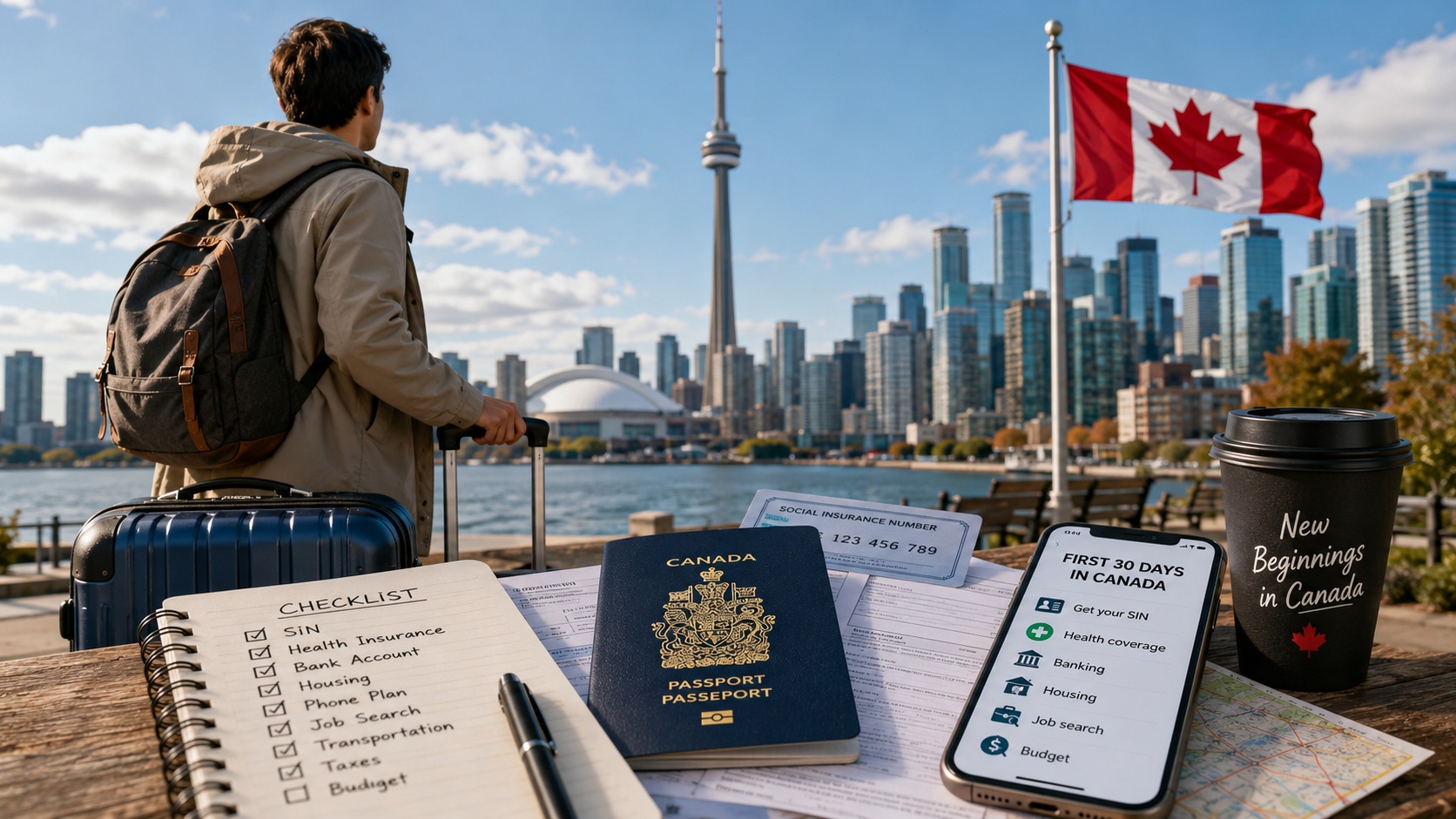
Our First 30 Days in Canada Newcomer Checklist explains how several of these early settlement tasks fit together.
Can opening a Canadian bank account help establish documents?
A Canadian bank account can become part of your financial setup and may produce statements showing your Canadian address.
Whether a bank statement is accepted as proof of residence depends on the specific government program or transaction.
If you are still setting up your finances, our guide to the documents needed to open a bank account in Canada explains that process separately.
Is a health card the same as a general photo ID?
No.
A health card exists primarily to demonstrate eligibility or registration for provincial or territorial health coverage.
Rules governing whether and how health cards can be requested or used as identification vary.
Ontario, for example, specifically tells residents that the Ontario health card is for accessing insured health-care services and should not simply be treated as a replacement for every general identification purpose.
If you still need to apply for health coverage, read our guide to getting a health card in Canada as a newcomer.
Is a provincial photo ID proof of immigration status?
Do not treat a provincial identification card as a replacement for your immigration documents.
A provincial card may establish identity for many purposes, but immigration status and authorization to remain in Canada are documented through the appropriate federal immigration documents.
Keep your immigration documents secure even after receiving provincial identification.
Can you use provincial photo ID for international travel?
Do not rely on it for international travel.
Ontario explicitly states that its Photo Card cannot be used for international travel.
International travel documentation depends on factors including citizenship, destination and immigration status. A passport is generally the key travel document, together with any visa, permit or other documentation required for the trip.
Can an Ontario Photo Card be used for travel within Canada?
Ontario states that its Photo Card can be used as proof of identity for travel within Canada.
However, transportation companies and security authorities can have specific identification requirements.
Always check the current acceptable-ID rules for your airline, rail company or other transportation provider before travelling.
Can you open a bank account with provincial photo ID?
Government-issued photo identification can be useful for financial transactions, and Ontario specifically mentions opening a bank account as an example of an activity for which its Photo Card can make identification easier.
However, federally regulated banks have specific identification rules and may require particular documents or combinations of documents.
Do not assume that one provincial photo card is the only document you will ever need for banking.
If banking is your immediate goal, check the institution's requirements and our Best Bank Accounts for Newcomers in Canada guide.
Can a photo ID help when getting a cell phone plan?
Identification is commonly required when opening telecommunications accounts, particularly where identity or credit verification is involved.
The exact documents accepted depend on the provider and type of service.
If you have just arrived and need a Canadian number, our guide to cell phone plans in Canada for newcomers explains prepaid and postpaid service, credit checks and common documentation issues.
What if your documents are not in English or French?
Translation requirements vary by province.
Ontario requires accepted documents for its Photo Card to be in English or French. When they are not, the province requires the originals along with a certified translation that meets Ontario's rules.
Alberta requires documents to be in English or accompanied by a written translation from an approved translator.
Do not pay for a translation before checking which translators and formats your province accepts.
What if your name is different on different documents?
Name differences can cause delays during identification applications.
This may happen after marriage, divorce, adoption or a legal name change.
Provincial authorities may require documentation connecting your previous and current legal names.
Ontario, for example, lists government-issued marriage documents and change-of-name certificates among documents that can support certain name changes.
Bring original or otherwise officially accepted documents rather than assuming a photocopy will be sufficient.
Should you carry your passport everywhere?
A passport is valuable and difficult to replace, particularly when you are outside your country of citizenship.
Once you have appropriate local identification, you may not need to use your passport for every routine transaction.
Whether another ID is sufficient depends on what you are doing, but having provincial identification can reduce the number of everyday situations in which you need to handle your passport.
Store important immigration and travel documents securely.
What if you later decide to get a driver's licence?
Check your province's rules before applying.
In Ontario, someone who holds an Ontario Photo Card and then applies for a driver's licence must surrender the Photo Card, which will be cancelled.
This prevents a person from simultaneously holding both documents under the Ontario system.
If driving is likely to become important for work or daily life, consider that before choosing which identification route makes the most sense.
What should newcomers prepare before applying?
Before visiting a provincial service location, check the official requirements and prepare the documents relevant to your situation.
Depending on your province, this may include:
- passport or another accepted identity document;
- immigration documents;
- proof of provincial residence;
- documents showing legal name and date of birth;
- name-change documentation where applicable;
- approved translations where required;
- your existing driver's licence or photo ID if the province requires it to be surrendered; and
- payment for the applicable fee.
This is a planning list, not a universal document list. Follow your province's current requirements.
Provincial photo ID checklist for newcomers
| Step | What to do |
|---|---|
| 1 | Confirm which non-driver identification product exists where you live. |
| 2 | Check residency, age and immigration or legal-presence requirements. |
| 3 | Review the official acceptable-document list. |
| 4 | Gather original identity and immigration documents where required. |
| 5 | Prepare acceptable proof of provincial residence if required. |
| 6 | Arrange an approved translation only if necessary. |
| 7 | Check whether an existing driver's licence or ID must be surrendered. |
| 8 | Confirm the current government fee. |
| 9 | Apply through the official provincial service channel. |
| 10 | Store your new ID and other important documents securely. |
Common mistakes newcomers should avoid
- Searching for one national Canadian photo ID application that does not exist.
- Assuming the rules are identical across provinces.
- Using outdated third-party document lists.
- Bringing photocopies when originals are required.
- Getting a translation that the provincial authority does not accept.
- Assuming a health card should be used as general ID everywhere.
- Assuming a provincial photo card replaces immigration documents.
- Trying to keep a driver's licence and a non-driver photo card when provincial rules prohibit it.
- Assuming provincial photo ID is sufficient for international travel.
- Failing to update an address or other required information after moving.
Driver's licence or photo ID: which should you choose?
If you do not drive and do not plan to drive, a provincial non-driver identification card may be a practical way to obtain government-issued photo identification where such a program is available to you.
If you expect to drive, getting the appropriate provincial driver's licence may make more sense because a driver's licence serves both as driving authorization and government-issued photo identification.
Newcomers holding a foreign licence should be especially careful. Some provinces require you to surrender another licence when obtaining a non-driver ID, which could affect your driving plans.
Bottom line
You do not necessarily need a Canadian driver's licence to have government-issued photo identification.
However, there is no single national non-driver photo card with one application process for everyone in Canada. Identification programs, eligibility rules, fees and accepted documents depend on your province or territory.
Ontario residents who do not drive may qualify for the Ontario Photo Card, while Alberta has its own identification card program. Other jurisdictions have their own systems and requirements.
For newcomers, the safest approach is to identify the official authority where you live, check the current eligibility rules and gather the required original documents before applying.
Important: Identification requirements, fees, accepted documents and provincial programs can change. This article provides general information based on official guidance available in 2026. Always verify the current requirements with your provincial or territorial government or official identification authority before applying.
Official Sources & Further Reading
- Government of Ontario — Ontario Photo Card
- Government of Ontario — Acceptable Identity Documents
- Ontario — Photo Card Act, 2008
- Government of Alberta — Get a Government ID Card
- Government of Alberta — ID Requirements for Identification Cards
- Government of Alberta — New Driver's Licence and Identification Cards