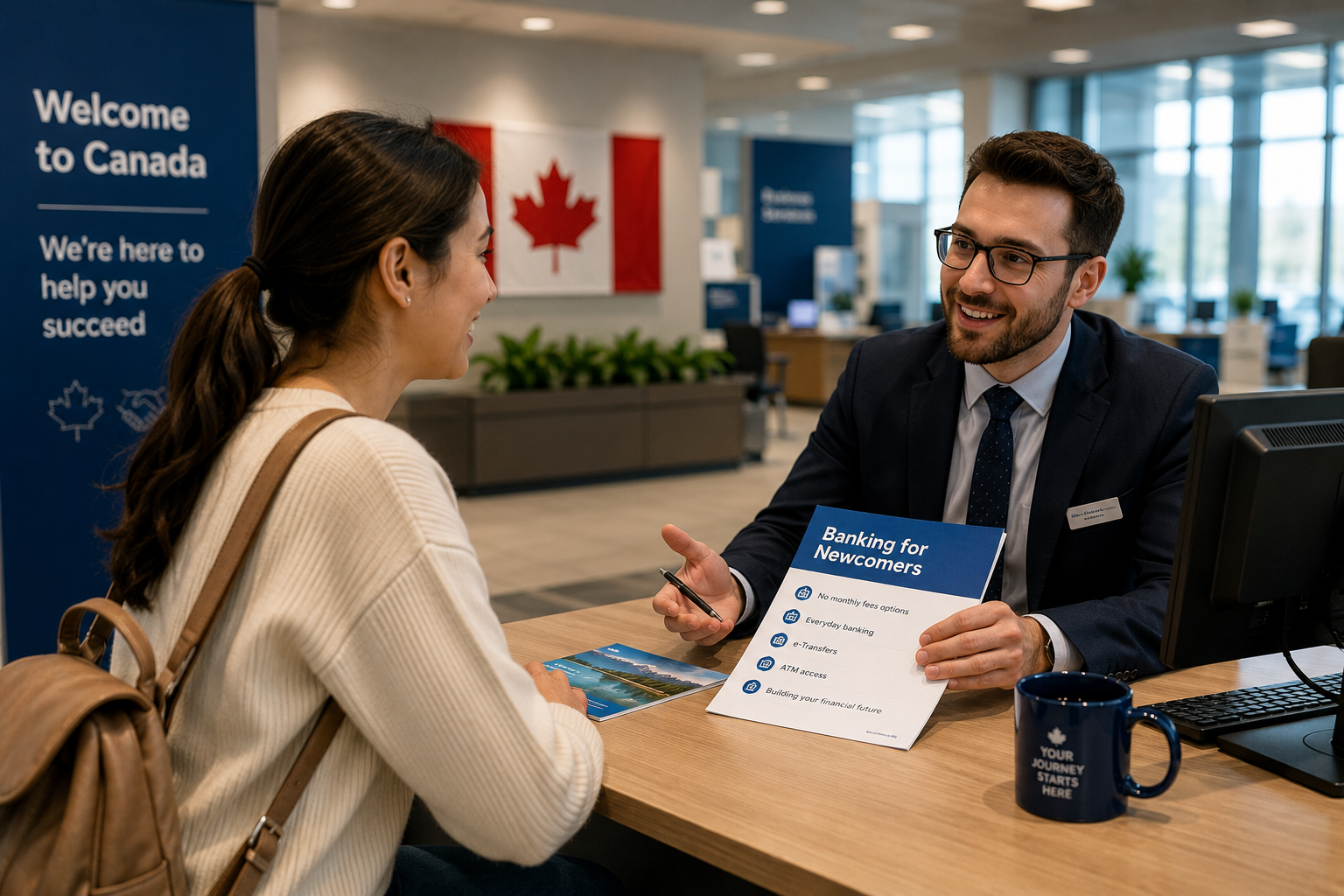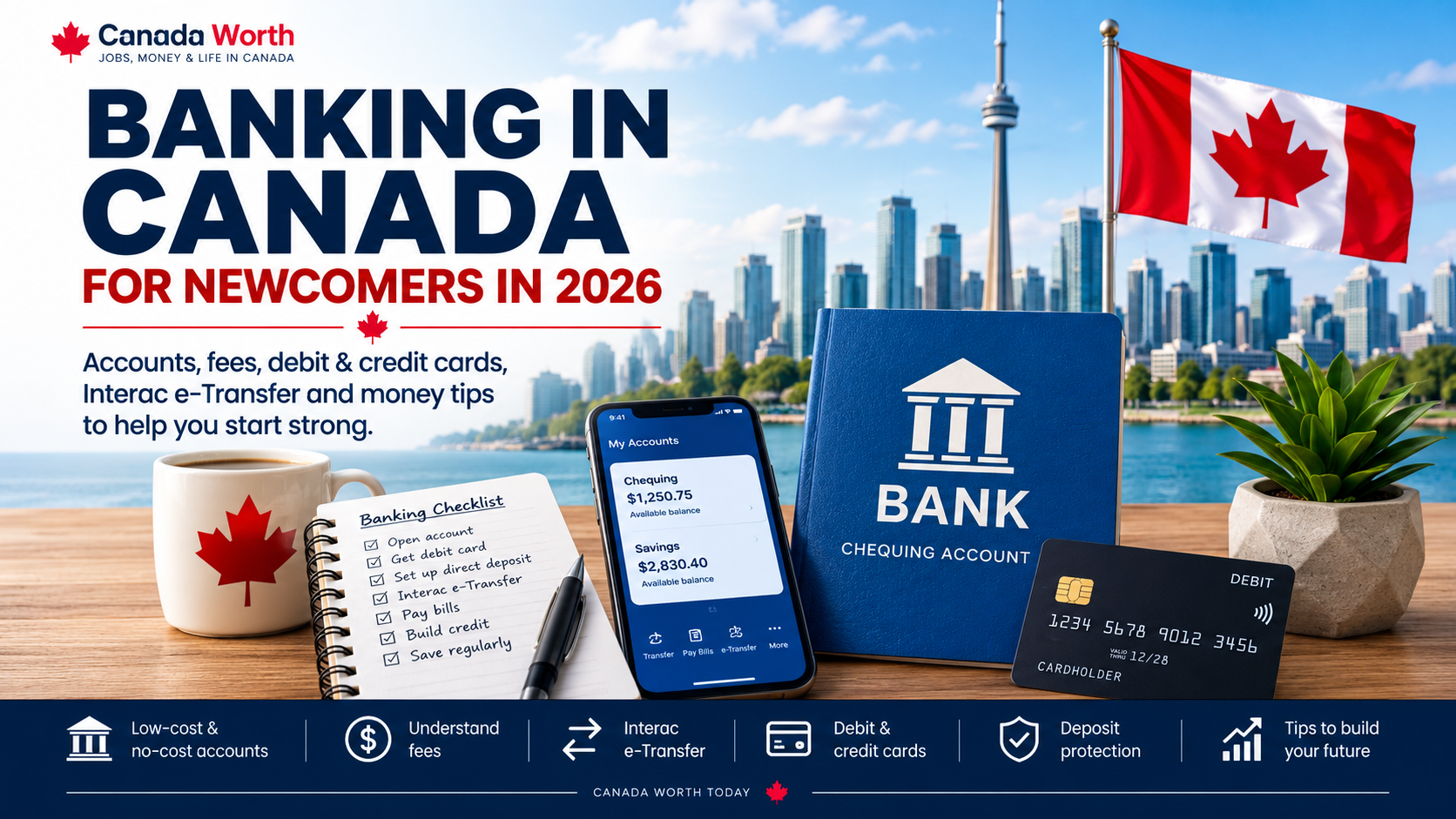
Opening a bank account is one of the first financial steps many newcomers take after arriving in Canada. You may need an account to receive your salary, pay rent and bills, send money, use a debit card and begin establishing your financial life in the country.
But Canadian banking can feel unfamiliar at first. Newcomers may encounter terms such as chequing account, Interac e-Transfer, direct deposit, transit number, institution number, credit score and deposit insurance — sometimes within their first few days in Canada.
The good news is that you do not need to understand everything at once. Once you know how the basic pieces fit together, everyday banking in Canada becomes much easier to manage.
This guide explains banking in Canada for newcomers in 2026, including how to open an account, what documents may be required, how chequing and savings accounts work, common banking fees, debit and credit cards, Interac e-Transfer, direct deposit, deposit protection and practical mistakes to avoid.
Banking in Canada for Newcomers: Quick Overview
| Banking Feature | What Newcomers Should Know |
|---|---|
| Chequing account | Usually used for everyday spending, bills and receiving income |
| Savings account | Designed primarily for saving money and may pay interest |
| Debit card | Generally spends money directly from your bank account |
| Credit card | Uses borrowed credit that must be repaid |
| Interac e-Transfer | Common way to send and receive money electronically in Canada |
| Direct deposit | Allows salary and certain other payments to enter your account electronically |
| Low-cost account | Qualifying accounts under the federal commitment cost no more than C$4 per month |
| No-cost account | Eligible newcomers may qualify during their first year in Canada |
| CDIC protection | Eligible deposits at member institutions may be insured within applicable limits and categories |
This is a general overview. Individual financial institutions may offer different products, fees, transaction limits and eligibility requirements.
Can a Newcomer Open a Bank Account in Canada?
Yes. The Financial Consumer Agency of Canada states that you may be able to open a Canadian bank account with proper identification even if you are not a Canadian citizen.
Canadian consumer protections also provide important rights regarding access to basic banking services.
You may be able to open a bank account even if you:
- do not have a job;
- do not have money to deposit immediately; or
- have previously been bankrupt.
The bank must still be able to verify your identity using acceptable identification.
Depending on the institution and your circumstances, you may be able to begin the process online, by telephone or in person. Some situations may require a branch visit.
What Documents Do You Need to Open a Bank Account?
Banks must verify the identity of customers opening accounts.
The exact documents you can use depend on the identification method and your circumstances. Government guidance allows several forms of reliable identification, including certain government-issued documents and foreign passports.
One method involves providing two documents from reliable sources:
- one showing your name and address; and
- another showing your name and date of birth.
There are other permitted identification methods as well.
Because newcomers may have different combinations of immigration and identity documents, check the current requirements of the institution before visiting a branch.
When original identification is required, photocopies are not a substitute.
Do You Need a SIN to Open a Bank Account?
Your Social Insurance Number, or SIN, is sensitive personal information and should be protected carefully.
A financial institution may need your SIN for accounts or investments that generate income, such as interest, because certain income must be reported for tax purposes.
However, you should not treat your SIN like a general-purpose identification number.
Ask why it is being requested and provide it only when legitimately required.
Chequing vs. Savings Accounts
Two account types newcomers will encounter frequently are chequing and savings accounts.
Chequing account
A chequing account is generally intended for everyday banking.
You might use it to:
- receive your salary;
- pay rent;
- pay utility and phone bills;
- make debit card purchases;
- withdraw cash;
- send Interac e-Transfers;
- set up automatic payments; and
- receive direct deposits.
Savings account
A savings account is generally intended for money you want to keep separate from everyday spending.
It may be useful for:
- an emergency fund;
- short-term savings;
- future purchases;
- travel;
- moving expenses; or
- other financial goals.
Savings accounts may pay interest, but rates and transaction rules vary by institution and product.
Which Account Should a Newcomer Open First?
For many newcomers, a chequing account is the most practical first account because it can handle everyday transactions and employment income.
A savings account can then be added when you want to separate money for emergencies or other goals.
That does not mean everyone needs multiple accounts immediately.
Start with what you actually need. Opening several accounts without understanding their fees and conditions can make your finances unnecessarily complicated.
Low-Cost and No-Cost Accounts in Canada
One of the most useful banking developments for newcomers is Canada's modernized Commitment on Low-Cost and No-Cost Accounts.
Under the framework implemented in December 2025, Canadians can access qualifying low-cost accounts costing no more than C$4 per month through participating institutions.
Eligible newcomers to Canada can qualify for a no-cost account during their first year in Canada, subject to the program's eligibility and documentation requirements.
For purposes of the commitment, newcomers include certain permanent residents, refugees and temporary residents, including eligible students and workers.
Low-cost and no-cost accounts must also provide a minimum package of everyday banking services.
This is particularly important because newcomers should not assume that a high monthly banking fee is unavoidable.
What Do Low-Cost and No-Cost Accounts Include?
The current federal framework requires qualifying low-cost and no-cost accounts to include a minimum number of debit transactions each month and other basic features.
The Financial Consumer Agency of Canada currently states that these accounts include at least 18 debit transactions per month.
However, individual institutions can offer more than the minimum.
Always check:
- how many transactions are included;
- which transaction types count toward the limit;
- whether Interac e-Transfers are included;
- ATM rules;
- fees for transactions beyond the allowance; and
- what happens when your newcomer eligibility period ends.
Newcomer Banking Offers: Look Beyond the Bonus
Canadian financial institutions frequently compete for new customers, and newcomers may see offers involving temporary fee waivers, credit cards, cash incentives or other benefits.
A promotion can be useful, but it should not be the only reason you choose an account.
Consider what happens after the promotional period.
Ask:
- What is the regular monthly fee?
- How many transactions are included?
- Is there a minimum balance requirement?
- Are there conditions attached to the promotional offer?
- How convenient are the ATMs and branches?
- Does the account fit how I actually use money?
A C$300 promotional benefit, for example, is less attractive if the account later costs more than an alternative that better fits your needs. This example is illustrative only and is not a reference to a particular current bank offer.
For a comparison-focused guide, see our article on bank accounts for newcomers to Canada.
Understanding Monthly Bank Fees
Some Canadian chequing accounts charge a monthly account fee.
The fee may depend on the account package, and some institutions may waive it when particular conditions are met.
Do not evaluate an account based only on its headline monthly price.
Your actual banking cost can also depend on:
- number of transactions;
- ATM usage;
- Interac e-Transfers;
- overdraft services;
- international transfers;
- foreign transactions;
- paper services; and
- other optional features.
New 2026 Rules for NSF Fees
There is an important banking change newcomers should know about in 2026.
As of March 12, 2026, new federal regulations cap non-sufficient funds (NSF) fees charged by federally regulated banks at C$10 for personal deposit accounts.
An NSF situation can occur when a payment attempts to leave your account but there is not enough money available.
The 2026 protections also generally prevent a consumer from being charged an NSF fee more than once within two business days for the same personal deposit account, and an NSF fee is not charged when the overdraft amount is less than C$10.
Even with the lower cap, avoiding failed payments is preferable. Keep track of automatic withdrawals and use low-balance alerts where available.
Low-Balance Electronic Alerts
Federally regulated banks are required to send electronic alerts when the balance in a chequing or savings account falls below a specified amount.
These alerts can help customers notice that their balance is getting low before another payment is processed.
Do not ignore them.
A simple notification can give you time to review upcoming bills and move money when appropriate.
Debit Cards in Canada
When you open a chequing account, you will commonly receive a debit card.
Debit purchases generally use money already in your bank account.
If your account has C$1,000 and you make a C$50 debit purchase, the transaction generally reduces the available money in your account rather than creating a credit-card balance.
Debit cards can also be used at ATMs, subject to your institution's network, account terms and withdrawal limits.
Credit Cards Work Differently
A credit card is not the same as a debit card.
Instead of directly spending the money in your chequing account, you are borrowing against an approved credit limit.
You then receive a statement showing transactions, the amount owing, payment information and other details.
Credit cards can be useful, but they can also become expensive when balances are carried and interest applies.
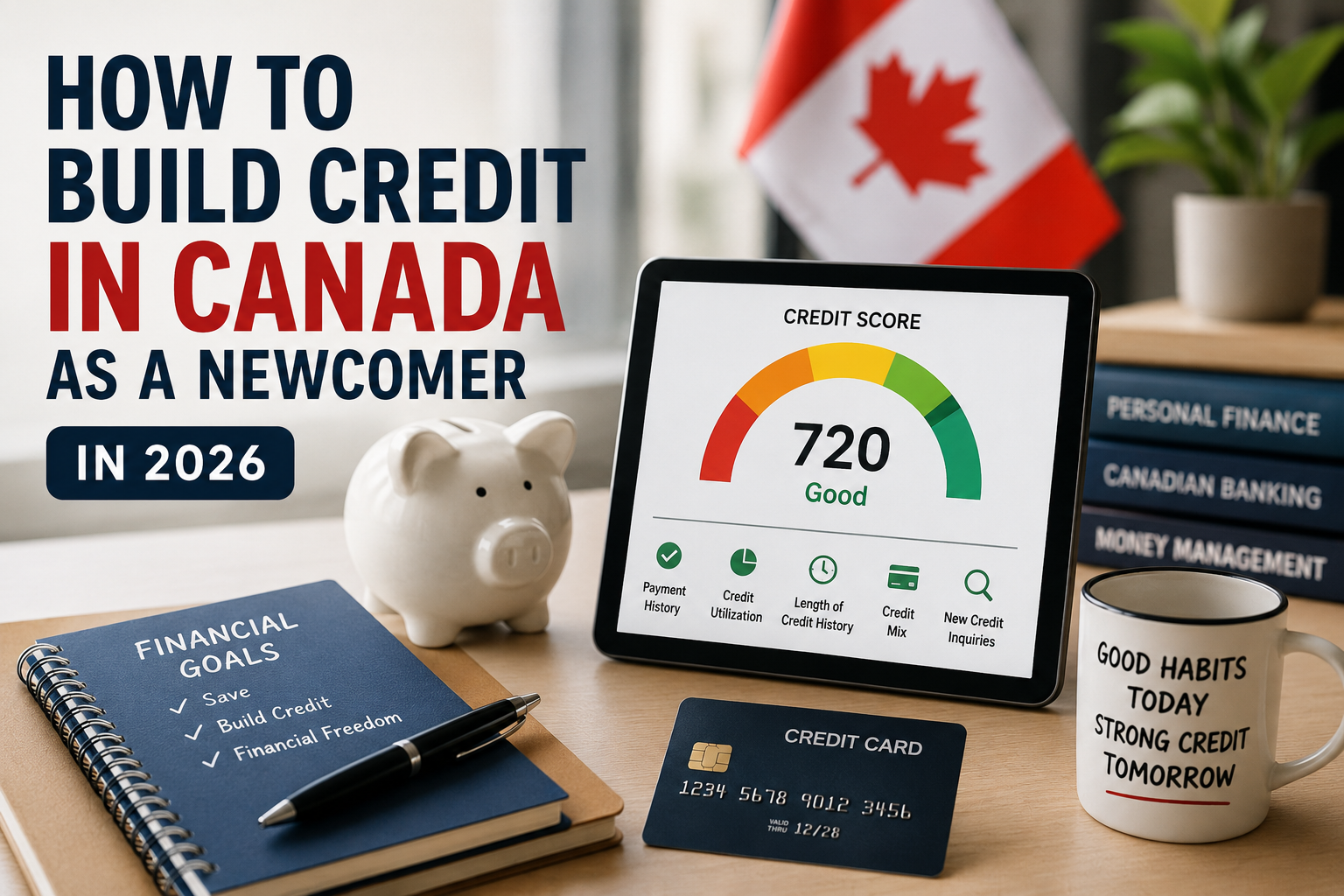
For newcomers, a credit card can have another important role: responsible use may help establish Canadian credit history.
For more detail, read our guide on how to build credit in Canada as a newcomer.
Debit vs. Credit: A Simple Comparison
| Feature | Debit Card | Credit Card |
|---|---|---|
| Source of money | Your bank account | Borrowed credit |
| Monthly statement balance to repay | Generally no | Yes |
| Can help establish credit history | Generally no | Potentially, when reported and used responsibly |
| Interest on carried balance | Not applicable in the same way | May apply |
| Typical everyday use | Purchases and account access | Purchases using a credit limit |
Terms and protections vary by product, so always read the agreement for the card you actually use.
What Is Interac e-Transfer?
Interac e-Transfer is one of the everyday banking tools that can feel distinctly Canadian to a newcomer.
It allows customers at participating Canadian financial institutions to send money using online or mobile banking.
You generally use the recipient's email address or mobile phone number rather than entering their bank account details.
Common uses include:
- splitting a restaurant bill;
- paying a roommate;
- sending money to a friend;
- paying certain small businesses;
- collecting money from someone; and
- other person-to-person payments.
Does Interac e-Transfer Cost Money?
That depends on your financial institution and banking plan.
Interac states that financial institutions can determine their service plans and fee structures.
Some account packages include e-Transfers, while others may apply charges or limits.
Check your own plan instead of assuming that every transfer is free.
What Is Autodeposit?
Autodeposit allows eligible Interac e-Transfers sent to your registered contact information to be deposited automatically into the linked account without requiring you to answer a security question.
This can make receiving money more convenient.
Even when using Autodeposit, remain alert to unexpected messages and scams. Do not assume that every email or text mentioning Interac is legitimate.
How to Receive Your Salary in Canada
Many Canadian employers pay workers through direct deposit.
Instead of giving you a physical paycheque, the employer deposits your pay electronically into your bank account.
Your employer may request banking information to set this up.
Depending on the process, you may provide information from a direct-deposit form or a void cheque generated through your financial institution.
What Is a Void Cheque?
A void cheque contains banking information needed for certain electronic payment arrangements but is marked so it cannot be used as a normal cheque.
Many banks allow customers to download a digital void cheque or direct-deposit form through online banking.
You may encounter several numbers on Canadian banking information:
- Transit number: identifies the branch or location associated with the account.
- Institution number: identifies the financial institution.
- Account number: identifies your specific account.
These details are important financial information. Provide them only when there is a legitimate reason.
Paying Bills Through Online Banking
Online bill payment is another common feature of Canadian banking.
Depending on your financial institution, you may be able to add organizations as payees and pay bills directly from your chequing account.
Examples might include:
- credit cards;
- utilities;
- telecommunications companies; and
- other participating organizations.
Always verify the account or reference number before submitting a payment.
Automatic Payments: Convenient but Worth Monitoring
Automatic withdrawals can simplify recurring bills, but they should not be forgotten after setup.
Review your bank account regularly and keep track of upcoming withdrawals.
This is especially important when your balance is low.
A useful monthly habit is to review:
- upcoming rent;
- phone and internet bills;
- insurance;
- subscriptions;
- credit-card payments; and
- other automatic withdrawals.
ATM Fees: Your Bank's ATM vs. Another ATM
ATM costs can vary depending on where you withdraw money.
Using an ATM associated with your own financial institution may be included in your account package, while using another institution's ATM can result in additional fees.
Private ATM operators may have their own charges as well.
If you withdraw cash frequently, ATM availability near your home, work or school can be an important factor when choosing a financial institution.
Bank, Credit Union or Online Institution?
Newcomers are not limited to Canada's largest banks.
Depending on your province and needs, you may encounter traditional banks, federal credit unions, provincially regulated credit unions, caisses populaires and online financial institutions.
Traditional bank
Large banks often provide extensive branch and ATM networks along with a broad range of financial products.
Credit union
Credit unions are member-owned financial cooperatives. Their availability, products and deposit-insurance arrangements can depend on the jurisdiction and institution.
Online financial institution
Digital-focused institutions may offer competitive fees and convenient online banking, but they may have fewer or no traditional branches.
There is no universal winner. The right choice depends on whether you value branches, ATM access, low fees, digital tools, product selection or another feature.
How to Compare Bank Accounts Properly
Instead of asking only "Which bank is best?", compare accounts based on your actual banking habits.
| Question | Why It Matters |
|---|---|
| What is the monthly fee? | A recurring charge affects your annual banking cost |
| How many transactions are included? | Extra transactions may cost more |
| Are e-Transfers included? | Frequent transfers can affect your total cost |
| Where are the ATMs? | Out-of-network withdrawals may be less convenient or more expensive |
| Does the promotion expire? | Your cost may change after the introductory period |
| Is there a minimum balance condition? | You may need to keep money in the account to receive certain benefits |
| Do I need branches? | A digital-only option may not suit everyone |
Calculate the Annual Cost, Not Just the Monthly Fee
A monthly fee can look small until you calculate it over a full year.
For example, consider a hypothetical account costing C$16 per month:
| Cost | Amount |
|---|---|
| Monthly fee | C$16 |
| 12 months | C$192 |
If another account provides everything you need for less, the difference can become meaningful over several years.
This is a hypothetical example only and does not represent the current fee of a particular account.
Minimum Balance Waivers: Understand the Trade-Off
Some account packages may waive a monthly fee when you maintain a specified minimum balance.
This can sound like free banking, but consider the opportunity cost.
If several thousand dollars must remain in a chequing account to avoid a monthly fee, ask whether keeping that money there makes sense for your situation.
Compare the value of the fee waiver with other appropriate uses for your cash, including emergency savings.
What Is CDIC?
The Canada Deposit Insurance Corporation (CDIC) is a federal Crown corporation that protects eligible deposits held at its member institutions if a member institution fails.
CDIC protection is automatic for eligible deposits. You do not purchase it separately.
However, not every financial product is a deposit and not every institution is necessarily a CDIC member.
How Much Does CDIC Protect?
CDIC protects eligible deposits separately up to C$100,000 per insured category at each member institution, including principal and interest.
Eligible deposits can include certain:
- chequing account deposits;
- savings account deposits;
- term deposits and GICs; and
- other eligible deposits.
CDIC coverage is organized by insured categories, so the rules are more detailed than simply saying every person has only C$100,000 of total protection.
Always use CDIC's current information to determine how coverage applies to your accounts.
What CDIC Does Not Protect
CDIC deposit insurance does not cover every type of financial asset.
For example, investments such as stocks, bonds, mutual funds, exchange-traded funds and cryptocurrencies are not eligible deposits protected by CDIC.
This distinction matters because having an investment account at a financial institution does not mean every asset inside it is covered by deposit insurance.
What About Credit Union Deposit Insurance?
Not every credit union uses the federal CDIC framework.
Provincially regulated credit unions may operate under provincial deposit-insurance systems with their own rules and coverage.
If you are considering a credit union, check the protection that specifically applies to that institution rather than assuming it is identical to CDIC.
Joint Bank Accounts
Couples and families may consider joint accounts for shared expenses.
A joint account can make it easier to manage rent, groceries and household bills, but it also gives account holders responsibilities and access according to the account terms.
Before opening one, understand:
- who can withdraw money;
- who can make transactions;
- how the account will be used;
- how shared expenses will be funded; and
- what happens if the relationship or household arrangement changes.
Some people use a joint account for shared bills while keeping individual accounts for personal spending.
Sending Money Outside Canada
Newcomers may need to send money to family or accounts in another country.
International transfers are different from domestic Interac e-Transfers.
When comparing international money-transfer options, look beyond the advertised transfer fee.
Consider:
- exchange rate;
- transfer fee;
- possible receiving fees;
- delivery time;
- transfer limits; and
- the final amount the recipient receives.
A service advertising a low fee may still be expensive if its exchange rate is less favourable.
Using Your Canadian Debit Card Abroad
If you travel outside Canada, your debit or credit card may involve foreign transaction, currency-conversion or ATM charges depending on the product and network.
Before travelling, check your financial institution's current terms.
Do not assume that a card with no domestic transaction fee will also be free to use internationally.
Banking and Building Credit Are Different
Opening a chequing account does not automatically build a strong credit history.
Your bank account and your credit file serve different purposes.
Credit history is influenced by credit products and how they are managed and reported.
That is why newcomers should learn about credit separately instead of assuming that simply keeping money in a bank account creates a high credit score.
Our newcomer credit guide explains this process in more detail.
How Much Money Should You Keep in Chequing?
There is no universal amount.
A practical approach is to keep enough for upcoming bills, regular spending and an appropriate buffer while keeping longer-term savings organized according to your financial goals.
Your answer will depend on:
- income schedule;
- monthly expenses;
- account minimums;
- emergency savings;
- debt;
- interest rates; and
- personal comfort level.
The important thing is knowing why the money is in each account.
A Simple First-Month Banking Checklist for Newcomers
| Step | Action |
|---|---|
| 1 | Gather acceptable identification |
| 2 | Compare several account options |
| 3 | Ask whether you qualify for a no-cost newcomer account |
| 4 | Understand monthly fees and transaction limits |
| 5 | Open the account that fits your needs |
| 6 | Set up online and mobile banking securely |
| 7 | Set up direct deposit if required |
| 8 | Learn how Interac e-Transfer works |
| 9 | Enable useful account alerts |
| 10 | Consider how you will begin building credit |
Banking Scams Newcomers Should Watch For
People who are unfamiliar with Canada's banking system can be attractive targets for scammers.
Be cautious if someone unexpectedly contacts you and asks for:
- your online banking password;
- your debit-card PIN;
- one-time verification codes;
- remote access to your computer;
- gift cards or cryptocurrency payments;
- urgent transfers to "protect" your money; or
- sensitive personal information without a clear legitimate reason.
If a message claims to come from your bank, do not automatically trust the phone number, email address or link contained in the message.
Use the institution's official app, website or a trusted telephone number to contact it independently.
Be Careful With Interac e-Transfer Messages
Interac e-Transfer notifications can also be imitated by scammers.
If you receive an unexpected transfer notification, verify it carefully before following links or entering banking credentials.
Interac advises users to remain vigilant and verify unexpected transactions.
When in doubt, access your online banking independently rather than through a link in an unsolicited message.
Common Banking Mistakes Newcomers Make
1. Choosing a bank only for the welcome bonus
Promotions end. Your account may remain open for years.
2. Ignoring monthly fees
Calculate what the account could cost over 12 months.
3. Assuming every ATM is free
Check your institution's ATM network and account terms.
4. Confusing debit with credit
They use fundamentally different sources of money.
5. Carrying unnecessary credit-card debt
Credit-card interest can make purchases substantially more expensive.
6. Sharing verification codes
Treat security codes like passwords.
7. Forgetting when a newcomer promotion ends
Put the end date in your calendar and review the account beforehand.
8. Keeping accounts you no longer need
Periodically review whether each account still provides value.
Can You Change Banks Later?
Yes. Your first Canadian bank does not have to be your bank forever.
As your needs change, another account may become more suitable.
Before closing an old account, make sure you have moved or updated:
- direct deposits;
- automatic bill payments;
- subscriptions;
- Interac Autodeposit registration where applicable;
- government deposits where applicable; and
- any other recurring transactions.
Keep the old account open long enough to make sure important transactions have moved successfully, while considering any fees that may apply.
Questions to Ask Before Opening Any Bank Account
Before signing an agreement, ask the financial institution:
- What is the regular monthly fee?
- Do I qualify for a newcomer or no-cost account?
- When does the promotional period end?
- How many transactions are included?
- Are Interac e-Transfers included?
- What happens if I exceed the transaction limit?
- Which ATMs can I use without additional account-network charges?
- Is there a minimum balance requirement?
- What overdraft or NSF rules apply?
- How do I receive low-balance alerts?
- Is the institution a CDIC member or covered by another deposit insurer?
If the answer is unclear, ask for an explanation before opening the account.
Frequently Asked Questions
Can I open a Canadian bank account without a job?
Yes. Government guidance states that you can open a bank account even if you do not have a job, provided the institution can meet the applicable identification and account-opening requirements.
Can a temporary resident open a bank account?
Non-citizens may be able to open Canadian bank accounts with appropriate identification. Eligibility for particular newcomer packages can depend on immigration status and the institution's requirements.
Are bank accounts free for newcomers?
Not every account is automatically free. However, under Canada's current low-cost/no-cost account commitment, eligible newcomers can qualify for a no-cost account during their first year in Canada at participating institutions.
How much is a low-cost bank account?
Under the federal commitment, qualifying low-cost accounts cost no more than C$4 per month.
What is the NSF fee limit in 2026?
As of March 12, 2026, federally regulated banks are subject to a C$10 cap on NSF fees for personal deposit accounts, along with additional consumer protections.
Do I need a credit card immediately?
No. Whether a credit card is appropriate depends on your circumstances. If you choose to use one, understand the interest rate, fees, payment due dates and credit limit before spending.
Is Interac e-Transfer the same as a wire transfer?
No. Interac e-Transfer is a Canadian electronic money-transfer service commonly used for domestic payments. International wire transfers and other remittance services operate differently.
Is my money automatically protected if it is at a bank?
Eligible deposits at CDIC member institutions receive automatic protection according to CDIC's coverage rules. Not every financial product is an eligible deposit, so verify the institution and product.
Final Thoughts
Banking in Canada does not need to be complicated for newcomers.
Start with the fundamentals: choose an account that matches how you actually use money, understand the fees, learn how debit and credit differ, protect your personal information and become familiar with everyday tools such as direct deposit and Interac e-Transfer.
Newcomers in their first year should also check whether they qualify for a no-cost account under Canada's current low-cost/no-cost banking framework. A few minutes spent comparing account terms can potentially prevent years of unnecessary fees.
Most importantly, do not feel pressured to choose every financial product immediately after arriving. Your banking needs will change as you find work, establish credit, build savings and become more familiar with life in Canada.
Choose what you need now, understand what you are signing and review your accounts periodically.
For your next steps, compare bank accounts for newcomers to Canada and learn how to build credit in Canada as a newcomer.
This article provides general information only and does not constitute financial, legal, immigration or tax advice. Banking products, fees, promotions, eligibility requirements and regulations can change. Verify current information directly with the relevant financial institution and official Canadian authorities before making financial decisions.
Official Sources & Further Reading
- Financial Consumer Agency of Canada — Opening a Bank Account
- Financial Consumer Agency of Canada — Low-Cost and No-Cost Accounts
- Financial Consumer Agency of Canada — Commitment on Low-Cost and No-Cost Accounts
- Financial Consumer Agency of Canada — NSF Fee Regulations
- Canada Deposit Insurance Corporation — What's Covered
- Interac — Interac e-Transfer