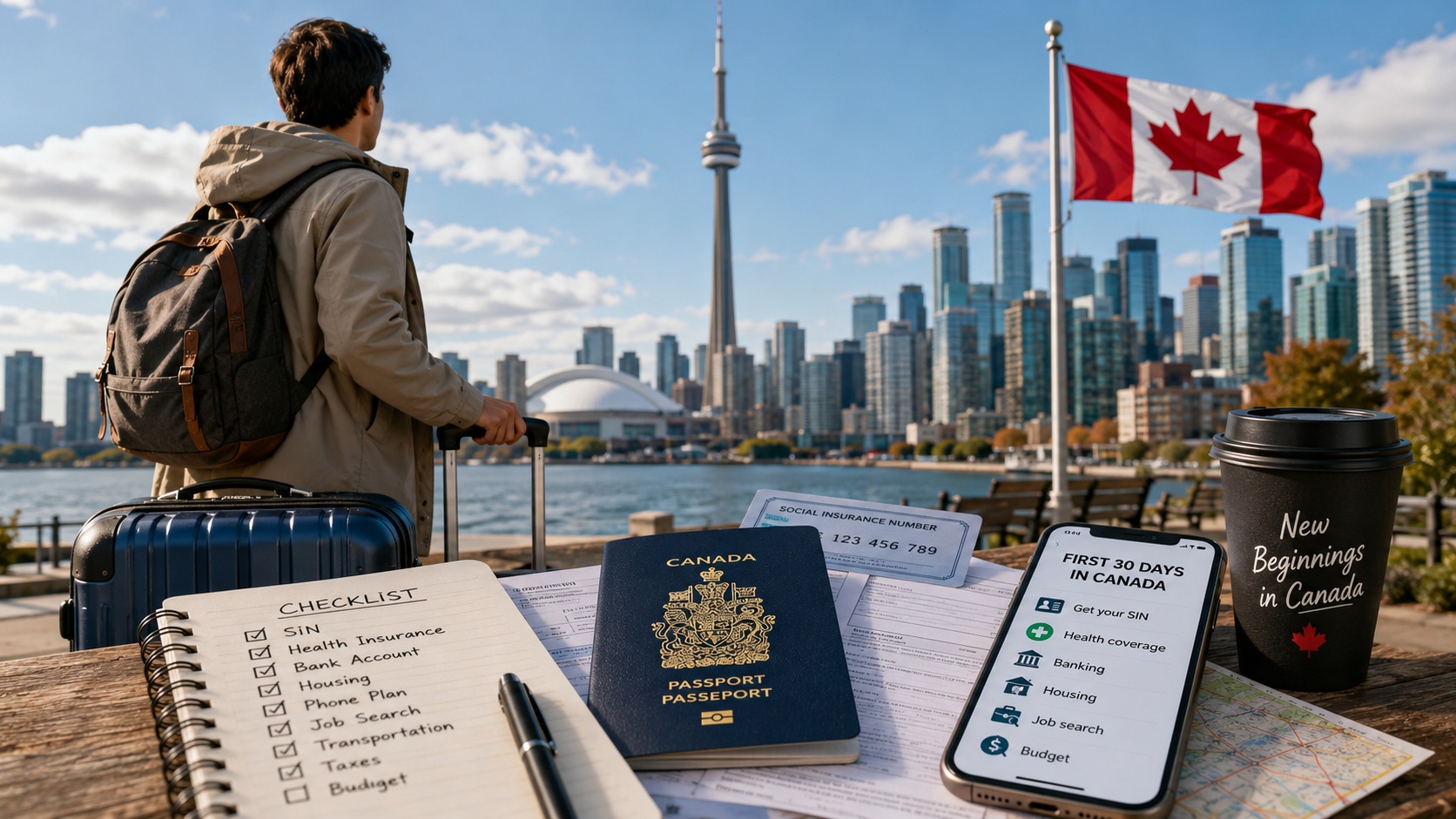
Moving to Canada comes with a long list of financial decisions. Rent, groceries, transportation, phone plans and other everyday expenses can quickly add up, especially during the first few months in the country.
What many newcomers do not realize is that becoming a resident of Canada for income tax purposes may also open the door to certain government benefits and tax credits.
In some situations, you may even be able to apply for benefits before filing your first Canadian income tax return.
The important part is understanding that there is no single “newcomer benefit” automatically paid to everyone who arrives in Canada. Eligibility depends on factors such as your residency status for tax purposes, family situation, income, province or territory, and how long you have lived in Canada.
This guide explains the main benefits newcomers should check in 2026, how the rules work and what practical steps to take after arriving.
Quick Answer: What Benefits Can Newcomers Get in Canada?
Depending on their circumstances, newcomers may be able to qualify for federal, provincial or territorial benefits and credits.
Some of the most important programs to check include:
- Canada Groceries and Essentials Benefit (CGEB)
- Canada Child Benefit (CCB)
- Provincial and territorial benefits and credits
- Disability-related benefits and credits when eligibility requirements are met
- Other income-tested programs that may be available depending on the household
One of the biggest mistakes a newcomer can make is assuming that government benefits only become relevant after filing a first Canadian tax return.
The Canada Revenue Agency (CRA) provides procedures for eligible newcomers to apply for certain benefits during their first year in Canada.
However, eligibility should never be assumed. Immigration status and tax residency are related but different concepts, and each benefit has its own rules.
Newcomer Benefits Decision Table
The table below is a Canada Worth Today editorial guide designed to help newcomers identify which programs may deserve their attention first. It is not an eligibility determination by the CRA.
| Newcomer situation | What to check first | Why it matters | Practical next step |
|---|---|---|---|
| Single newcomer with low or modest income | CGEB and provincial/territorial programs | Income-tested benefits may help with everyday costs | Check CRA newcomer application requirements and your province's programs |
| Married or common-law couple | CGEB and applicable provincial benefits | Household income and marital status can affect eligibility and payments | Make sure the CRA has accurate information for both partners |
| Family with children | CCB, CGEB and provincial/territorial child benefits | Eligible families may have access to multiple programs | Review CCB newcomer requirements and gather documents for each child |
| Newcomer who has not filed a Canadian tax return yet | First-year newcomer benefit procedures | Some eligible newcomers do not necessarily have to wait for their first tax return | Check the CRA's newcomer application instructions |
| Temporary resident | Benefit-specific eligibility rules | Some programs have additional residence or permit requirements | Verify the rules for the specific benefit before applying |
| Newcomer who has already filed taxes | Federal and provincial/territorial benefits | Tax returns are used to calculate many income-tested benefits | Continue filing a return every year, even with little or no income |
This table is intentionally a starting point rather than a promise of eligibility. Your exact situation must be assessed under the rules of each program.
Canada Groceries and Essentials Benefit (CGEB)
One of the most important changes for newcomers in 2026 is the Canada Groceries and Essentials Benefit.
Beginning in July 2026, the CGEB replaced the former GST/HST Credit. The federal government also increased the benefit by 25% for five years beginning with the 2026–27 benefit year.
The CGEB is a tax-free payment intended to help eligible individuals and families with low or modest incomes offset the cost of everyday essentials.
For the July 2026 to June 2027 payment period, eligible recipients may receive up to:
- C$679 for a single person
- C$890 for a married or common-law couple
- C$234 for each eligible child under age 19
These are maximum amounts, not guaranteed payments.
The actual amount can depend on adjusted family net income, marital status, number of eligible children and other circumstances.
Can a newcomer receive the CGEB before filing taxes?
Potentially, yes.
This is particularly important for people who have recently arrived in Canada.
According to the CRA, a new resident of Canada may apply for the benefit during the year they become a resident for income tax purposes instead of simply waiting until their first Canadian tax return is filed.
Newcomers without children generally use Form RC151, while those with children should review the CCB application process because the required procedure may differ.
After the first tax year, filing annual income tax returns becomes essential because the CRA generally uses tax information to determine ongoing eligibility and calculate payments.
Canada Worth Scenario: A Single Newcomer
Consider a newcomer who becomes a Canadian resident for income tax purposes in 2026, has no children and earns a modest income after arriving.
A common assumption would be: “I haven't filed taxes in Canada yet, so there is nothing for me to check.”
That assumption could be wrong.
- Determine whether you became a resident of Canada for income tax purposes.
- Check the current CGEB eligibility requirements.
- Review Form RC151 if it applies to your situation.
- Report the income information requested by the CRA.
- Keep your address and marital status updated.
- File your Canadian tax return when required to maintain future benefit calculations.
The important takeaway is not that this hypothetical newcomer will automatically receive the maximum amount. The useful takeaway is that a first-year newcomer may have an application route worth checking before the first Canadian tax return.
Canada Child Benefit for Newcomer Families
For newcomers with children, the Canada Child Benefit can be one of the most important federal programs to understand.
The CCB is a tax-free monthly payment administered by the CRA to eligible families to help with the cost of raising children under 18.
For the July 2026 to June 2027 benefit year, the maximum annual benefit is:
- C$8,157 per child under age 6
- C$6,883 per child aged 6 through 17
Actual payments decrease as adjusted family net income rises, so these maximum figures should not be treated as the amount every family receives.
Do permanent residents qualify for the CCB?
Permanent residents can potentially qualify if they meet the other CCB requirements.
Canadian citizens, protected persons and certain temporary residents may also qualify depending on their circumstances.
For newcomers, the key point is that immigration status is only one part of the test. The applicant must also meet the CRA's requirements concerning residence, responsibility for the child and other eligibility conditions.
What about temporary residents?
Temporary residents need to pay particular attention to the residence requirement.
According to the CRA, a temporary resident generally needs to have lived in Canada for the previous 18 months and hold a valid permit in the 19th month, provided the permit does not state that it does not confer temporary resident status.
Other CCB requirements must still be satisfied.
Canada Worth Scenario: A Newcomer Family With Children
Imagine a couple arriving in Canada with two young children.
Instead of asking only “How much CCB will we receive?”, a more useful checklist would be:
- Have we established Canadian residency for tax purposes?
- Does at least one spouse or common-law partner meet the required status condition?
- Are we primarily responsible for the care and upbringing of the children?
- Have we provided the CRA with the information it requires about our income before arriving in Canada?
- Have we submitted the appropriate newcomer/CCB documentation?
- Is our marital status correctly recorded?
- Is our Canadian address current?
Only after those questions are answered does estimating a possible payment become useful.
For a broader look at first-year expenses, read our Cost of Living in Canada in 2026 guide.
Provincial and Territorial Benefits Matter Too
Federal benefits are only part of the picture.
Depending on where you live, your province or territory may offer additional credits or benefits. Some are administered by the CRA together with federal programs, while others may be handled directly by the provincial or territorial government.
This means two newcomer households with similar incomes could have different benefit situations simply because they live in different provinces.
- Province or territory of residence
- Household income
- Number and ages of children
- Marital status
- Housing circumstances
- Eligibility for disability-related programs
- Provincial program rules
Rather than searching for “free money for immigrants,” newcomers should use official federal and provincial benefit finders and verify each program individually.
Benefits and Your First Canadian Tax Return
Canada's tax system and benefit system are closely connected.
Many newcomers believe that filing an income tax return only matters if they owe tax. That is not the case.
Even someone with little or no taxable income may need to file a return so the CRA can calculate eligibility for income-tested benefits and credits.
Once you enter the regular Canadian tax-filing cycle, failing to file can interrupt or delay benefit payments because the CRA may no longer have the income information needed to calculate them.
How Newcomers Can Apply for Benefits in Canada
There is no single application that automatically unlocks every benefit available in Canada.
The process depends on your family situation and the program you are applying for.
If you do not have children
A newcomer without children who becomes a resident of Canada for income tax purposes may need to use Form RC151 to provide the CRA with the information required to determine eligibility for the CGEB and related payments.
Use the latest version and instructions directly from the CRA rather than relying on an old form downloaded from a third-party website.
If you have children
Newcomers with children should review the Canada Child Benefit application procedure.
The CRA may require Form RC66, Canada Child Benefits Application, together with additional information concerning status and residency.
Do not assume that receiving one federal benefit means every other benefit has been automatically activated.
Documents Newcomers Should Keep Ready
- Social Insurance Number, when applicable
- Immigration documents
- Date-of-entry records
- Spouse or common-law partner information
- Children's documents
- Records showing your Canadian address
- Income information from before and after arriving in Canada
- CRA correspondence
- Copies of forms submitted to government agencies
If you still need to obtain your Social Insurance Number, read our guide to getting a SIN in Canada in 2026.
7 Mistakes That Can Delay or Reduce Newcomer Benefits
1. Assuming you must wait for your first tax return
Some eligible newcomers may have an application route during their first year in Canada.
2. Treating the maximum payment as guaranteed income
Maximum benefit amounts are not promises. Income, marital status, children and program-specific rules can substantially change the actual payment.
3. Forgetting to report a change in marital status
Marriage, separation, divorce or beginning or ending a common-law relationship can affect benefit calculations.
4. Not updating your address
Moving is common during a newcomer's first year. If you are still establishing your Canadian address, read our proof of address guide for newcomers.
5. Failing to file annual tax returns
The CRA uses tax-return information to calculate many benefits and credits.
6. Using outdated benefit information
Government programs change. The replacement of the GST/HST Credit by the CGEB in 2026 is a good example.
7. Paying someone who promises to “unlock” government benefits
Be cautious with anyone who guarantees a benefit payment, asks for unnecessary banking credentials or demands money to access a government program.
Canada Worth Newcomer Benefits Checklist
The following checklist is an editorial framework created by Canada Worth Today. It is not an official CRA checklist.
During your first weeks in Canada
- Keep your immigration and entry documents organized.
- Apply for a SIN if you are eligible and need one.
- Establish a reliable Canadian mailing address.
- Determine whether you have become a Canadian resident for income tax purposes.
- Keep records of income earned before and after arriving.
Once your basic documents are organized
- Check whether the CGEB may apply to your situation.
- If you have children, review CCB eligibility and newcomer application requirements.
- Check benefits and credits available in your province or territory.
- Read official application instructions before submitting forms.
- Keep copies of forms and supporting documents.
During the rest of your first year
- Update the CRA when relevant personal information changes.
- Keep track of CRA correspondence.
- Prepare for your first Canadian income tax return.
- Do not build your household budget around an estimated benefit until eligibility and the actual amount are known.
Every year after that
- File your Canadian tax return on time.
- Ensure your spouse or common-law partner files when required for benefit calculations.
- Review benefit amounts and eligibility rules for the new benefit year.
- Update your address, marital status and other relevant information when circumstances change.
Canada Worth Decision Guide: What Should You Check First?
| Your situation | Start here | Then check |
|---|---|---|
| No children and low/modest income | CGEB newcomer eligibility | Provincial or territorial benefits |
| Children under 18 | CCB eligibility | CGEB and provincial child/family programs |
| Temporary resident | Status and residence requirements | Whether a minimum period in Canada applies |
| Permanent resident | Tax residency and program-specific requirements | Federal plus provincial/territorial benefits |
| Already filed your first Canadian return | CRA benefit information | Provincial programs and annual eligibility changes |
How Benefits Fit Into a Newcomer's Financial Plan
Benefits can help an eligible household, but they should not replace a realistic financial plan.
Someone comparing job offers should consider take-home pay and local expenses rather than looking only at gross salary. Our Average Salary in Canada guide provides additional context.
Housing can be even more important. Read our guide to renting an apartment in Canada without a credit history.
If you are planning your first month after arrival, use our First 30 Days in Canada newcomer checklist.
A Practical Example: Why Two Newcomers May Receive Different Benefits
Consider two hypothetical newcomers who arrive in Canada during the same year.
Newcomer A is single, has no children and earns a modest income.
Newcomer B has a spouse and two children.
Even if both arrived on the same date and live in the same city, their potential benefit situations can be very different.
Newcomer A may primarily investigate the CGEB and applicable provincial programs, while Newcomer B may need to investigate the CCB, CGEB and family-related provincial programs.
This is why a generic answer to “How much money do newcomers get from the government?” is misleading. There is no universal newcomer payment.
Frequently Asked Questions
Do newcomers automatically receive government benefits in Canada?
No. Arriving in Canada does not automatically entitle someone to every government benefit. Each program has eligibility requirements.
Can I apply for benefits before filing my first Canadian tax return?
For certain benefits and eligible newcomers, yes. The CRA has specific procedures that allow new residents to provide the information needed to determine eligibility during their first year.
Is the Canada Groceries and Essentials Benefit taxable?
The CGEB is a tax-free benefit.
Did the CGEB replace the GST/HST Credit?
Yes. Beginning in July 2026, the Canada Groceries and Essentials Benefit replaced the GST/HST Credit.
Can temporary residents receive the Canada Child Benefit?
Some temporary residents may qualify, but additional requirements apply, including the applicable residence and permit rules.
Do I need to file taxes if I have no income?
There are circumstances where filing a Canadian tax return remains important even with little or no income because tax information is used to calculate certain benefits and credits.
Are the maximum benefit amounts guaranteed?
No. Maximum amounts are reference figures. Actual entitlement depends on the household's circumstances and the rules of the program.
Final Takeaway
Newcomers to Canada should not assume that government benefits are automatic, but they should not assume they have to wait years to investigate them either.
The most effective approach is to understand your tax residency, organize your documents, identify the programs relevant to your household and verify eligibility directly with the responsible government agency.
Government benefits can provide meaningful support, but a newcomer should treat them as one part of a larger financial plan built around realistic income, housing costs and everyday expenses.
Official Sources and Further Reading
- Canada Revenue Agency — Newcomers to Canada
- Canada Revenue Agency — Canada Groceries and Essentials Benefit
- CRA — Who can get the Canada Groceries and Essentials Benefit
- CRA — How much you can get
- Canada Revenue Agency — Canada Child Benefit
- CRA — Who can apply for the Canada Child Benefit
- CRA — Benefits, credits and taxes for newcomers