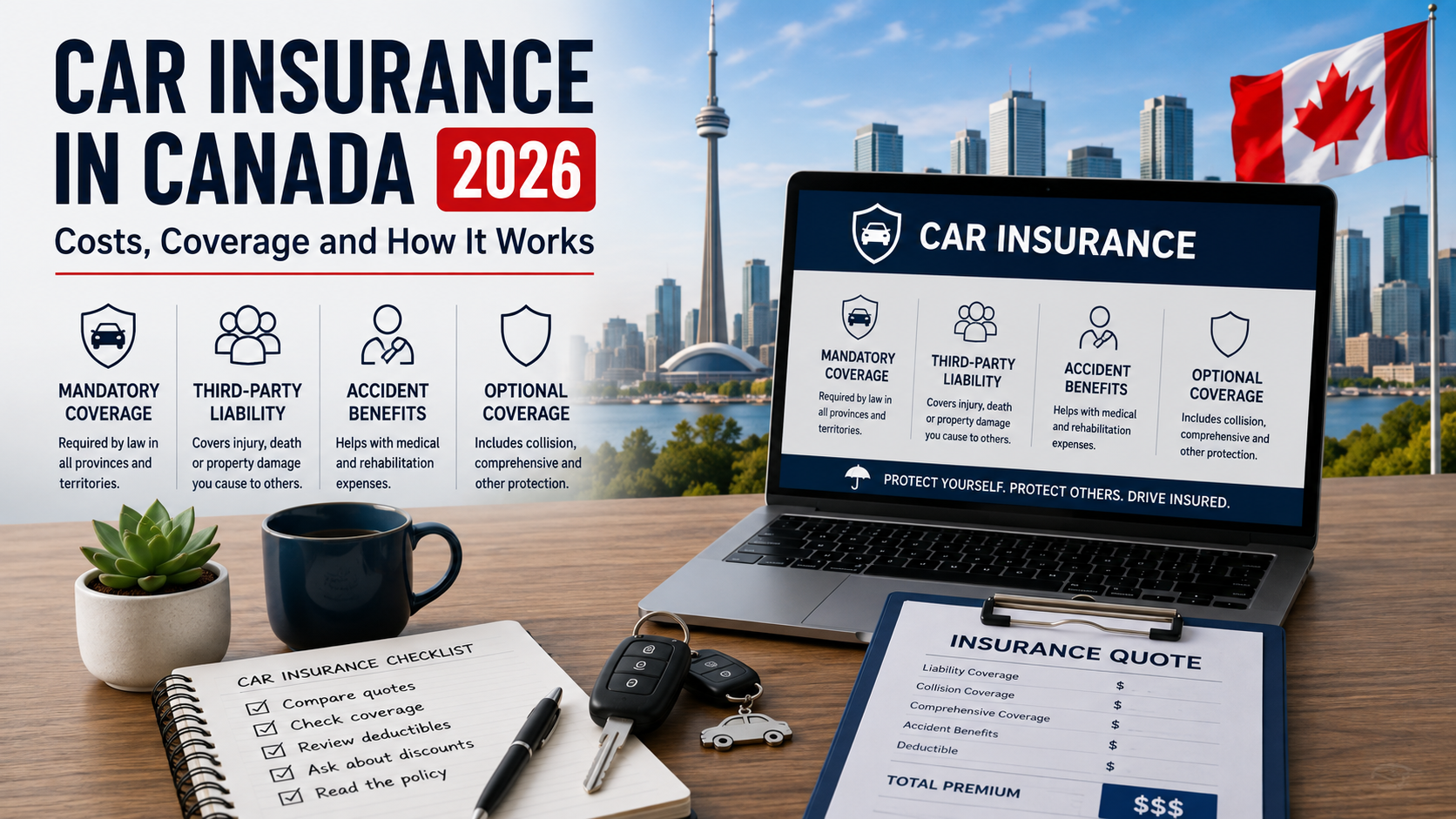
Car insurance is a legal requirement for vehicle owners in Canada, but the system is not the same everywhere in the country. The coverage you must carry, where you purchase it and how claims are handled depend largely on the province or territory where you live.
That makes comparing car insurance more complicated than simply looking for the cheapest monthly premium. A policy with a lower price may have different deductibles, limits or optional protection than another quote.
This 2026 guide explains how car insurance works in Canada, which types of coverage drivers should understand, what can affect premiums and what newcomers should consider before insuring their first vehicle.
Is car insurance mandatory in Canada?
Yes. You cannot legally drive an uninsured vehicle in Canada. Vehicle owners must obtain the insurance required in their province or territory before driving.
However, there is no single Canada-wide auto insurance policy. Provincial and territorial governments determine the insurance requirements that apply in their jurisdictions.
This means a driver moving from Ontario to British Columbia, for example, enters a different insurance system and should not assume the same policy rules will continue to apply.
How car insurance works in Canada
Car insurance provides financial protection against certain losses associated with owning and operating a vehicle. Depending on the policy and jurisdiction, coverage may respond to injuries, liability claims and damage involving the insured vehicle.
Every driver should distinguish between mandatory coverage and optional coverage.
Mandatory coverage is the protection required by law in the driver's province or territory. Optional insurance can provide additional protection beyond those minimum requirements.
The exact combination varies across Canada, which is why drivers should check their provincial regulator or public insurer rather than assuming requirements are identical nationwide.
Private and public auto insurance systems in Canada
One major difference between provinces is where drivers purchase mandatory auto insurance.
According to the Insurance Bureau of Canada, mandatory coverage is sold through private insurers in jurisdictions including Alberta, Ontario, Nova Scotia, New Brunswick, Newfoundland and Labrador, Northwest Territories, Nunavut, Prince Edward Island and Yukon.
British Columbia, Manitoba and Saskatchewan use government insurers for mandatory basic coverage, while optional coverage may also be available from private insurers.
Quebec uses another model: bodily injury protection is provided through the public system, while vehicle owners obtain required civil liability/property-related automobile insurance from private insurers.
| Location | General insurance model |
|---|---|
| Ontario | Private insurers |
| Alberta | Private insurers |
| British Columbia | Mandatory basic coverage through ICBC; optional coverage also available |
| Manitoba | Mandatory basic coverage through the public insurer |
| Saskatchewan | Mandatory basic coverage through the public insurer |
| Quebec | Combination of public bodily injury protection and private automobile insurance |
The table is a simplified overview. Coverage requirements and insurance systems can change, so drivers should always verify current rules with the regulator or public insurer in their province.
What does mandatory car insurance cover?
There is no single answer for all of Canada because mandatory coverage varies by jurisdiction.
One important type of protection is third-party liability coverage. It can protect you financially when you are legally responsible for injury, death or property damage resulting from an automobile incident, subject to the terms and limits of the policy.
Other mandatory protections can include accident benefits, uninsured automobile protection or property-damage coverage, depending on the province.
Do not assume that carrying the legal minimum means every type of damage to your own vehicle is covered.
Third-party liability coverage
Third-party liability is one of the most important parts of an auto insurance policy.
Imagine that you cause a collision that seriously injures another person or damages property. Liability coverage may respond to covered claims against you up to your policy limit.
Minimum requirements vary by jurisdiction. Drivers can often purchase liability limits above the legal minimum.
Choosing a liability limit should therefore involve more than finding the lowest premium. A serious collision can create costs far greater than a minor vehicle repair.
Collision coverage
Collision coverage generally protects against covered physical damage to your vehicle caused by a collision or upset, subject to the policy terms and deductible.
For example, it may apply when your vehicle collides with another automobile or an object.
Collision is not necessarily mandatory in every province. However, a lender or leasing company may require certain physical-damage coverage as a condition of financing or leasing a vehicle.
Comprehensive coverage
Comprehensive coverage generally protects against specified non-collision losses, subject to the policy.
Depending on the insurer and policy, covered events can include risks such as:
- Theft or attempted theft
- Vandalism
- Fire
- Certain weather-related damage
- Falling or flying objects
Drivers should read the actual policy wording because exclusions and deductibles apply and coverage can differ.
What is a car insurance deductible?
A deductible is the portion of a covered loss that you are responsible for paying before the insurer pays the remaining eligible amount under the applicable coverage.
For example, if a covered repair costs $3,000 and the applicable deductible is $500, the policy may cover the remaining eligible amount after the deductible, subject to all policy terms.
Choosing a higher deductible can sometimes reduce the insurance premium, but it also means accepting a larger out-of-pocket expense if you make a covered claim.
How much does car insurance cost in Canada in 2026?
There is no single reliable price that represents what every Canadian driver should expect to pay for car insurance in 2026.
Premiums can vary substantially according to the province, insurer, driver and vehicle. For that reason, a national average should not be treated as a personal quote.
The Government of Canada advises consumers that car insurance costs depend on factors including the insurance plan selected, age, driving record, location and driving experience. Prices can also vary among insurance companies.
The most accurate way to determine what insurance will cost you is to obtain quotes using your actual driver, vehicle and location information.
What affects car insurance premiums?
Insurers use multiple factors when determining premiums, subject to the rules that apply in each jurisdiction.
Factors that may affect what a driver pays include:
- Where you live: insurance experience and risk can vary by location.
- Driving record: collisions and convictions can affect premiums.
- Driving experience: the length and type of driving history can matter.
- Vehicle: repair costs, claims experience and other vehicle characteristics may affect pricing.
- How the vehicle is used: commuting and other usage patterns can matter.
- Coverage selected: additional protection and higher limits generally affect the premium.
- Deductibles: changing a deductible can affect both the premium and your potential out-of-pocket costs.
The factors insurers are permitted to use are regulated and can differ by province.
Car insurance for newcomers to Canada
Car insurance can be particularly confusing for newcomers because previous driving experience was earned outside Canada.
New residents should ask insurers or brokers whether documentation of their previous driving and insurance history can be considered. Requirements can differ between insurers and provinces, so it is important to ask what evidence is accepted before requesting quotes.
Useful documents may depend on the insurer and jurisdiction. Do not assume that foreign driving history will automatically be treated the same way by every company.
If you are still planning the financial side of settling in Canada, our guide to how much money you need to live in Canada can help you compare vehicle expenses with other major household costs.
British Columbia: how ICBC insurance works
British Columbia operates a public basic auto insurance system through the Insurance Corporation of British Columbia (ICBC).
Vehicles in B.C. must carry ICBC Basic Autoplan insurance. Drivers can also purchase optional coverage for additional protection.
Examples of optional protection available in British Columbia include collision, comprehensive and extended third-party liability coverage.
This makes B.C. different from a private-market province such as Ontario, where drivers shop among private insurers for their automobile policies.
Ontario car insurance rules in 2026
Ontario drivers purchase auto insurance from private insurers, but the province regulates the system through the Financial Services Regulatory Authority of Ontario (FSRA).
Ontario requires vehicle owners to carry specific mandatory coverages. For example, the minimum required third-party liability coverage is $200,000, although higher limits can be purchased.
Ontario also made an important change to accident benefits in 2026.
Effective July 1, 2026, medical, rehabilitation and attendant care benefits remain mandatory, while certain other accident benefits became optional. Drivers purchasing or reviewing coverage should therefore pay close attention to which benefits are included rather than assuming every benefit that may have existed in a previous policy structure remains automatically included.
Because this is a significant 2026 change, Ontario drivers should review current FSRA guidance and their policy documents when renewing or purchasing coverage.
Why the cheapest policy is not always the best policy
Price matters, especially when transportation already represents a major household expense. But comparing quotes only by the final premium can hide meaningful differences.
When comparing policies, look at:
- Liability limits
- Deductibles
- Collision coverage
- Comprehensive coverage
- Accident benefits where applicable
- Optional endorsements or additional protection
- Exclusions
- Payment terms
Two quotes that appear similar can provide different protection.
How to compare car insurance quotes
In provinces with private insurance markets, comparing multiple quotes can help drivers understand their options.
Try to compare equivalent coverage rather than asking one insurer for basic protection and another for a policy with substantially higher limits and additional coverage.
1. Use the same driver information
Provide accurate and consistent information about drivers, addresses, driving history and vehicle usage.
2. Compare the same liability limits
A quote with a higher liability limit should not be treated as identical to one offering only the minimum required coverage.
3. Compare deductibles
A cheaper quote may simply have a higher deductible.
4. Check optional coverage
Determine whether collision, comprehensive or other optional protection is included in each quote.
5. Ask about available discounts
Insurers may offer discounts depending on the jurisdiction, customer and policy arrangement. Ask what discounts are available rather than assuming they have automatically been applied.
6. Confirm the insurer or broker is licensed
Provincial and territorial insurance regulators oversee licensing and consumer protection. Consumers can check with their regulator when they need to confirm whether an insurance company, agent or broker is properly licensed or registered.
Should you buy collision and comprehensive coverage?
There is no universal answer.
A driver with a newer or more valuable vehicle may view protection against physical damage differently from someone driving an older vehicle with a relatively low market value.
Before deciding, consider:
- The current value of the vehicle
- The premium for the additional coverage
- The deductible
- How easily you could afford to replace or repair the vehicle yourself
- Whether a lender or leasing company requires the coverage
The goal is to understand what financial risk you are keeping and what risk you are transferring to the insurer.
Can you reduce your car insurance costs?
There is no guaranteed method that will lower every driver's premium, but several actions may be worth considering.
- Compare quotes where your province allows competition among insurers.
- Maintain a safe driving record.
- Ask about legitimate discounts for which you qualify.
- Review deductibles and coverage options.
- Consider insurance costs when choosing a vehicle.
- Keep your insurer informed about material changes to your driving situation.
- Review your coverage at renewal rather than automatically assuming your existing policy remains the best fit.
Reducing coverage purely to obtain a lower premium can expose you to larger financial losses, so any savings should be evaluated alongside the protection you are giving up.
Car ownership versus other living expenses
Insurance is only one part of the cost of owning a vehicle. Drivers also need to budget for fuel, maintenance, repairs, registration where applicable, parking and the purchase or financing cost of the vehicle itself.
Those expenses can make transportation a significant part of a household budget.
If you are comparing cities or provinces before moving, see our guide to the cheapest places to live in Canada in 2026. Housing and transportation costs should be considered together rather than independently.
Everyday expenses matter as well. Our breakdown of grocery prices in Canada in 2026 provides another useful benchmark when building a monthly budget.
What happens if you drive without insurance?
Driving without required automobile insurance is illegal in Canada and can result in serious financial and legal consequences under provincial or territorial law.
The exact penalties depend on the jurisdiction.
For example, FSRA states that in Ontario vehicle owners, lessees and drivers who do not carry valid auto insurance can face significant fines. A driver's licence can also be suspended and a vehicle can be impounded.
Drivers should never treat insurance as an optional expense simply because they have not previously been involved in a collision.
What should newcomers do before buying a car?
Insurance should be researched before committing to a vehicle purchase, not after.
A newcomer can find an affordable vehicle and then discover that the total cost of ownership is higher than expected once insurance, fuel, parking and maintenance are included.
A practical approach is to:
- Confirm the licensing requirements in your province.
- Research how previous driving experience may be recognized.
- Choose several potential vehicles rather than only one.
- Request insurance quotes for those vehicles where possible.
- Compare the total monthly cost of ownership.
- Purchase the required insurance before driving the vehicle.
Newcomers organizing their finances may also want to read our guide to bank accounts for newcomers in Canada and our guide to building credit in Canada as a newcomer.
Questions to ask before choosing an auto insurance policy
Before accepting a quote, consider asking the insurer or broker:
- Which coverages are legally required?
- What liability limit does this quote include?
- What are the deductibles?
- Does the policy cover collision damage to my vehicle?
- Does it include comprehensive coverage?
- Which accident benefits are mandatory and which are optional in my province?
- Are there important exclusions I should understand?
- How would adding another driver affect the policy?
- What changes do I need to report to the insurer?
- What happens to the premium if I change my vehicle or address?
Understanding the answers before purchasing a policy can prevent unpleasant surprises when you need to make a claim.
The bottom line
Car insurance in Canada is mandatory, but the way it works depends heavily on where you live. Some provinces use private insurers, others use public insurance systems, and the required types of coverage are not identical nationwide.
Rather than focusing on a single Canadian “average price,” drivers should compare the actual coverage and quotes available for their location, driving history and vehicle.
For newcomers in particular, checking insurance costs before buying a vehicle can make budgeting much easier. The price of the car is only the beginning of the cost of owning and driving it in Canada.
Important: Auto insurance rules, coverage requirements, premiums and provincial programs can change. This article provides general information based on sources available in 2026 and is not insurance, legal or financial advice. Always confirm current requirements with your provincial or territorial regulator, public insurer, or a licensed insurance professional before purchasing coverage.
Official Sources & Further Reading
- Financial Consumer Agency of Canada — Car Insurance
- Immigration, Refugees and Citizenship Canada — Driving in Canada
- Financial Services Regulatory Authority of Ontario — Standard Auto Insurance Policy
- FSRA — Ontario Accident Benefits Changes Effective July 1, 2026
- ICBC — Basic Insurance
- Insurance Bureau of Canada — Mandatory Auto Insurance Requirements by Province and Territory