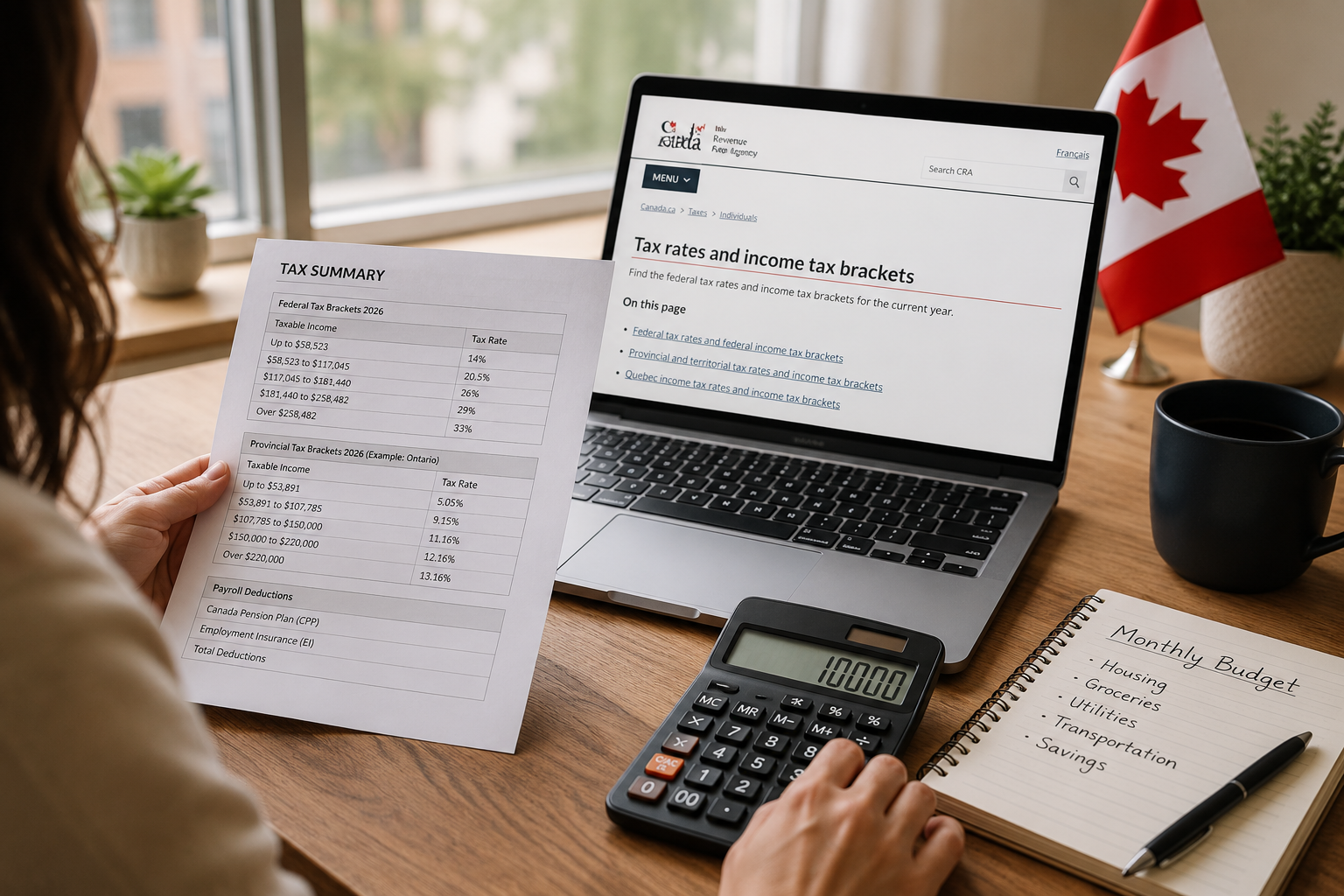
Income tax in Canada can look confusing when you see several percentages on a paycheque. The key point is that Canada uses a progressive tax system: earning enough to enter a higher tax bracket does not mean your entire income is taxed at the higher rate.
In 2026, most Canadian workers may have federal income tax, provincial or territorial income tax, Canada Pension Plan (CPP) contributions and Employment Insurance (EI) premiums deducted from their pay. Quebec has its own pension and parental insurance arrangements, so payroll deductions work somewhat differently there.
This guide explains the 2026 federal and provincial income tax brackets, how marginal tax rates work and why the amount deposited into your bank account can be significantly lower than your gross salary.
How income tax works in Canada
Canadian personal income tax generally has two main layers: federal income tax and provincial or territorial income tax.
The federal government applies federal tax brackets across Canada, while each province and territory has its own rates and thresholds. Quebec administers its own provincial personal income tax system.
Your tax situation also depends on factors such as taxable income, deductions, non-refundable tax credits and other circumstances. This means two people earning the same salary may not necessarily have exactly the same final tax bill.
If you are comparing salaries while looking for work, our guide to average salaries in Canada can help put gross income into perspective before considering taxes and other payroll deductions.
Federal income tax brackets in Canada for 2026
For the 2026 tax year, the Canada Revenue Agency lists five federal income tax brackets.
| 2026 taxable income | Federal tax rate |
|---|---|
| Up to $58,523 | 14% |
| $58,523.01 to $117,045 | 20.5% |
| $117,045.01 to $181,440 | 26% |
| $181,440.01 to $258,482 | 29% |
| Over $258,482 | 33% |
One important change compared with earlier years is the lowest federal rate. For 2026, the first federal bracket is taxed at 14%.
What does a marginal tax rate mean?
This is one of the most important concepts to understand about Canadian income tax.
Suppose your taxable income is $70,000 in 2026. You are above the $58,523 threshold for the first federal bracket, but that does not mean the entire $70,000 is taxed federally at 20.5%.
Instead, the federal brackets apply in layers:
- The portion of taxable income up to $58,523 falls within the 14% federal bracket.
- Only the portion above $58,523 and within the next bracket is subject to the 20.5% federal rate.
Tax credits and other adjustments can then affect the actual amount of tax payable.
This distinction between a marginal tax rate and the percentage of your total income ultimately paid in tax is why simply multiplying your salary by your highest bracket rate does not produce an accurate tax bill.
2026 provincial and territorial income tax rates
Federal income tax is only part of the picture. Provinces and territories apply their own tax brackets in addition to federal tax.
The table below shows the 2026 provincial and territorial personal income tax brackets published by the Canada Revenue Agency. Quebec rates are published separately by Revenu Québec.
| Province or territory | 2026 income tax brackets |
|---|---|
| Alberta | 8% to $61,200; 10% to $154,259; 12% to $185,111; 13% to $246,813; 14% to $370,220; 15% above $370,220 |
| British Columbia | 5.6% to $50,363; 7.7% to $100,728; 10.5% to $115,648; 12.29% to $140,430; 14.7% to $190,405; 16.8% to $265,545; 20.5% above $265,545 |
| Manitoba | 10.8% to $47,564; 12.75% to $101,200; 17.4% above $101,200 |
| New Brunswick | 9.4% to $52,333; 14% to $104,666; 16% to $193,861; 19.5% above $193,861 |
| Newfoundland and Labrador | 8.7% to $44,678; 14.5% to $89,354; 15.8% to $159,528; 17.8% to $223,340; 19.8% to $285,319; 20.8% to $570,638; 21.3% to $1,141,275; 21.8% above $1,141,275 |
| Nova Scotia | 8.79% to $30,995; 14.95% to $61,991; 16.67% to $97,417; 17.5% to $157,124; 21% above $157,124 |
| Ontario | 5.05% to $53,891; 9.15% to $107,785; 11.16% to $150,000; 12.16% to $220,000; 13.16% above $220,000 |
| Prince Edward Island | 9.5% to $33,928; 13.47% to $65,820; 16.6% to $106,890; 17.62% to $142,520; 19% to $200,000; 20% above $200,000 |
| Saskatchewan | 10.5% to $54,532; 12.5% to $155,805; 14.5% above $155,805 |
| Northwest Territories | 5.9% to $53,003; 8.6% to $106,009; 12.2% to $172,346; 14.05% above $172,346 |
| Nunavut | 4% to $55,801; 7% to $111,602; 9% to $181,439; 11.5% above $181,439 |
| Yukon | 6.4% to $58,523; 9% to $117,045; 10.9% to $181,440; 12.8% to $500,000; 15% above $500,000 |
These are marginal provincial or territorial rates. As with federal tax, the rate for a higher bracket applies only to the portion of taxable income within that bracket.
Quebec income tax rates for 2026
Quebec administers its provincial personal income tax separately. According to Revenu Québec, the 2026 provincial brackets are:
| 2026 taxable income | Quebec tax rate |
|---|---|
| $54,345 or less | 14% |
| More than $54,345 up to $108,680 | 19% |
| More than $108,680 up to $132,245 | 24% |
| More than $132,245 | 25.75% |
Quebec residents should use Revenu Québec resources when calculating provincial tax because the province has its own tax system, credits and payroll arrangements.
Does your province affect how much tax you pay?
Yes. Where you live can make a meaningful difference because provincial and territorial tax brackets vary considerably.
However, comparing only the first tax rate can be misleading. Each jurisdiction has different brackets, credits and other tax provisions. Your total tax burden depends on your income and personal circumstances, not simply the lowest advertised provincial rate.
Taxes are also only one part of affordability. Housing, groceries, transportation and utilities can vary substantially between provinces and cities. If location is part of your financial decision, see our guide to the cheapest places to live in Canada in 2026.
Taxable income is not always the same as your salary
Your annual salary and your taxable income are related, but they are not necessarily identical.
Taxable income is generally the amount remaining after eligible deductions are applied to income under Canadian tax rules. Tax credits can then reduce tax payable.
When comparing a job offer, it is useful to distinguish among:
- Gross income: earnings before payroll deductions.
- Taxable income: the amount used to calculate income tax after applicable deductions.
- Net or take-home pay: the amount left after income tax and other payroll deductions.
What is the Basic Personal Amount?
Canada has a federal Basic Personal Amount, a non-refundable tax credit that can reduce federal income tax payable.
For 2026, the federal Basic Personal Amount ranges from a maximum of $16,452 to a minimum of $14,829, depending on net income.
This does not mean everyone receives $16,452 in cash or that the first $16,452 of income should simply be removed from every tax calculation. It is used within the tax-credit system to calculate a non-refundable credit.
Provinces and territories also have their own personal tax credits and rules.
What gets deducted from a paycheque in Canada?
Income tax is not the only deduction employees may see on a Canadian paycheque.
For many employees outside Quebec, three major statutory deductions are:
- Federal and provincial or territorial income tax
- Canada Pension Plan (CPP) contributions
- Employment Insurance (EI) premiums
Depending on the employer, a paycheque can also include deductions for workplace pension plans, benefits, union dues or other authorized amounts.
CPP contributions in 2026
For 2026, the Canada Revenue Agency lists the Year's Maximum Pensionable Earnings (YMPE) at $74,600, with a basic exemption of $3,500.
The employee and employer CPP contribution rate is 5.95% on contributory earnings within the applicable range, with a maximum employee contribution of $4,230.45 for this portion of CPP in 2026.
There is also a second additional CPP contribution, commonly called CPP2. For 2026, earnings between the YMPE of $74,600 and the additional maximum pensionable earnings of $85,000 can be subject to CPP2. The employee contribution rate on that band is 4%, with a maximum employee CPP2 contribution of $416.
Quebec workers generally contribute to the Quebec Pension Plan (QPP) rather than CPP.
Employment Insurance premiums in 2026
Employment Insurance is another common payroll deduction.
For 2026, the EI employee premium rate outside Quebec is $1.63 per $100 of insurable earnings, equivalent to 1.63%.
The maximum insurable earnings for 2026 are $68,900, resulting in a maximum annual employee EI premium of $1,123.07 outside Quebec.
For workers in Quebec, the 2026 EI employee rate is lower at $1.30 per $100 of insurable earnings, with a maximum annual employee EI premium of $895.70.
Why is take-home pay lower than your salary?
A job advertised at $60,000 per year does not mean $5,000 will arrive in your bank account every month.
The advertised figure is generally gross annual salary. Before the employee receives their pay, the employer may need to withhold income tax, CPP or QPP contributions and EI premiums, along with any other applicable deductions.
The exact net amount depends on factors including:
- Province or territory of employment
- Annual income
- Pay frequency
- Tax credits claimed on TD1 forms
- CPP or QPP contributions
- EI premiums
- Employer pension or benefit deductions
- Other applicable payroll deductions
For newcomers planning their first months in the country, budgeting from gross salary alone can therefore create an unrealistic picture. Our guide on how much money you need to live in Canada in 2026 provides additional context for building a realistic monthly budget.
Example: how federal tax brackets apply to $100,000 of taxable income
Consider a simplified example of a person with $100,000 of taxable income in 2026.
For federal tax purposes, the income crosses two brackets:
- The first $58,523 falls within the 14% federal bracket.
- The remaining $41,477 falls within the 20.5% federal bracket.
Before accounting for tax credits or other adjustments, applying those rates to the two portions produces approximately $16,695.13 in federal tax.
This is only an illustration of how progressive federal brackets work. It is not an estimate of the person's final total tax bill or take-home pay. Provincial or territorial tax, credits, deductions, CPP or QPP, EI and individual circumstances must also be considered.
Do newcomers pay income tax in Canada?
Newcomers can have Canadian tax obligations depending on their residency status for income tax purposes and the income they earn.
Canadian tax residency is not determined only by citizenship or immigration status. The Canada Revenue Agency considers residential ties and other relevant circumstances when determining residency for tax purposes.
Because residency can affect what income must be reported and which credits or benefits may apply, newcomers with income from another country or a more complicated residency situation may need professional tax advice or guidance directly from the CRA.
Newcomers who are beginning to establish their finances may also find our guides to bank accounts for newcomers in Canada and building credit in Canada as a newcomer useful.
When do Canadians file their income tax return?
Most individuals file an income tax and benefit return after the end of each calendar year. The CRA establishes filing and payment deadlines, and special rules can apply in some situations, including for self-employed individuals.
Even when an employer has already withheld income tax throughout the year, filing a return is important because the final calculation determines whether additional tax is owed or whether the taxpayer may receive a refund.
Filing a return can also be necessary to receive or continue receiving certain government benefits and credits.
How to estimate your take-home pay
If you are comparing job offers or planning a monthly budget, use an official payroll calculator rather than subtracting one tax percentage from your salary.
The Canada Revenue Agency provides the Payroll Deductions Online Calculator (PDOC), which can calculate federal and provincial payroll deductions for most provinces and territories.
When estimating take-home pay, make sure you use:
- The correct province or territory
- Your actual gross pay
- The correct pay frequency
- Current-year tax information
- Applicable TD1 claim amounts
Your actual paycheque may still differ if your employer deducts benefits, pension contributions or other amounts.
Income tax and the real cost of living
Tax rates matter, but they should not be considered in isolation when deciding where to work or live.
A province with relatively low income tax can still have expensive housing or other living costs. Conversely, a location with higher taxes may have different costs and services that affect your overall budget.
For a broader comparison, read our guide to grocery prices in Canada in 2026 and our breakdown of utilities costs in Canada.
What workers should remember about Canadian taxes
The biggest mistake is assuming that your highest tax bracket applies to your entire salary. Canada uses progressive federal and provincial or territorial tax brackets, so different portions of taxable income can be taxed at different rates.
Your paycheque can also include CPP or QPP and EI deductions, which are separate from income tax.
When evaluating a salary or planning a budget, focus on expected net income rather than gross salary alone, and use official calculators when you need a personalized estimate.
Important: Tax rules, credits, payroll calculations and other amounts can change. The figures in this article are based on official information available for the 2026 tax year. This article is for general informational purposes and is not personal tax, legal or financial advice. For calculations specific to your circumstances, consult the Canada Revenue Agency, Revenu Québec where applicable, or a qualified tax professional.
Official Sources & Further Reading
- Canada Revenue Agency — 2026 Tax Rates and Income Brackets
- Canada Revenue Agency — Tax Rates and Income Brackets
- Canada Revenue Agency — CPP Contribution Rates, Maximums and Exemptions
- Canada Revenue Agency — CPP2 Contribution Rates and Maximums
- Government of Canada — 2026 EI Maximum Insurable Earnings and Premium Rates
- Revenu Québec — 2026 Income Tax Rates