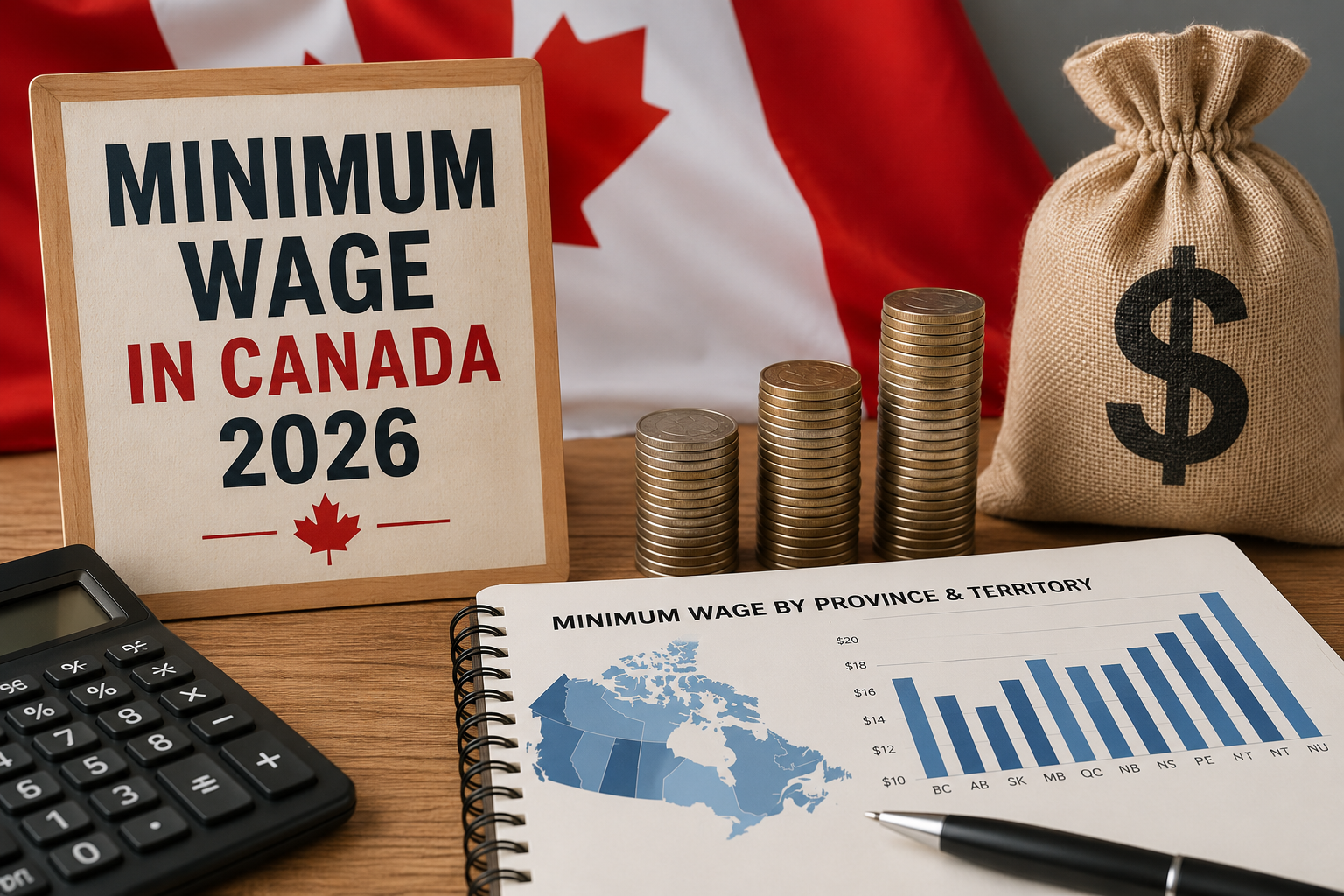
Minimum wage in Canada is not the same across the country. Each province and territory sets its own general minimum wage, while employees working in federally regulated industries may be covered by the federal minimum wage.
As of August 2026, general minimum wages across Canada range from $15.00 per hour in Alberta to $19.75 per hour in Nunavut. Several jurisdictions have also announced increases that will take effect later in 2026.
This guide compares the minimum wage in every Canadian province and territory, explains how the federal minimum wage works and shows how much a minimum-wage worker could earn before taxes.
Minimum Wage in Canada 2026: Quick Comparison
| Province / Territory | Current General Minimum Wage | Next Announced Change |
|---|---|---|
| Alberta | $15.00/hour | No change listed in the federal database |
| British Columbia | $18.25/hour | Effective June 1, 2026 |
| Manitoba | $16.00/hour | $16.40 on October 1, 2026 |
| New Brunswick | $15.90/hour | Effective April 1, 2026 |
| Newfoundland and Labrador | $16.35/hour | Effective April 1, 2026 |
| Northwest Territories | $16.95/hour | $17.20 on September 1, 2026 |
| Nova Scotia | $16.75/hour | $17.00 on October 1, 2026 |
| Nunavut | $19.75/hour | $20.17 on September 1, 2026 |
| Ontario | $17.60/hour | $17.95 on October 1, 2026 |
| Prince Edward Island | $17.00/hour | $17.30 on October 1, 2026 |
| Quebec | $16.60/hour | Effective May 1, 2026 |
| Saskatchewan | $15.35/hour | $15.70 on October 1, 2026 |
| Yukon | $18.51/hour | Effective April 1, 2026 |
Rates shown are general minimum wage rates as of August 19, 2026. Some workers, occupations and age groups may be subject to different rules or rates. Always verify the latest rate with the appropriate government authority.
What Is the Federal Minimum Wage in Canada in 2026?
Canada's federal minimum wage increased to $18.15 per hour on April 1, 2026.
The federal minimum wage does not automatically replace the provincial minimum wage for every worker in Canada. It applies to employees working in federally regulated private-sector industries.
Examples of federally regulated sectors can include banking, telecommunications and certain interprovincial or international transportation activities.
There is another important rule: when the minimum wage in the province or territory where a federally regulated employee usually works is higher than the federal rate, the higher provincial or territorial rate applies.
Minimum Wage in Ontario 2026
Ontario's general minimum wage is currently $17.60 per hour.
On October 1, 2026, it will increase to $17.95 per hour.
The Ontario government announced that the increase is tied to the province's Consumer Price Index and is expected to affect more than 700,000 workers.
Ontario is home to Canada's largest city and one of its most expensive housing markets. Workers considering Toronto should therefore compare wages with housing and other living expenses rather than looking at hourly pay alone.
Our guide to average rent in Canada in 2026 provides additional context for comparing housing expenses.
Minimum Wage in British Columbia 2026
British Columbia increased its general minimum wage from $17.85 to $18.25 per hour on June 1, 2026.
The province ties annual minimum-wage adjustments to inflation. British Columbia reported that the 2026 increase of just over 2.1% was based on the province's average monthly inflation rate in 2025.
Some categories of workers have separate minimum rates. For example, app-based ride-hail and delivery workers are subject to different rules and minimum compensation based on engaged time.
Minimum Wage in Alberta 2026
Alberta's general minimum wage remains $15.00 per hour.
The province also maintains a separate $13.00-per-hour rate for eligible students under 18, subject to specific conditions and restrictions.
Because Alberta's general rate is lower than several other provinces, workers comparing job opportunities should consider both wages and local living costs.
Hourly pay alone does not determine how affordable a city or province will be.
Minimum Wage in Quebec 2026
Quebec's general minimum wage increased to $16.60 per hour on May 1, 2026.
Workers considering Quebec should also remember that employment conditions, taxes, housing costs and language requirements can differ from other parts of Canada.
Minimum Wage in Manitoba 2026
Manitoba's general minimum wage is currently $16.00 per hour.
A scheduled increase will bring the rate to $16.40 per hour on October 1, 2026.
This means anyone using this article after October 1 should verify the effective rate before calculating expected earnings.
Minimum Wage in Saskatchewan 2026
Saskatchewan's general minimum wage is currently $15.35 per hour.
It will increase to $15.70 per hour on October 1, 2026.
The Saskatchewan government states that minimum-wage changes are generally calculated using an indexation formula.
Minimum Wage in New Brunswick 2026
New Brunswick's minimum wage increased to $15.90 per hour on April 1, 2026.
The province also lists a minimum overtime wage of $23.85 per hour as of that date, although overtime eligibility and rules depend on provincial employment standards.
Minimum Wage in Nova Scotia 2026
Nova Scotia increased its minimum wage to $16.75 per hour on April 1, 2026.
A second increase is already scheduled. On October 1, 2026, the general minimum wage will reach $17.00 per hour.
Because there are two changes during 2026, workers and employers should pay particular attention to the effective date when calculating wages.
Minimum Wage in Prince Edward Island 2026
Prince Edward Island's general minimum wage is currently $17.00 per hour.
The rate is scheduled to increase to $17.30 per hour on October 1, 2026.
A further increase to $17.60 has already been listed for April 1, 2027.
Minimum Wage in Newfoundland and Labrador 2026
Newfoundland and Labrador increased its minimum wage to $16.35 per hour on April 1, 2026.
The provincial government stated that the 2026 adjustment was based on changes to the national Consumer Price Index under its Labour Standards Regulations.
Minimum Wage in Yukon 2026
Yukon's minimum wage is $18.51 per hour as of April 1, 2026.
This places Yukon among the Canadian jurisdictions with the highest general minimum wages.
However, northern living expenses can differ considerably from those in many southern Canadian cities, so the nominal hourly rate should not be considered in isolation.
Minimum Wage in Northwest Territories 2026
The Northwest Territories currently has a minimum wage of $16.95 per hour.
Effective September 1, 2026, the rate will increase to $17.20 per hour.
The territorial government says its adjustment method considers changes in the Consumer Price Index and average hourly wages.
Minimum Wage in Nunavut 2026
Nunavut currently has the highest general minimum wage listed in the federal government's comparison database at $19.75 per hour.
That rate will increase again to $20.17 per hour on September 1, 2026.
Although this is substantially higher than the minimum wage in provinces such as Alberta, the cost of living in northern communities can also be significantly different.
Which Province Has the Highest Minimum Wage in Canada?
As of August 19, 2026, Nunavut has the highest general minimum wage in Canada at $19.75 per hour.
Among the provinces, British Columbia has one of the highest general rates at $18.25 per hour.
However, comparing minimum wages without considering living expenses can be misleading.
A worker earning a higher hourly wage in an expensive housing market may have less disposable income than someone earning a lower wage in a more affordable location.
For a broader comparison, see our guide to the cheapest places to live in Canada in 2026.
How Much Can You Earn Per Month on Minimum Wage?
Monthly earnings depend on the hourly wage and the number of hours worked.
For a simple illustration, consider someone working 40 hours per week for 52 weeks. Dividing annual earnings by 12 produces an approximate monthly gross income.
| Hourly Wage | Approx. Weekly Gross | Approx. Monthly Gross | Approx. Annual Gross |
|---|---|---|---|
| $15.00 | $600 | $2,600 | $31,200 |
| $16.00 | $640 | $2,773 | $33,280 |
| $17.00 | $680 | $2,947 | $35,360 |
| $18.00 | $720 | $3,120 | $37,440 |
| $19.00 | $760 | $3,293 | $39,520 |
| $20.00 | $800 | $3,467 | $41,600 |
These are simplified gross-income examples before income tax, CPP/QPP, EI and other applicable deductions. They assume 40 paid hours every week for 52 weeks and should not be treated as guaranteed take-home income.
Can You Live on Minimum Wage in Canada?
Whether minimum wage is enough depends heavily on where you live, how many hours you work, your housing arrangement and your household expenses.
Housing is usually one of the biggest factors. A person sharing an apartment may face a very different monthly budget from someone renting a one-bedroom unit alone.
Food, transportation, utilities, phone service and taxes also need to be considered.
Our guide to how much money you need to live in Canada in 2026 provides a broader monthly-budget comparison.
You can also compare grocery prices in Canada and utility costs in Canada when estimating your budget.
Minimum Wage vs. Average Salary
Minimum wage and average salary measure very different things.
The minimum wage is the legal wage floor that generally applies to covered workers. Average earnings, on the other hand, reflect wages across many occupations, experience levels and industries.
For this reason, Canada's average salary is considerably higher than what a full-time minimum-wage worker would earn.
See our guide to the average salary in Canada for a broader look at Canadian earnings.
Does Every Worker Receive the Same Minimum Wage?
No. General minimum-wage tables are useful for comparison, but exceptions and special rates can apply.
Depending on the jurisdiction, different rules may exist for students, certain occupations, domestic workers, farm workers, employees receiving gratuities or other specific categories.
Overtime rules can also differ by jurisdiction and occupation.
Workers should therefore check the employment standards authority for the province or territory where they work instead of relying only on a national comparison table.
Does Minimum Wage Apply to Newcomers?
Newcomers who are legally authorized to work in Canada generally have employment protections under the applicable federal, provincial or territorial labour standards, although the exact rules depend on the job and jurisdiction.
An employer cannot simply ignore applicable employment standards because a worker recently arrived in Canada.
If you are currently searching for work, our guide on how to get a job in Canada as a newcomer explains the job-search process in more detail.
You can also explore the most in-demand jobs in Canada in 2026 to compare career opportunities.
Why Minimum Wage Changes Over Time
Many Canadian jurisdictions periodically adjust their minimum wages using formulas or policy decisions that consider inflation and other economic indicators.
This is why a minimum-wage article can become outdated quickly.
Several rates are changing again in September or October 2026, including those in Manitoba, Northwest Territories, Nova Scotia, Nunavut, Ontario, Prince Edward Island and Saskatchewan.
Always check the effective date rather than assuming one rate applies throughout the entire calendar year.
Final Thoughts
There is no single minimum wage that applies to every worker across Canada.
As of August 2026, general minimum wages range from $15.00 per hour in Alberta to $19.75 per hour in Nunavut, while the federal minimum wage is $18.15 per hour for employees covered by federal labour standards.
Several jurisdictions have already announced increases for September and October, so workers should verify the latest rate before making financial or employment decisions.
And remember that the highest hourly wage does not automatically mean the best financial situation. Rent, groceries, utilities, taxes and other expenses determine how far a paycheque actually goes.
This article provides general information and is not legal, tax or employment advice. Minimum-wage rates and employment standards can change. Verify current requirements with the appropriate federal, provincial or territorial government authority.